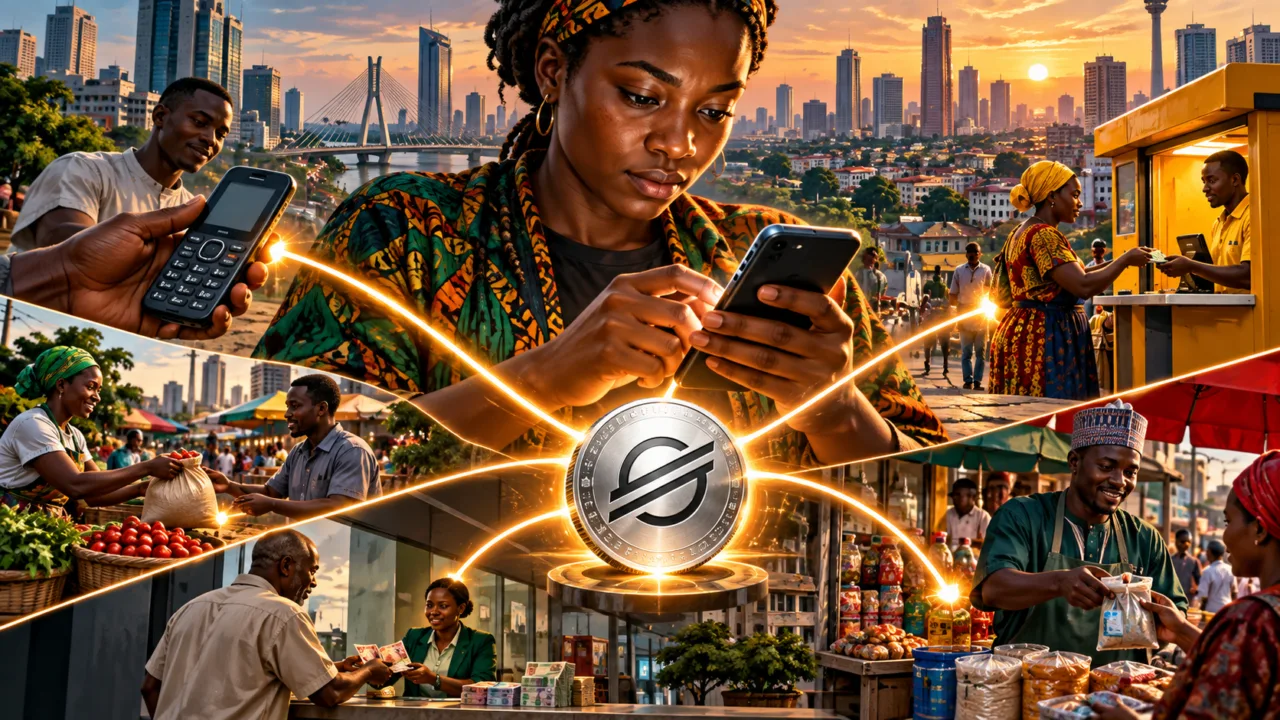
Crypto in Africa: five projects secure $477,000
The Stellar Community Fund distributed approximately $4.04 million in XLM during its 45th round. Eight projects belong to the Open Track, 28 to the Integration Track and four to technical calls for proposals. Africa accounts for 5 of the 40 funded projects, or 12.5% of the cohort.
The trend extends a movement already visible across the continent. BrefCrypto recently examined how DCS Pay and Kotani Pay aim to connect USDT and USDC to mobile money across six African markets. Stellar is funding almost exactly the same type of infrastructure.
Sorted is receiving $150,000 to develop a stablecoin banking app designed to run on Android Go and low-powered phones, including in areas with intermittent connectivity. The project targets Africa and South Asia.
Minisend is securing $100,000. Its goal is to let users send USDC and then pay out the equivalent in local currency through M-PESA, Airtel Money or directly into a bank account.
The recipient does not need to become a crypto expert.
The Stellar Community Fund lists Sorted, Minisend and several other African solutions among the projects in SCF #45.
From the CFA franc to SME trade
The third project, Kutana, is receiving $97,000 to tackle African B2B commerce. Its Trade Secure solution uses USDC on Stellar to place transaction funds in escrow. The money is then released gradually as the different commercial milestones are completed.
For an SME importing goods from another African country, the challenge is not simply transferring money. It also needs to know when to pay, whom to trust and how to reduce risk when the buyer and seller operate in two different jurisdictions.
This issue is becoming increasingly important as stablecoins already account for a considerable share of cross-border crypto flows in Nigeria.
Lomi, meanwhile, is receiving $95,000 to build a bridge between USDC and the BCEAO CFA franc, the XOF. Its infrastructure targets the eight WAEMU countries and is intended to connect mobile money and card payments with settlement on Stellar.
The geographic potential deserves attention: Benin, Burkina Faso, Côte d’Ivoire, Guinea-Bissau, Mali, Niger, Senegal and Togo all use the same currency.
A single XOF rail could therefore reach several markets without rebuilding the entire monetary infrastructure at every border.
Stellar is primarily targeting the last mile
The fifth project cited by BitcoinKE is SlimePay, which is receiving $35,000. It is working on a Stellar Anchor designed to settle payments to merchants in African currencies, starting with an USDC-to-Nigerian-naira corridor.
Stellar Anchors are specifically designed to bridge the blockchain and traditional financial systems. For example, they can enable a user to receive a stablecoin on one side and local currency in a bank account on the other. SlimePay plans to use several Stellar standards, including SEP-6, SEP-24 and SEP-31, to connect user accounts, banks and the blockchain network.
Individually, $35,000 or $100,000 remain modest amounts. The distribution of the projects nevertheless points to something more interesting.
Sorted is targeting basic phones. Minisend, mobile money. Kutana, business-to-business trade. Lomi, the CFA franc. SlimePay, the naira.
These are five versions of the same problem: crypto’s last mile in Africa.
Blockchain can transfer USDC within seconds. But the recipient must still be able to use it to buy something, receive CFA francs or naira, or get money through M-PESA.
That is also why Kenyan regulation is already beginning to treat stablecoins as genuine financial infrastructure, rather than solely as trading assets.
The approximately $477,000 from SCF #45 will not transform African payments on its own. It does, however, show where Stellar is placing its bets: fewer tokens to buy, more bridges between digital dollars and money that can actually be used in Africa.