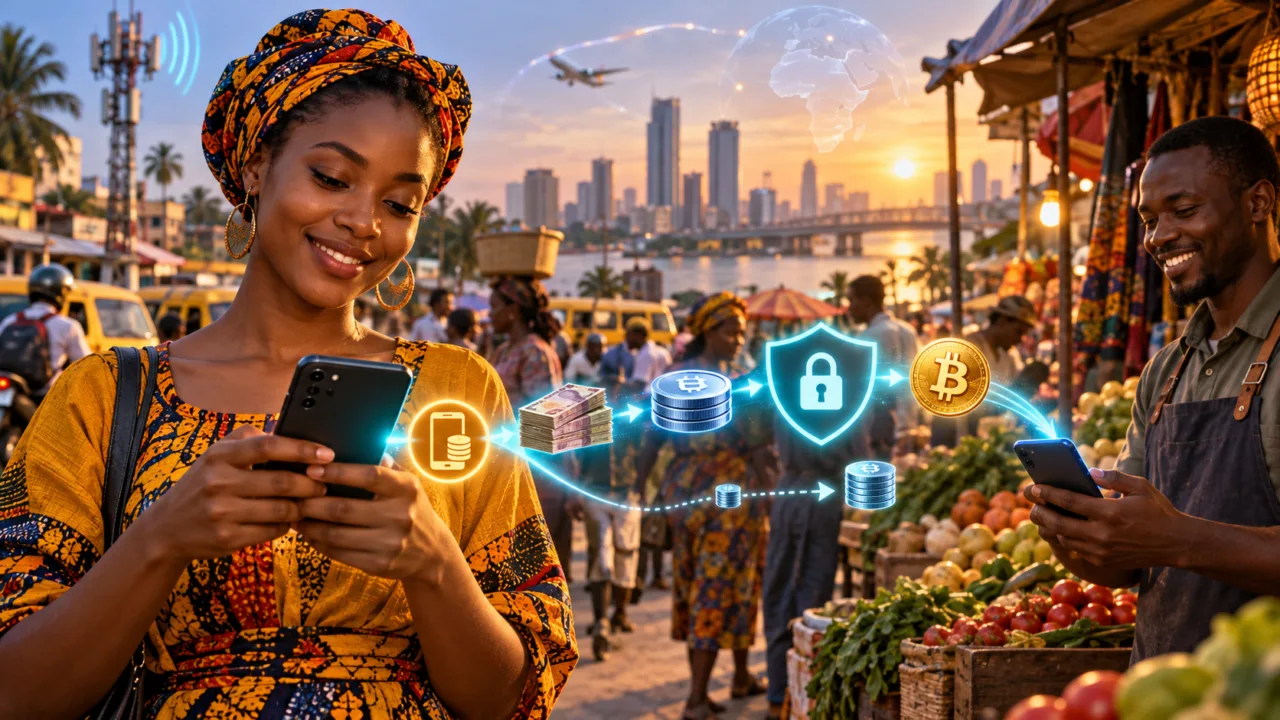
The principle sounds almost straightforward: money is held on a phone, the user chooses a cryptocurrency, pays from their Mobile Money balance and receives the assets on an exchange or wallet.
Behind that simple action, however, are several very different systems.
Some platforms integrate Mobile Money directly and automatically convert local currency. Others use a P2P marketplace where the user pays an independent seller. Specialized fintechs also enable users to move from stablecoins to mobile money, sometimes without looking anything like a traditional exchange.
Those differences matter greatly when it comes to fees and security.
Depending on the country, buying the equivalent of 100 dollars in USDT can cost a few extra percentage points in fees. On P2P markets, the quoted price may already include a premium. And when a transaction involves multiple blockchain networks, additional fees may appear at withdrawal.
The market is nevertheless expanding. The GSMA recorded 2.3 billion registered Mobile Money accounts in 2025 and 593 million active over a 30-day period. Sub-Saharan Africa accounted for more than two-thirds of global growth in registered accounts that year. At the same time, Chainalysis estimates that the region received more than 205 billion dollars in on-chain crypto value between July 2024 and June 2025, up around 52% year on year.
Mobile money and crypto were once two separate worlds.
They are beginning to become two layers of the same digital financial system.
Mobile Money and crypto naturally converge in Africa
The first reason is fairly simple: many users already have a Mobile Money wallet before they have a bank account or crypto wallet.
In some countries, sending money to a phone number is an everyday action. Crypto therefore needs to connect to this existing infrastructure rather than ask users to start from scratch.
The trend is particularly clear in the DRC, where bank accounts, dollars, Mobile Money and crypto can coexist. The BrefCrypto report on crypto in the DRC, its payments and use cases explains this combination of local currency, dollars, Mobile Money, Bitcoin and stablecoins in detail.
The GSMA estimates that more than 2,000 billion dollars circulated through Mobile Money in 2025, around 23% more than in 2024. Merchant payments alone reached approximately 155 billion dollars.
It was almost inevitable that the crypto ecosystem would try to connect to this infrastructure.
The appeal is not purely speculative.
A freelancer may receive a stablecoin.
A merchant may want to convert part of their funds into digital dollars.
A family may receive value from another country.
An investor may simply want to buy 20 dollars’ worth of Bitcoin.
Mobile Money then becomes the entry point—and sometimes the exit point.
Buying with Mobile Money can mean three different things
The term “buying cryptocurrency with Mobile Money” covers at least three methods.
The first is direct purchase.
The platform itself integrates a Mobile Money provider. The user chooses their local currency, enters the amount, selects Orange Money, Airtel, M-Pesa or another available operator, confirms the payment and receives the crypto.
This is generally the simplest method.
The second method is P2P, or peer-to-peer trading.
The platform connects a buyer and a seller. The seller holds the cryptocurrency. The buyer sends local currency through Mobile Money. The platform temporarily locks the crypto in an escrow system until payment is confirmed.
The third relies on a specialized crypto-fiat gateway.
For example, a fintech may receive USDT or USDC and send the equivalent value to a Mobile Money wallet, or carry out the reverse transaction.
The recently announced partnership between DCS Pay and Kotani Pay illustrates this approach: their infrastructure aims to connect stablecoins, local currencies, Mobile Money and USSD across several African markets. BrefCrypto examined this new bridge between USDT, USDC and African payments.
These three methods can produce the same economic result.
They do not carry the same level of risk.
Direct purchases remain the easiest option
Consider a practical example.
A platform offers direct crypto purchases in CDF, XOF, XAF or KES.
The user enters 100,000 CDF.
They select USDC.
They choose Orange Money.
Their phone number is linked to the transaction.
A confirmation request may appear on the phone, or an OTP code may be sent.
After confirmation, the platform credits the USDC.
The user never had to speak to a seller.
They did not negotiate a price.
They did not choose a P2P listing.
The experience is closer to buying a conventional digital service.
Binance currently documents this functionality in several African markets. Its support page, updated in July 2026, mentions M-Pesa and Airtel in Kenya, MTN and Moov in Benin, Wave, Orange and Free in Senegal, and Airtel, Vodacom and Orange in the DRC. Availability remains country-dependent and may change.
This simplicity nevertheless comes at a cost.
The payment provider charges a commission.
The platform may include a spread.
The conversion rate between local currency and crypto is not necessarily the rate shown on Google or on a major international market.
Easy does not mean free.
Mobile Money fees can be significantly higher than spot trading costs
Fees deserve particular attention.
On a major exchange, spot trading between two assets may cost around a few tenths of a percent.
A Mobile Money transaction involves more participants.
There is the crypto platform.
The payment partner.
The Mobile Money operator.
Currency conversion.
And possibly a spread.
In the fee schedule published by Binance for its Mobile Money fiat service, the purchase fees shown in July 2026 were, for example, 2.2% for CDF, 2.2% for XOF, 3.8% for XAF, 1.5% for KES, 1.5% for GHS and 2% for UGX or TZS. Selling fees differed.
Take the equivalent of 100 dollars with a 2.2% fee.
More than 2 dollars disappears before Bitcoin or USDT has even moved.
If the user later sells with a 1.5% fee, the round-trip cost is already significant, before taking other exchange-rate differences or withdrawal fees into account.
For a purchase intended to be held for several years, this cost may be acceptable.
For someone converting small sums every day, it becomes much more important.
The right calculation is therefore never just:
“How much is Bitcoin worth?”
The question should be:
How much BTC, USDT or USDC will I actually receive for 100,000 units of local currency?
This final amount is what allows two services to be compared.
P2P works like a small marketplace
P2P trading is more hands-on.
Suppose you want to buy 50 USDT with Orange Money.
You open the P2P section.
Several sellers appear.
The first offers 1 USDT at a certain rate.
The second asks for slightly more.
A third accepts only purchases above a certain amount.
Each listing may show the number of completed transactions, completion rate, limits and accepted payment methods.
You choose an offer.
The platform locks the seller’s USDT.
You send local currency to the Mobile Money number provided, following the order instructions.
Once the payment has been made, you mark the transaction as paid.
The seller checks their own Mobile Money account.
They confirm receipt.
The platform then releases the USDT.
Binance says its P2P system supports various local payment methods depending on the region and has historically added Orange Money, MTN Mobile Money, Moov Money and other African solutions. Its new P2P system integrated into Binance Wallet follows the same principle of connecting users and enabling local payment.
P2P may seem more complicated.
In return, it offers more choice in terms of prices and payment methods.
Escrow is the cornerstone of P2P
Without escrow, buying crypto from a stranger through Mobile Money would be particularly risky.
Imagine how it would work without protection.
You send 100,000 CDF.
The seller promises to send the USDT afterward.
Then they disappear.
Escrow reduces this risk.
When a P2P order is opened, the platform locks the relevant crypto. The seller can no longer simply withdraw it while the buyer is making the payment.
Once the Mobile Money funds are confirmed, the crypto is released to the buyer.
If something goes wrong, a dispute procedure may be initiated.
This does not make P2P risk-free.
The user must remain inside the platform’s system.
A seller may say:
“Cancel the order and send me the money directly—I’ll give you a better price.”
That is precisely when escrow protection disappears.
The same applies to conversations moved to WhatsApp or Telegram to bypass the platform’s rules.
A slightly better price is of little use if no crypto arrives afterward.
P2P works well when users understand one simple rule:
The intermediary is there precisely to ensure that personal trust is not required.
Leaving the system means removing that protection.
How to choose a P2P seller
Not every listing deserves the same level of trust.
Price is the first visible factor.
It is not necessarily the most important.
A seller offering USDT at a price 2% below everyone else’s deserves one question: why?
Check the trading history.
An account with several thousand completed transactions and a high completion rate provides more information than a recently created account with three transactions.
Limits matter too.
One merchant may accept between 10 and 500 dollars.
Another may accept only between 1,000 and 10,000.
You should also check that the name or payment conditions comply with the service’s rules.
Some sellers accept payments only from a Mobile Money account bearing the same name as the buyer’s KYC account.
This rule helps reduce problems linked to third-party payments.
Average release time can also be useful.
A reliable seller who is consistently slow can make the experience frustrating.
Finally, be wary of unusual instructions.
A legitimate merchant has no reason to ask for a seed phrase, password, 2FA code or remote access to the phone.
Mobile Money payment is enough.
Everything else should trigger caution.
The P2P price may be higher than the global price
Suppose USDT is worth approximately one dollar on major markets.
That does not mean it will be available locally at exactly the official exchange rate between the dollar and the national currency.
The P2P market operates according to its own supply and demand.
If many users want to buy USDT but few local sellers hold it, a premium may emerge.
USDT becomes more expensive.
The opposite can also happen.
It is therefore important to distinguish between three figures:
the global crypto price;
the official exchange rate;
the price actually offered on the local market.
In some economies where access to dollars is difficult, these figures can diverge.
That is precisely why crypto in Africa should not be analyzed solely through global charts.
Access costs matter.
The BrefCrypto report on crypto flows in Africa and the real cost of payments notes that African demand does not come solely from speculation. Transfers, dollar savings and payments all contribute, with small-value flows playing an important role.
Chainalysis estimates that more than 8% of the crypto value received in sub-Saharan Africa during the period studied came from transfers below 10,000 dollars, a higher proportion than in the rest of the world.
The detail may look purely statistical.
It describes a market heavily oriented toward individual users.
Why many users start with USDT or USDC
A beginner might think that buying crypto with Mobile Money mainly means buying Bitcoin.
In practice, stablecoins occupy a central role.
Why?
Because their price is designed to remain close to the dollar.
Suppose someone wants to convert the equivalent of 300 dollars from their Mobile Money wallet to pay a supplier one week later.
Buying Bitcoin introduces another variable.
BTC may be worth 300 dollars today and the equivalent of 270 when the invoice is due.
USDT or USDC, by contrast, seek to maintain a value close to the dollar.
That explains why they are often used as an intermediate currency.
The BrefCrypto guide to the advantages and risks of stablecoins examines this function in detail.
A user can buy USDT through Mobile Money.
Then buy Bitcoin on the spot market.
Or transfer the stablecoins.
Or simply hold them.
One shortcut should nevertheless be avoided.
USDT is not a physical dollar bill.
Neither is USDC.
The token depends on its issuer, reserves and operating framework.
Price stability does not mean an absence of risk.
Buy Bitcoin directly or use USDT first?
Both methods are possible, depending on the platform.
Direct purchase has an obvious advantage.
Fewer steps.
You have 100,000 CDF.
You buy BTC.
Done.
Using USDT adds another transaction.
CDF to USDT.
Then USDT to BTC.
Why do it?
Because the BTC/USDT market is extremely liquid on many platforms.
The user may sometimes gain more control over the price through a limit order.
They can also hold some USDT without buying Bitcoin immediately.
On the other hand, each step may add fees.
Comparison is therefore essential.
Suppose a direct purchase costs 2.2%.
Buying USDT also costs 2.2%, followed by 0.1% in trading fees.
The difference remains small.
If the direct service applies a large additional spread, using the spot market may become more attractive.
There is no absolute rule.
The right choice depends on the actual final amount received.
A beginner can start with the simplest method.
A more experienced user can optimize later.
Trying to save 0.2% is pointless if the added complexity increases the risk of sending 100% of the funds over the wrong network.
The blockchain network becomes critical at withdrawal
You have just bought 100 USDT.
You want to send it to an external wallet.
The app now asks:
Ethereum?
Tron?
Solana?
BNB Smart Chain?
Another network?
This is when many beginners discover that “USDT” is not a network.
It is a token that can exist on several blockchains.
The destination address must be compatible with the network being used.
The wallet must also support that network.
Fees can vary widely.
Sending a stablecoin on Ethereum can be more expensive when the network is congested than using some cheaper blockchains.
However, the lowest price should not be the only criterion.
The recipient must be able to receive and use that network.
A platform may accept USDT on Tron but not on another blockchain.
An error can make recovery difficult or even impossible.
The right habit is simple.
For a first transfer to a new address, send a small amount.
Confirm that it arrives.
Then send the rest.
Paying a few extra fees is often better than turning 1,000 USDT into a very expensive learning experience.
An exchange and a wallet are not the same thing
After the purchase, the crypto can remain on the platform.
That is convenient.
Selling back to Mobile Money will generally be easier.
But the user then depends on the intermediary.
The alternative is to withdraw to a personal wallet.
With self-custody, the user controls the keys that allow the assets to be moved.
This autonomy comes at a price.
No one may be able to restore the funds if the recovery phrase is permanently lost.
No one should receive that phrase either.
The choice therefore depends on the intended use.
Someone who regularly buys small amounts to resell may prefer the simplicity of an exchange.
Someone holding a significant amount for several years may be more interested in personal custody.
African users are also gaining access to more tools that directly connect Bitcoin and Mobile Money without exactly replicating the model of major exchanges. BrefCrypto recently covered BitSpenda and Bitzed, two projects connecting Bitcoin, Lightning and Mobile Money in Africa.
This development is worth watching.
The future of African crypto will not necessarily play out solely on CEXs.
KYC often remains mandatory
Mobile Money does not automatically make crypto purchases anonymous.
A Mobile Money account is often already tied to a verified identity.
Major crypto platforms also require KYC.
Binance, for example, states that identity verification is required for its Mobile Money service in the relevant markets.
The user may need to provide an identity document.
A photo.
Sometimes a facial verification.
Transaction limits may depend on the level of verification.
The principle is similar to that of the traditional financial sector.
The company must know who it is dealing with and comply with its regulatory obligations.
This centralization of information nevertheless creates another issue: data protection.
A crypto account may combine identity details, a phone number, transactions and sometimes blockchain addresses.
Access should therefore be protected with a unique password and two-factor authentication.
The Mobile Money account must also be secured.
A fraudster who takes control of a SIM card or phone may try to access several layers of the financial system at once.
Crypto and Mobile Money bring the rails closer together.
Digital risks move closer together too.
P2P scams often begin outside the platform
The scenario is familiar.
Someone posts:
“USDT available, best rate.”
The conversation starts on Facebook or WhatsApp.
The seller then provides a Mobile Money number.
No escrow.
No platform.
No proof of reserves.
The buyer sends the money.
Then the seller disappears.
Technically, this was not even secure P2P.
It was a trust-based transaction between two strangers.
A regulated P2P marketplace reduces this problem through escrow and merchant histories.
Scammers therefore naturally try to move victims outside that system.
Another technique is to produce fake proof of payment.
When selling crypto for Mobile Money, assets should not be released simply because a screenshot says “transaction successful.”
The balance must be checked directly in your own Mobile Money account.
An SMS can be forged.
So can an image.
Confirmation must come from the financial system itself.
The rule works both ways.
The buyer should not treat a promise as crypto delivery.
The seller should not treat a screenshot as payment.
Mobile Money has risks of its own
Crypto does not mean that every fraud originates on the blockchain.
Mobile Money already has its own forms of fraud.
Fake agents.
SIM swaps.
Calls requesting a secret code.
Messages announcing a fictitious transfer.
Refund requests after an alleged mistaken transfer.
Phishing links.
The GSMA notes that fraud remains a significant problem for the Mobile Money industry despite its spectacular expansion.
When crypto and Mobile Money are connected in the same transaction, the two risk surfaces combine.
A user must protect their Mobile Money code.
Their exchange account.
Their email.
Their two-factor authentication.
And possibly their crypto wallet.
This multiplication may seem burdensome.
It simply reflects a reality: several financial systems are involved in the same transaction.
A good rule is never to share an OTP received by SMS with a stranger.
Even if they claim to be a support agent.
The OTP exists precisely to prove that the person has access to the phone.
Sharing it often amounts to giving an attacker the second key they need.
Selling back to Mobile Money matters just as much as buying
A common mistake is to look only at the entry point.
“I can buy crypto with Airtel Money.”
Good.
But can you also sell it and easily recover local currency?
At what price?
With what fees?
How long will it take?
This question is particularly important if the crypto is used to receive income or transfers.
A platform may offer an excellent entry point and a poor exit.
Binance currently says its service also supports sales to several Mobile Money wallets in the covered markets. For CDF, its published fee schedule listed, for example, 1.5% in selling fees and Airtel, Vodacom and Orange options in the DRC.
Other countries have different methods and fees.
P2P also provides an exit route.
The user sells their USDT to a merchant.
The merchant pays through Mobile Money.
The USDT is released after verification.
Local liquidity matters enormously.
It may be very easy to sell 50 dollars.
It may be much more difficult to sell 50,000 dollars at the same rate.
The ecosystem must therefore be assessed in both directions.
Stablecoins strengthen the link with African payments
The market is already moving beyond simple crypto purchases.
DCS Pay and Kotani Pay, for example, aim to connect USDT and USDC to Mobile Money, USSD and other local payment rails in Nigeria, Kenya, Ghana, Egypt, South Africa and Tanzania.
The objective is no longer only:
local currency → crypto.
It becomes:
local currency → stablecoin → another country → local currency.
This architecture directly targets the cross-border payments market.
The World Bank still reported an average global cost of 6.36% for international transfers of small amounts in the data available in 2025. Sub-Saharan Africa has historically ranked among the most expensive regions.
BrefCrypto has already shown how Standard Bank, Mobile Money, blockchain and stablecoins are beginning to converge in the same African payments market.
This convergence explains why buying crypto by phone goes far beyond investment.
The real battle concerns payment infrastructure.
In the DRC, Mobile Money opens a highly practical gateway
The DRC is an interesting example because several monetary layers coexist there.
Congolese franc.
Dollar.
Mobile Money.
Cash.
Banks.
Crypto.
According to Binance documentation updated in July 2026, CDF is among the currencies supported by its local buying and selling service, with Airtel, Vodacom and Orange listed as Mobile Money methods. The published fees were 2.2% for purchases and 1.5% for sales.
This does not mean every user will always have the same limits or availability.
Services may change.
Checking the app before each significant transaction is therefore still necessary.
The practical benefit is nevertheless clear.
A user with CDF in their phone wallet can theoretically enter the crypto ecosystem without first going through a traditional bank account.
The path becomes:
Mobile Money → platform → stablecoin or Bitcoin.
Then possibly:
crypto → platform → Mobile Money.
This does not solve every problem.
The local dollar rate matters.
Fees matter.
Regulation matters.
The provider’s security matters.
But access changes radically.
The bank is no longer necessarily the first door.
Kenya shows how far integration can go
Kenya is almost impossible to ignore when discussing Mobile Money.
M-Pesa has deeply normalized the idea that a phone can serve as a financial wallet.
Crypto platforms are therefore connecting to infrastructure that is already extremely familiar.
Binance currently lists M-Pesa and Airtel among its Mobile Money options in Kenya.
But the Kenyan market also shows the other side of development: regulation is advancing.
BrefCrypto recently detailed Kenya’s stronger oversight of stablecoins and crypto intermediaries.
This development is logical.
Once Mobile Money, stablecoins and traditional payments begin to interconnect, central banks take a closer interest in the flows.
Who issues the digital dollar?
Which intermediary can distribute it?
How are cross-border movements controlled?
What consumer protections exist?
Buying through Mobile Money may look like a simple app feature.
At scale, it touches monetary policy, foreign exchange and the national payments system.
That is why the rules can change quickly.
Nigeria illustrates the shift from speculation to payments
Nigeria has a different profile.
Crypto use is widespread there, and stablecoins play an important role.
Services are now seeking to shorten the distance between tokens and everyday spending.
BrefCrypto, for example, covered SpaceTrade and its plan to bring together USDT, naira conversion, payments and bills.
The model is revealing.
At the beginning of the crypto ecosystem, the question was:
“How do I buy Bitcoin?”
Then:
“How do I buy USDT?”
Now the question is becoming:
“How can I use these assets without making five conversions?”
Mobile Money and local fintechs become important precisely at this stage.
Crypto may be technically global.
The grocery store, landlord or supplier often still wants to be paid in local currency.
The system’s success therefore depends on the final conversion.
This final step is sometimes called an off-ramp.
In many African markets, the natural off-ramp is not necessarily a bank account.
It is the phone.
Direct purchases and P2P are not competitors
One might imagine that direct Mobile Money integration will eventually eliminate P2P.
That is far from certain.
The two systems meet different needs.
Direct purchases prioritize simplicity.
Quoted price.
Payment.
Crypto credited.
P2P offers greater flexibility.
Multiple sellers.
Multiple prices.
Different limits.
More payment methods.
Where direct purchases are unavailable, P2P may remain accessible.
It may also offer a better rate.
Conversely, during periods of strong demand, P2P prices may include a significant premium.
The direct service may then become more competitive.
The right user does not become ideologically attached to one method.
They compare.
How much will I pay?
How much will I receive?
How long will it take?
What level of protection exists?
These four questions are already enough to eliminate many poor offers.
The cheapest market is not always the best.
Nor is the easiest one.
A specialized fintech may sometimes be more suitable than an exchange
Major exchanges are built to support a wide range of functions.
Spot.
Futures.
Staking.
Copy trading.
Bots.
Launchpads.
A user who simply wants to convert USDC into Mobile Money does not need all of that.
That is precisely the space specialized gateways are entering.
Yellow Card, for example, documents the use of Mobile Money in its payment infrastructure for certain African markets and products. Its widget allows an eligible user to select Mobile Money, enter their number and confirm the deposit with the payment provider.
Kotani Pay follows a comparable infrastructure-focused approach by connecting stablecoins to local rails.
These companies may be simpler for certain use cases.
That does not mean they are automatically better.
Availability, regulation, fees, liquidity, supported networks and withdrawal conditions must all be checked.
The important thing is to understand the model.
An exchange primarily serves as a market.
An on/off-ramp primarily serves as a bridge between two monetary systems.
The same user may need both.
Buying with Mobile Money does not eliminate crypto risk
Once the purchase is complete, Mobile Money has little bearing on the asset’s price.
You hold Bitcoin?
Your investment now depends on Bitcoin.
You hold SOL?
It depends on Solana and the market.
You hold a meme coin?
The risk may be much greater.
Buying through Airtel Money obviously does not protect against a 70% drop.
Two questions must therefore be separated.
How do I access crypto?
And:
Which crypto should I buy?
The first concerns infrastructure.
The second concerns investment.
An excellent payment method can provide access to a very poor asset.
Conversely, relatively high entry fees do not necessarily prevent a long-term investment from being relevant if the asset performs favorably.
Users should avoid confusing convenience with quality.
The app may make buying extremely easy.
It should not make thinking optional.
A small test transaction is valuable
For a first Mobile Money purchase, starting small is probably the best approach.
Not because 10 dollars will generate much.
Because it allows the entire chain to be tested.
Does the Mobile Money account work?
Does the platform actually accept the payment?
How much is charged in fees?
How much USDT is received?
Can it then be withdrawn?
Which network is available?
How much does the withdrawal cost?
And above all: can the crypto be sold and the money recovered through Mobile Money?
A test transaction answers all these questions with limited risk.
The beginner can then increase the amount gradually.
This approach is far healthier than making a large first deposit because a video promises high returns.
Crypto is often presented as a technology that enables speed.
Security often requires doing exactly the opposite.
How to buy cryptocurrency with Mobile Money in practice
The general method can be summarized simply.
First choose a provider that is available and legally accessible in your country.
Create an account.
Complete identity verification if required.
Select Mobile Money as the purchase method or enter the P2P market.
Compare the rate and fees.
Start with a limited amount.
Pay only through the instructions provided in the order.
Wait for confirmation.
Then check that the crypto has actually been credited.
On P2P, never bypass escrow.
For a direct purchase, check the final amount before confirming.
After buying, decide whether the assets will remain on the platform or be withdrawn to a wallet.
For a new wallet, make a test transfer.
And keep a record of the transactions.
This process is not spectacular.
That is probably a good sign.
Selling back to Mobile Money completes the system
Adoption becomes much more useful when the path works in both directions.
A worker receives 100 USDC.
They convert it into local currency.
The funds arrive on their phone.
They then pay their everyday expenses.
No merchant around them needs to know what USDC is.
This is probably the most important aspect of the convergence between crypto and Mobile Money.
The blockchain can operate in the background.
The phone wallet remains the everyday interface.
BitSpenda already follows a similar model for certain Bitcoin transfers in Africa: according to the presentation relayed by BrefCrypto, Bitcoin and Lightning can serve as the rail while the recipient receives value directly through Mobile Money.
In this model, the person receiving the money does not even need to become a Bitcoin specialist.
Crypto becomes infrastructure rather than a product.
That may be the most interesting part of the evolution.
Mobile Money could become one of the main gateways to African crypto
The GSMA’s figure captures the scale of the market: 593 million Mobile Money accounts were active monthly in 2025, with much of the growth coming from sub-Saharan Africa.
Crypto does not need to replace this infrastructure.
It can connect to it.
This is a major difference from some earlier visions of blockchain, in which every existing technology had to be made obsolete.
Mobile Money already works.
The agents exist.
Users know the menus.
Phone numbers are already linked to wallets.
Crypto can add something else: international assets, stablecoins, blockchain settlement and transfers between monetary networks.
The challenge lies in integration.
Fees low enough.
Liquidity.
Regulatory compliance.
Protection against fraud.
Reliable conversion.
A good user experience.
If these layers continue to improve, buying cryptocurrency with Mobile Money will probably no longer be viewed as a special feature.
It will simply become another way to convert money from a phone.
And yet the underlying change is profound.
A user who previously had access only to local currency can now, depending on their country and the services available, move from Mobile Money to a dollar stablecoin or Bitcoin in a few steps.
The gateway to the global crypto market may fit inside a SIM card.
The right habit is to master the exit as well
The best conclusion is probably not “use this particular app.”
Platforms change.
Fees change.
Rules change.
Available payment methods change too.
The right approach is to understand the architecture.
Mobile Money is the first layer.
The provider or P2P market forms the gateway.
The stablecoin or cryptocurrency is the asset.
The wallet or exchange then provides custody.
At some point, you will need to travel the route in the opposite direction.
This point is often overlooked.
Buying is easy when everyone wants your local currency.
Selling at the right price can become more difficult when liquidity disappears.
Before making a significant purchase, you should therefore understand the complete circuit:
local currency → Mobile Money → crypto → wallet → crypto → Mobile Money → local currency.
A sound infrastructure must work in both directions.
This is particularly important for users who are not simply speculating, but receiving a salary, paying a supplier, transferring funds or holding part of their savings in digital assets.
Africa already has one of the world’s most developed Mobile Money infrastructures.
It also has one of the fastest-growing crypto markets.
The convergence of the two is therefore no accident.
Mobile money solves the final local step that blockchain alone cannot: delivering international digital value to the phone the user already relies on in everyday life.
That is what makes buying crypto through Mobile Money more than a simple button in an app.
It becomes a bridge between two financial systems.