Why crypto inheritance plans fail
The difficulty stems from the model explained in our guide to crypto wallets. A blockchain recognizes neither death certificates nor heirs. It accepts a valid signature. If no one can find the private key, the asset remains visible but unusable.
Conversely, someone who discovers the seed phrase can transfer the funds before the estate is settled. Technical possession does not necessarily prove legal ownership. The plan must therefore separate information, access and authority.
Common mistakes include failing to create an inventory, relying on a backup that has become unreadable, forgetting a passphrase, leaving the family unaware of a wallet or keeping instructions that contain outdated information.
Create an inventory without exposing secrets
The inventory should list the types of assets, blockchains, exchanges, hardware wallets and available backups. It may include public addresses needed for verification, but not necessarily private keys.
For each platform, record the service’s legal name, the associated email address, whether two-factor authentication is enabled and the published inheritance procedure. Account recovery codes should be protected separately.
For each self-custody wallet, the inventory should specify the backup type, whether a passphrase is used, the number of signatures required and the compatible software. A vague note such as “Bitcoin on Ledger” does not indicate whether an additional passphrase or multiple accounts are involved.
Keep the will separate from access information
A will can name the beneficiaries and executor, but it is often accessible to several people during the process. Writing a seed phrase directly into it creates a risk of copying and may leave the secret permanently stored in official records.
A safer approach is to use the will to set out the rights involved and a separate document for the technical instructions. Storage locations can be entrusted to different people or institutions, ensuring that no single party can act alone before the intended event.
Inheritance law varies by country. A technical arrangement must not circumvent rules concerning forced heirs, taxes or estate administration. A local notary or lawyer should review the structure when the assets are substantial.
Seed phrases, passphrases and backups
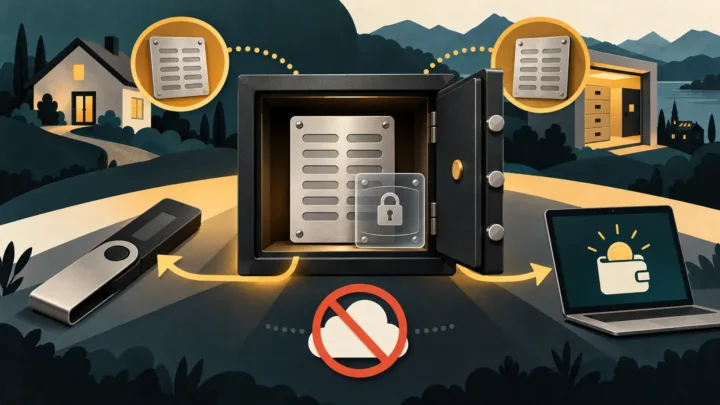
The seed phrase should be readable and tested, but never copied into an email or shared cloud account. A metal plate offers better protection against fire and water than paper, although it does not prevent physical theft.
If an additional passphrase is used, it must be transmitted through a separate channel. The seed alone then opens a different wallet, often an empty one. Heirs may wrongly conclude that the assets have disappeared.
Complexity should remain proportionate to the skills of the people involved. A process involving multiple devices, fragments and passwords can fail if no one has carried out a supervised test.
Multisignature and shared responsibility
A multisignature wallet requires several keys to spend the funds, such as two out of three keys. Control can be distributed among the owner, a trusted person and a service provider. Losing one key does not necessarily result in the loss of the funds.
This architecture improves resilience, but it also requires the wallet configuration to be backed up: extended public keys, descriptor, signing policy and derivation paths. Two out of three seeds without the correct configuration file can make recovery more difficult.
Unchained’s guide to its inheritance protocol illustrates one possible multisig-based arrangement. It is an example from one provider, not a universal recommendation; costs, jurisdiction and reliance on the service must be assessed.
Exchange accounts and identity verification
On an exchange, an heir does not simply recover a key. They will generally need to provide a death certificate, proof of their status, a court decision or estate document and identification. The procedure may depend on the country where the entity managing the account is based.
Statements should be downloaded periodically, as they make inventory management, valuation and tax calculations easier. Keeping all assets on one platform can sometimes simplify the paperwork, but it preserves counterparty risk.
Our article on hardware wallets helps compare this dependence with self-custody.
Test and maintain the plan
A test does not mean revealing the seed phrase to the heirs. It can verify that they know where to find the instructions, whom to contact and how to identify the relevant hardware. A full restoration can be simulated using a test wallet containing a small amount.
The plan should be reviewed after a wallet change, a new passphrase, a move, a marriage, a separation or the death of a custodian. An annual review is a practical minimum for an active portfolio.
Temporary incapacity should also be addressed, not just death. A standard power of attorney does not automatically provide the technical means to use a wallet.
Key takeaways
- Keep legal rights, the inventory and technical secrets separate.
- Adapt the arrangement to the heirs’ skills and test a recovery scenario.
- Update the plan after every major change to the wallet or family situation.
A reliable crypto inheritance plan does not depend on a single document. It combines an inventory, backups, instructions, shared control and legal review so that the right people can act at the right time.
The most robust arrangement is still one that the family can understand, locate and execute without improvisation during an already difficult situation.