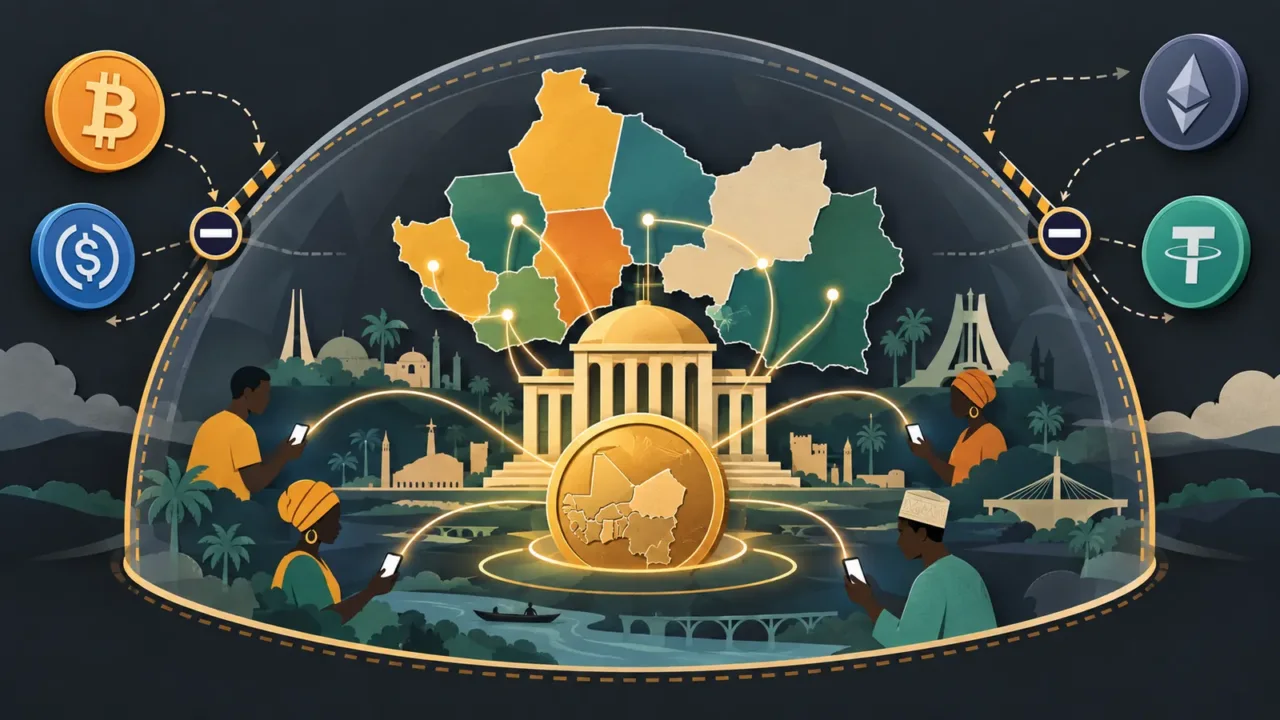
What the WAEMU framework tells us
The situation must be viewed alongside the context of crypto in Senegal and the other member states. WAEMU comprises Benin, Burkina Faso, Côte d’Ivoire, Guinea-Bissau, Mali, Niger, Senegal and Togo. The BCEAO conducts the common monetary policy, while national authorities retain powers over criminal law, taxation and consumer protection.
Bitcoin and stablecoins are not issued by the BCEAO. They do not benefit from the guarantee attached to an account held with a licensed bank, and a merchant cannot be forced to accept them as payment. This distinction separates the voluntary use of a digital asset from the legal tender status of the CFA franc.
The absence of an explicitly stated general ban on individuals does not amount to licensing. A company that collects funds, holds clients’ assets, facilitates payments or promises a return may fall within a separate regulated category.
The BCEAO’s position on cryptoassets
The BCEAO is now openly examining cryptoassets, stablecoins and central bank digital currencies. At its 2026 international conference, it presented their potential for financial inclusion and cross-border payments while highlighting issues involving financial stability, governance, cybersecurity and regulation.
The BCEAO’s official statement on the conference reflects an approach focused on analysis and preparation—not recognition of Bitcoin or USDT as currencies of the Union.
Two exaggerated claims should therefore be avoided. Saying that “crypto is completely banned in WAEMU” overlooks actual use and national differences. Saying that it is “authorized by the BCEAO” turns the absence of monetary status into official approval. The framework remains subject to change and should be checked with the relevant regulators.
Buying and selling cryptocurrencies in the Union
Users generally rely on international platforms, P2P services or local intermediaries. Payment may be made by bank transfer, card or Mobile Money, depending on the country. Each channel carries different risks, including payment fraud, account theft, sending funds to the wrong address, withdrawal blocks or intermediary failure.
Before carrying out a transaction, users should verify the provider’s legal identity, country of registration, custody terms and complaints procedure. A presence on social media or in a messaging group does not prove authorization. Promises of fixed returns warrant heightened caution.
BrefCrypto’s report on crypto in Côte d’Ivoire also shows that market access depends on local infrastructure. A service available in Abidjan may not be available in Bamako or Bissau, even though the currency is shared.
Stablecoins and cross-border transfers
Stablecoins address transfer and value-storage needs through a unit linked to the dollar. They may reduce certain technical delays, but they do not eliminate CFA franc conversion fees or issuer risk. Their local value may diverge from the official exchange rate when a liquidity premium emerges.
An on-chain transfer is only one part of the process. Converting into crypto and cashing out to Mobile Money or a bank account still depends on intermediaries. Identity checks, transaction limits and proof of funds’ origin may apply. Our guide to the advantages and risks of stablecoins explores this point in detail.
For a business, receiving stablecoins from foreign clients raises accounting and tax questions, including the valuation date, conversion, invoice documentation and foreign-exchange risk management. A technically possible transaction is not automatically compliant with every commercial and financial rule.
Payments, investment and fundraising
Three uses should be distinguished. Investment involves buying an asset to hold or resell. Payment involves settling for a good or service. Fundraising means that an organization receives money from the public in connection with a promise or project. Regulatory risk generally increases from the first use to the third.
Activities involving exchange, transfers, custody on behalf of third parties and public offerings may require authorization. A token presented as mere “community access” may be assessed differently if its marketing promises a return funded by contributions from new members.
Anti-money-laundering rules also apply to virtual assets. The FATF is updating its recommendations on virtual assets and virtual asset service providers, influencing the requirements applied by states and financial institutions.
Country-specific checks
Before carrying out a significant transaction, users should consult statements from the BCEAO, the Finance Ministry, the tax administration and, depending on the activity, the market regulator. Guidance may change without immediately updating every text available online.
It is also important to distinguish the country of residence, the provider’s country and the counterparty’s country. A platform registered outside the Union may accept a WAEMU client without holding a local license. This often limits the available avenues for recourse.
Key takeaways
- The CFA franc remains the official currency; cryptoassets are not legal tender.
- The BCEAO is studying these uses, but that process does not constitute general authorization.
- Payments, custody on behalf of others and fundraising require separate analysis.
The WAEMU framework is neither an absolute vacuum nor a blanket endorsement of crypto. To act prudently, users must combine regional rules with the laws of the country concerned and verify each provider’s exact status.