This distinction will become even more important in 2027.
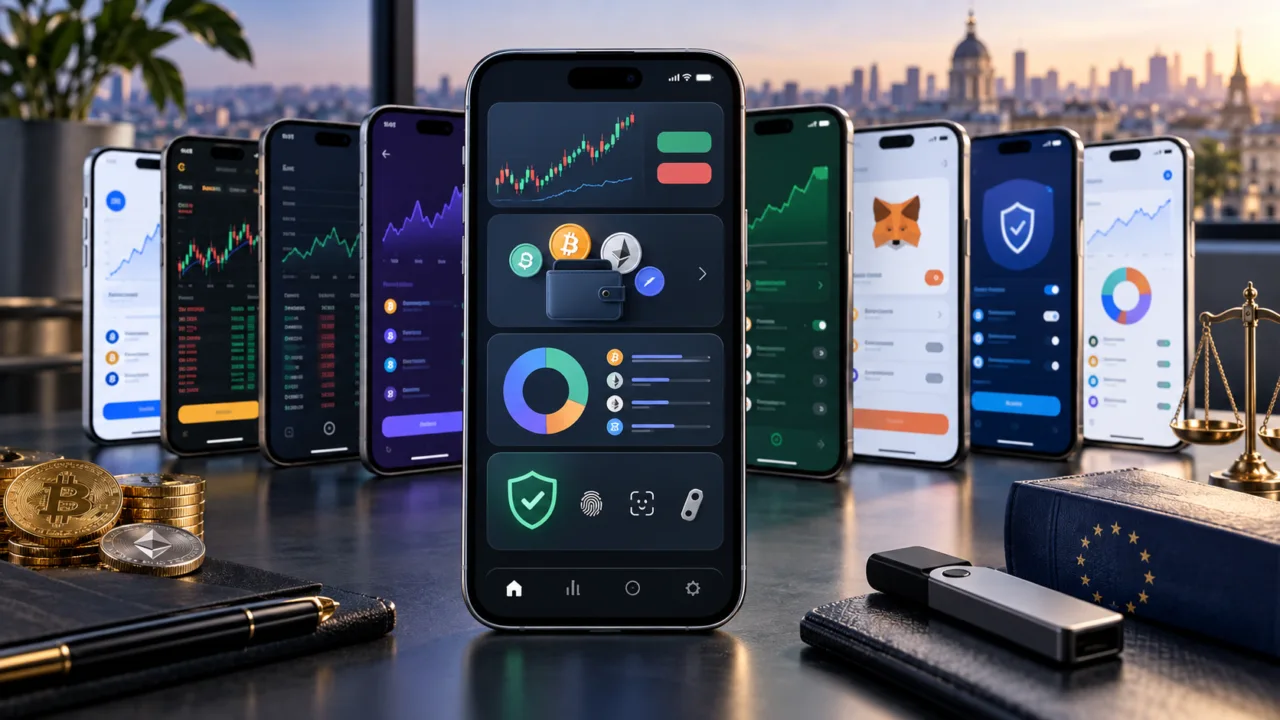
Crypto apps are no longer just interfaces for buying BTC and ETH. Binance now integrates a self-custody wallet directly into its app. Kraken combines crypto, tokenized stocks and international transfers. MetaMask now supports Bitcoin, Solana and Tron alongside the Ethereum ecosystem. Trust Wallet operates across more than 100 blockchains. Robinhood has significantly expanded its European offering. Coinbase combines an exchange, staking, advanced trading and access to Base.
The market is becoming visually simpler.
Technically, it is becoming much more complex.
A good crypto app should therefore be chosen based on three questions: What do you want to do, who controls the assets and what does it really cost?
The best choice for buying 50 euros worth of Bitcoin every month is not necessarily the right one for an active trader. And the ideal app for using Uniswap or Aave is not necessarily where a beginner should keep all of their crypto savings.
Crypto apps: what exactly are we talking about?
A crypto app may first be a centralized exchange. The BrefCrypto guide to how crypto exchanges work explains this first category: Coinbase, Binance, Kraken and Robinhood generally hold assets on behalf of clients until they withdraw them.
The experience resembles that of a banking app.
You open an account.
You complete KYC.
You deposit euros or another currency.
Then you buy Bitcoin, Ethereum or another asset.
A second category includes self-custody wallets such as MetaMask and Trust Wallet. Here, the app is not simply an account with a company. It is used to manage the keys that directly control the assets.
A third category focuses on tracking.
CoinTracker, for example, can aggregate multiple wallets and exchanges to analyze a portfolio and help calculate taxable gains or losses. Its app does not replace Coinbase or MetaMask. It sits above them.
The boundaries are nevertheless becoming increasingly blurred.
Binance now has a self-custody wallet within its app.
MetaMask lets users buy crypto through various providers.
Trust Wallet includes swaps, staking and even derivatives products provided by partners.
Kraken combines crypto, tokenized stocks, FX and transfers.
In 2027, the term “crypto app” will therefore increasingly refer to more than a single function.
One app is not always enough
The idea of a crypto super-app is appealing.
Buy.
Trade.
Hold.
Stake.
Pay.
Report your gains.
All from the same phone.
The problem is that these functions involve very different security models.
In a custodial app, the company technically controls the custody of the funds. The user has a claim on the assets held in their account and depends on the provider for withdrawals.
In a self-custody wallet, the user directly controls the keys.
This autonomy removes the traditional exchange-failure risk for assets that have been withdrawn.
It replaces that risk with others: lost seed phrases, phishing, malicious signatures, malware, incorrect addresses or compromised smart contracts.
The debate over centralization and decentralization in crypto is therefore not simply a choice between a “bad exchange” and a “good wallet.”
The two models serve different needs.
A beginner may buy BTC on a regulated exchange, then gradually transfer the portion intended for long-term holding to a personal wallet.
An active trader may leave more liquidity on the platform required for their activity.
A DeFi user will need a wallet capable of directly signing on-chain transactions.
In practice, the most robust digital portfolio may look more like a set of complementary apps than a miracle app.
That is precisely why the choice should begin with the intended use.
Coinbase remains one of the simplest crypto apps
Coinbase remains one of the strongest options for someone who wants to enter crypto without starting with an order book full of numbers.
Buying in the app is still very straightforward: select “Buy & sell,” choose the asset, enter the amount, review the details and confirm. Coinbase also supports limit orders directly in its app. (coinbase.com)
That simplicity comes at a cost, however.
Coinbase states that simple buys and sells may include Coinbase fees as well as a spread incorporated into the price. The amounts vary depending on the payment method, order, jurisdiction and market conditions. (coinbase.com)
Beginners should therefore always check the preview screen.
The price shown on the chart is not necessarily the final cost.
Coinbase becomes more competitive for active users who switch to its Advanced interface, which uses pricing more comparable to traditional exchanges.
The second advantage for 2027 is regulatory.
Coinbase obtained MiCA authorization from Luxembourg’s CSSF, allowing Coinbase Luxembourg to provide crypto services in the European Economic Area. The transition for France took place as early as October 2025. (coinbase.com)
For European users, this framework has become a much more important consideration than it was three years ago.
Binance remains the most comprehensive app
When it comes to the number of functions concentrated in a single app, Binance remains difficult to match.
Spot.
Trading.
Staking.
Earn.
P2P, depending on the region.
Conversion.
Wallet.
Web3.
Yield products.
The platform says Binance Earn supports more than 300 crypto assets, although available products vary by region and risk level. (binance.com)
The main change concerns Binance Wallet.
It is now a self-custody wallet integrated directly into the Binance environment. Documentation updated in 2026 states that it is compatible with more than 60 blockchains, including Ethereum, Solana, BNB Smart Chain, Polygon and Arbitrum. (binance.com)
On mobile, Binance uses an MPC architecture, short for Multi-Party Computation.
Instead of managing a traditional private key as a single secret that can easily be lost, the system distributes signing capability across several cryptographic elements.
This allows users to move from a centralized Binance account to Web3 without switching entirely to another app.
That is highly convenient.
It can also create confusion.
The balance held in a Binance account does not follow the same custody model as funds held in Binance Wallet.
The app may create an impression of unity even though the legal and cryptographic risks are not the same.
For 2027, Binance therefore remains one of the most versatile crypto apps.
It nevertheless requires more time to learn than an intentionally simplified app.
Kraken strikes a strong balance between simplicity and professional tools
Kraken is probably one of the most interesting options for someone who wants to start simply while retaining room to scale up.
The company now offers several separate applications.
Kraken is designed for purchases, sales, deposits, withdrawals and recurring investments.
Kraken Pro focuses on advanced trading and staking.
Kraken Desktop goes further, with more than 800 crypto markets available on the platform. (kraken.com)
The group is also developing Krak, a payments app that, according to Kraken, can send money to more than 160 markets and handle more than 300 currencies and crypto assets. (kraken.com)
This is an interesting development.
A crypto app is no longer used solely to speculate on the price of BTC.
It is beginning to compete with some traditional fintech use cases.
Kraken also benefits from a strong regulatory position in Europe. Its entity Payward Europe Solutions Limited holds a CASP license under MiCA issued by the Central Bank of Ireland and passported across the European Economic Area. (kraken.com)
The platform also highlights periodic Proof of Reserves reports.
This does not eliminate intermediary risk.
It provides more information about custody.
For 2027, Kraken seems particularly relevant to someone seeking a more technical app than Robinhood or simple Coinbase, without wanting to start directly with a DeFi wallet.
Robinhood is becoming a genuine crypto app in Europe
Robinhood was historically associated with U.S. stock trading.
That summary is now outdated.
In Europe, Robinhood now lists more than 90 cryptocurrencies in its ecosystem and allows users to buy BTC, ETH, XRP, SOL, DOGE, ADA, AVAX, LINK, SHIB, AAVE, BONK and several other assets. (robinhood.com)
Its European pricing is particularly easy to understand.
Robinhood currently charges 0.50% of the executed euro value, with a minimum of 0.01 euro. Robinhood itself does not charge for crypto transfers, although network fees still apply. (robinhood.com)
The platform also offers staking on certain assets such as ETH and SOL and allows transfers to external wallets for supported cryptocurrencies.
Its main appeal remains the user experience.
Someone who simply wants to buy a few major cryptocurrencies regularly may find the app much less intimidating than an exchange packed with professional tools.
Robinhood Europe UAB is authorized by the Bank of Lithuania as a financial brokerage firm, crypto-asset service provider and payment institution. (robinhood.com)
The app nevertheless offers less depth than Binance or Kraken for highly advanced users.
That is almost deliberate.
Robinhood is less focused on becoming a trader’s cockpit than on turning crypto into an additional asset class within a broader financial app.
For some users, that is exactly what they need.
MetaMask has become much more than an Ethereum wallet
For a long time, MetaMask almost automatically meant Ethereum.
In 2027, that definition is too narrow.
Official documentation now lists Ethereum, Bitcoin, Solana, Tron, Base, Polygon, BNB Chain, Arbitrum, Optimism, Avalanche, zkSync Era, HyperEVM, Robinhood Chain, Arc and several other networks directly. (metamask.io)
This is a major development.
Users can manage several ecosystems through an interface that was historically focused on EVM chains.
MetaMask remains primarily a Web3 tool.
It is used to connect to Uniswap.
Aave.
OpenSea.
Bridges.
Staking apps.
DeFi protocols.
On-chain markets.
Direct purchases are also possible through several integrated providers. Depending on the country, MetaMask may use services such as Coinbase Pay, MoonPay, Transak, Stripe, Banxa or other partners. (metamask.io)
The experience is therefore becoming closer to that of a complete crypto app.
However, the cost of this freedom must be understood.
When a user signs a malicious authorization, MetaMask cannot simply reverse the blockchain.
When a seed phrase is compromised, changing the app password may not be enough.
The risk of malware targeting crypto wallets directly makes this distinction particularly important.
MetaMask is powerful.
It requires more discipline than a standard exchange account.
Trust Wallet is probably one of the most versatile wallets
Trust Wallet focuses on another strength: multichain coverage.
The app now says it supports more than 100 blockchains and millions of assets, with Bitcoin, Ethereum, Solana and BNB Smart Chain among the main networks available. (trustwallet.com)
The wallet also allows users to stake certain assets, perform swaps and interact with DApps.
Trust Wallet now even offers more than 80 perpetual contract pairs through integrated services. (trustwallet.com)
This perfectly illustrates how crypto apps are evolving.
A wallet that was mainly used to store and send tokens is gradually becoming a complete financial interface.
This breadth can be useful for someone holding assets across several networks.
It can also create new risks.
The more an app provides access to swaps, DApps, derivatives and contracts, the more possible interactions there are.
Trust Wallet remains a self-custody wallet.
Users therefore control their own cryptographic secrets.
That means they are responsible for securing their backups.
The app highlights an integrated security scanner, but no automated system can eliminate all the risks associated with an on-chain signature.
For a significant long-term portfolio, it may also be reasonable to separate the mobile wallet used regularly from a less exposed hardware wallet.
A phone offers convenience.
Maximum security is not always synonymous with maximum convenience.
In 2027, this separation remains relevant.
CoinTracker addresses a different problem: understanding what you own
Not every crypto app is designed to hold or trade assets.
CoinTracker belongs to another category.
Its service aggregates information from multiple exchanges and wallets to track portfolio performance and calculate crypto gains and losses. Its privacy policy explicitly describes the service as a portfolio tracking and digital-asset gain-or-loss calculation app. (cointracker.io)
This category becomes much more important as users diversify.
At first, someone may hold only 500 euros worth of BTC on Coinbase.
Then comes ETH on Kraken.
USDC in MetaMask.
SOL being staked.
A few DeFi tokens.
Transactions across several networks.
A hardware wallet.
After two years, determining the true cost basis can become surprisingly complicated.
Blockchains record movements.
They do not automatically know that an Ethereum address and a Bitcoin address belong to the same person.
A portfolio app attempts to reconstruct that overall view.
The BrefCrypto guide to CoinTracker should be supplemented with the tax rules applicable in the relevant country, since calculation methods and reporting obligations are not universal.
You should also pay attention to the permissions granted.
A tracking app generally does not need the ability to withdraw your funds.
When using an exchange API, choose read-only access whenever that is sufficient.
Viewing a portfolio does not necessarily require the ability to empty it.
Fees should influence part of the decision
A beautiful app can be very expensive if its pricing model is poorly suited to the intended use.
Take Coinbase.
A simple purchase may include fees and a spread. Coinbase says the exact cost varies and should be checked in the preview before confirmation. (coinbase.com)
Robinhood Europe uses a more direct model of 0.50% for ordinary crypto transactions. (robinhood.com)
Kraken has different fee schedules depending on the product used.
Binance also applies variable models depending on the market, user level and service.
Wallets add another layer.
MetaMask and Trust Wallet cannot eliminate blockchain fees.
An Ethereum transaction costs gas.
A Bitcoin transaction pays miners.
A swap may add protocol, aggregator or provider fees.
An app may advertise “0% fees” while using a wider spread.
You should therefore look at the amount actually received.
That is the only honest comparison.
For a monthly investment of 50 euros, a difference of a few euros represents a significant percentage.
For a trader doing 100,000 euros in monthly volume, a few tenths of a percentage point become considerable.
The best crypto app is therefore not the one advertising the lowest headline figure.
It is the one whose total cost matches your usage.
Security starts before you even open the app
Downloading the right app is already a security step.
Fake wallets and fake crypto apps regularly circulate.
The risk does not disappear entirely on official stores either: malicious apps have already managed to pass their checks before being detected.
You should therefore start from the company’s official website when looking for a download link.
Kraken itself explicitly warns that unofficial apps using its name or logo can lead to account compromise and loss of funds. (kraken.com)
Second layer of protection: authentication.
A unique password.
An authentication app or security key where available.
Avoid relying solely on SMS for important accounts whenever possible.
Third layer of protection: withdrawals.
Some platforms allow users to create a whitelist of authorized addresses.
An attacker who gains access to the account then faces an additional barrier before moving the funds.
For self-custody wallets, the priority changes.
Never share your seed phrase.
Never enter it on a website requested by someone claiming to provide technical support.
Do not photograph it and store the image in your phone’s gallery.
Crypto self-custody provides more control.
It also makes some mistakes irreversible.
The ideal app depends mainly on your objective
A single ranking would be artificial.
For simply buying Bitcoin or Ethereum, Coinbase, Kraken or Robinhood may offer a more accessible experience.
For active trading, Kraken Pro or Binance provide more tools, markets and order types.
For using DeFi, MetaMask and Trust Wallet are much better suited.
For combining an exchange and Web3, Binance has significantly narrowed the gap through Binance Wallet.
For tracking multiple portfolios, an app such as CoinTracker meets the need better than a second exchange.
For staking, several solutions are possible, but native staking, centralized services, liquid staking and more complex yield products must be distinguished.
The best app can therefore change over time.
A beginner might start with Kraken.
Buy BTC.
Then learn to withdraw a small amount to Trust Wallet.
A few months later, they may use MetaMask to test a DeFi app.
Finally, they can aggregate all these positions in a tracker.
This progression is much healthier than trying to understand bridges, seed phrases, leverage, perpetuals and yield farming all at once on the first day.
Crypto already carries enough financial risk.
There is no need to add technical complexity without a reason.
Africa adds the question of payment methods
Choosing a crypto app in Africa depends on more than the token catalog.
You need to be able to fund the account.
And withdraw the funds.
Bank card.
Bank transfer.
Mobile Money.
P2P.
Stablecoins.
Available methods vary significantly from one country to another.
An app that works well in France may become impractical in Kenya or the DRC if it offers no suitable payment rails.
The crypto market in the DRC clearly illustrates the difference between an app’s theoretical availability and its practical usefulness.
Some exchanges have much more developed P2P ecosystems.
Others rely on local partners.
Self-custody wallets may themselves integrate several on-ramp providers.
This diversity should continue to grow in 2027 as stablecoins and Mobile Money move closer together.
Three points should nevertheless be checked before any transaction.
Is the service officially available in the country?
What is the actual conversion cost between local currency and crypto?
And does the method comply with local regulations?
P2P also introduces human risk.
A fake Mobile Money receipt or a reversed payment does not become safe simply because the crypto appears in the same transaction.
The app must therefore be assessed within its local environment.
Not in an abstract global ranking.
Regulation will matter more in 2027
In Europe, the change is already visible.
The AMF notes that in France, MiCA is now fully applicable and platforms must operate under an appropriate authorization to continue serving the relevant clients.
Coinbase operates under its Luxembourg authorization. (coinbase.com)
Kraken holds its MiCA authorization through the Central Bank of Ireland. (kraken.com)
Robinhood Europe is authorized as a crypto-asset service provider by the Bank of Lithuania. (robinhood.com)
This development is gradually ending the period when an app could serve millions of Europeans while operating in a regulatory gray area.
That does not mean authorization turns every token sold into a safe investment.
The regulator oversees the provider.
It does not guarantee the value of BTC, ETH or a meme coin.
The distinction matters.
A regulated app can perfectly well offer an asset that falls 80%.
In 2027, investors should therefore assess separately the risk of the app and the risk of the cryptocurrency purchased.
The two are connected.
They are not identical.
This is also why European users should be wary of older guides published before July 2026.
The regulatory landscape has changed.
Which crypto app should you choose in 2027?
For a beginner, I would first look for three qualities: simplicity, the ability to withdraw crypto and a clear regulatory framework in the relevant jurisdiction.
Coinbase fits that logic well, particularly in Europe under MiCA.
Kraken probably offers a better path from beginner to advanced user.
Robinhood is a good fit for someone primarily seeking a simple financial experience and easy-to-understand pricing.
Binance remains particularly interesting for users who want many features in a single app, with an ecosystem ranging from trading to self-custody through Binance Wallet.
MetaMask and Trust Wallet belong to another category.
I would not choose them as perfect substitutes for an exchange.
I would choose them when the goal becomes directly controlling assets and using the blockchain.
CoinTracker serves yet another purpose, once multiple accounts and wallets begin to make tracking cumbersome.
There is therefore no absolute winner.
In 2027, the most rational approach may even be to combine several tools while limiting each one to a specific function.
One exchange for buying.
One wallet for holding and Web3.
One tracker for accounting.
Each app then does what it does best.
A good app does not replace a good strategy
This is probably the most important conclusion.
A modern interface does not protect against a poor investment.
An app may offer 600 cryptocurrencies.
That does not mean you need to buy 60 of them.
It may offer leverage.
That does not mean you need to use it.
It may display a 18% yield.
That does not mean the capital is guaranteed.
The BrefCrypto crypto glossary is almost as important as choosing the buy button: understanding wallets, seed phrases, stablecoins, staking, gas, Layer 2 and smart contracts helps avoid many beginner mistakes.
The sector is also moving in an interesting direction.
By 2027, the best apps will probably make the blockchain increasingly invisible.
Passkeys instead of seed phrases for some wallets.
Abstracted gas fees.
Simplified cross-chain swaps.
Stablecoins used behind a payments interface.
Wallets integrated directly into applications.
This simplification is positive if it removes friction.
It becomes dangerous when it hides risk.
Users must always know who controls the keys, which asset they are buying, which network they are using and how much they are paying.
These four questions will outlast almost every interface innovation.
The app will change.
The principles will change much less.