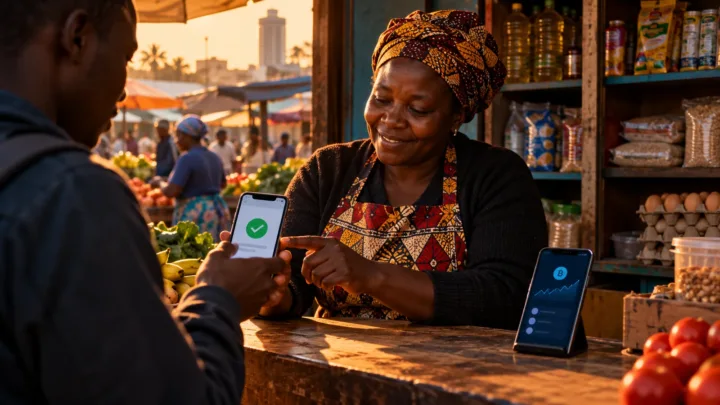
For residents, the relevant checks must be carried out at the account and individual service level. The availability of a P2P market, card, bank deposit, USD withdrawal or yield feature may change independently. A general reference to a supported country should not be interpreted as local financial authorization.
In brief
- Binance’s page lists Zimbabwe for the app, according to its update of August 18, 2026.
- The download list does not prove that every service works for a Zimbabwean account.
- Check the contracting entity, limits, fees and withdrawal options before depositing funds.
What Binance’s list confirms
The BrefCrypto guide to crypto in Zimbabwe explains the broader context. In its official list of regions supported for the app, Binance says it was updated on August 18, 2026, and includes Zimbabwe. This is a primary source for the download availability indicated by the company on that date. It does not confirm that a local user can deposit, buy, sell and withdraw all assets in the same way.
App availability often depends on software-distribution rules. The terms for each product depend on other factors, including declared residence, verification documents, the contracting entity, the payment method and internal changes. It is therefore more accurate to write that “the app is listed” than that “all Binance services are available in Zimbabwe.”
An available app does not mean a fully enabled account
Accounts may display different interfaces depending on their region or verification level. A visible feature is not necessarily activated. A general help page may explain how a product works without confirming that it is accessible to your profile. Before making any transfer, check the terms shown after logging in and, if necessary, request a written response from official support for your place of residence.
Opening an account may require an identity document, proof of address or additional verification. The availability of these steps does not guarantee approval. The information provided must match your actual residence. Using a false address or another person’s identity to bypass a restriction may breach the terms and jeopardize account recovery.
The first useful check concerns the entity signing the contract. Identify the company, its country of incorporation, the applicable law, the assets available and the complaint contacts. A group may operate several subsidiaries depending on the region and product. The name displayed in the app does not always specify which entity holds the funds or is legally responsible for the service.
The Zimbabwean FIU’s VASP portal brings together local AML registration resources for virtual-asset service providers. This information helps clarify the national framework, but it does not establish that a foreign platform is registered or authorized to provide all its services to residents. The scope must be checked directly against official laws and registers.
The BrefCrypto guide to crypto platforms in Africa explains this verification process in more detail. A license obtained in one jurisdiction does not automatically carry over to another. A reference to international authorization on a group website, on its own, does not prove that an account opened from Harare benefits from the same coverage.
Payment methods and regional restrictions
A payment option may be available in one country and unavailable in another. A bank card, transfer, mobile payment or P2P market may depend on the issuing bank, the account holder’s name, compliance checks and a local partner. Check the methods listed in the verified account rather than relying on a screenshot from another country.
Support pages change over time. Avoid repeating an old card restriction or partnership announcement without a date. Conversely, the appearance of a button does not mean that a payment will go through or that your financial institution will approve it. Check the fees, currency, processing times, beneficiary and refund mechanism before confirming.
For P2P transactions, review the escrow rules, release conditions and available remedies in the event of a dispute. Binance’s P2P documentation describes how the service generally works, but does not demonstrate that every payment method is available in Zimbabwe. Stay within the official messaging system and do not confirm a transaction until you have verified the funds in your own app.
Check each product separately
The word “Binance” may refer to several functions: spot purchases, P2P, conversion, yield products, derivatives, custody or cards. The terms for one product do not automatically apply to the others. An account may be able to buy an asset while withdrawals remain restricted, or offer one feature in a country without making derivatives available to residents of that same country.
With leverage, certain products expose users to liquidations and rapid losses. Yield services, meanwhile, involve a contractual relationship and counterparty risk distinct from a simple spot purchase. Cards and payment services depend on partners and may be withdrawn. Users should read the terms for the specific product, including residence limits and suspension clauses, before transferring value to it.
Custody is another consideration. When assets remain on the exchange, the user depends on the operator for access and transfers. Withdrawing to a personal wallet provides greater control, but requires securing the key and choosing the correct network. The guide to crypto fees and withdrawals explains the costs that may arise after a purchase.
Do not confuse the terms “available,” “supported” and “authorized.” A download page answers a technical question. A product page describes a company’s features. A public register concerns a specific legal status. None of these sources answers all three questions on its own.
Assess costs and plan the exit
Before buying, record the amount charged, currency, commission, spread and net quantity. Also check the minimum withdrawal, network, on-chain fees and processing times. Buying and selling prices are not always symmetrical. An apparently competitive offer may result in a higher total cost if it applies a wider spread or higher exit fees.
The most useful simulation starts with a specific need: for example, buying a modest amount of BTC and checking whether it can be withdrawn to a wallet controlled by the user. A simulation does not require depositing a large sum. If the terms change after identity verification, compare the new summary before confirming and retain the contractual summary.
Exiting in USD or ZiG deserves the same scrutiny as entering the platform. Confirm that a withdrawal channel is genuinely open to the local account, what documents it may require and which company processes the conversion. A dollar-denominated balance shown in an app does not necessarily represent money immediately available in a Zimbabwean bank account.
The BrefCrypto guide to exchanges helps distinguish between a platform, broker, custodian and P2P market. These roles do not provide the same rights in a dispute. Users need to know who the seller is, who holds the keys and who receives the payment.
Check before every transaction
Availability information changes as rules and partnerships evolve. Consult Binance’s list and terms on the day of the transaction. If a screen conflicts with an older article, rely on the dated official source and then ask support for clarification. Do not use a VPN, false residence or third-party account to simulate access rights.
Withdrawal problems should be handled through official support from within the app or a verified domain. Be wary of people claiming to be Binance agents on WhatsApp and offering to unlock an account in exchange for payment. Never share your recovery phrase, password or one-time code. These details provide access to the account or assets.
Conclusion: an app is not an authorization
Binance’s published list confirms that its app is included among the regions available in Zimbabwe in the update reviewed from August 18, 2026. It does not confirm that every product, payment method or withdrawal option is offered to all residents, nor does it constitute local authorization. The rules must be checked directly in the account and contractual documents.
Before depositing, identify the entity, review its status and compare the total cost. Then verify a realistic withdrawal process and the custody risks. The guide on buying Bitcoin in Côte d’Ivoire offers a methodological comparison, but its payment channels do not automatically apply to Zimbabwe. No generic ranking can replace these checks.