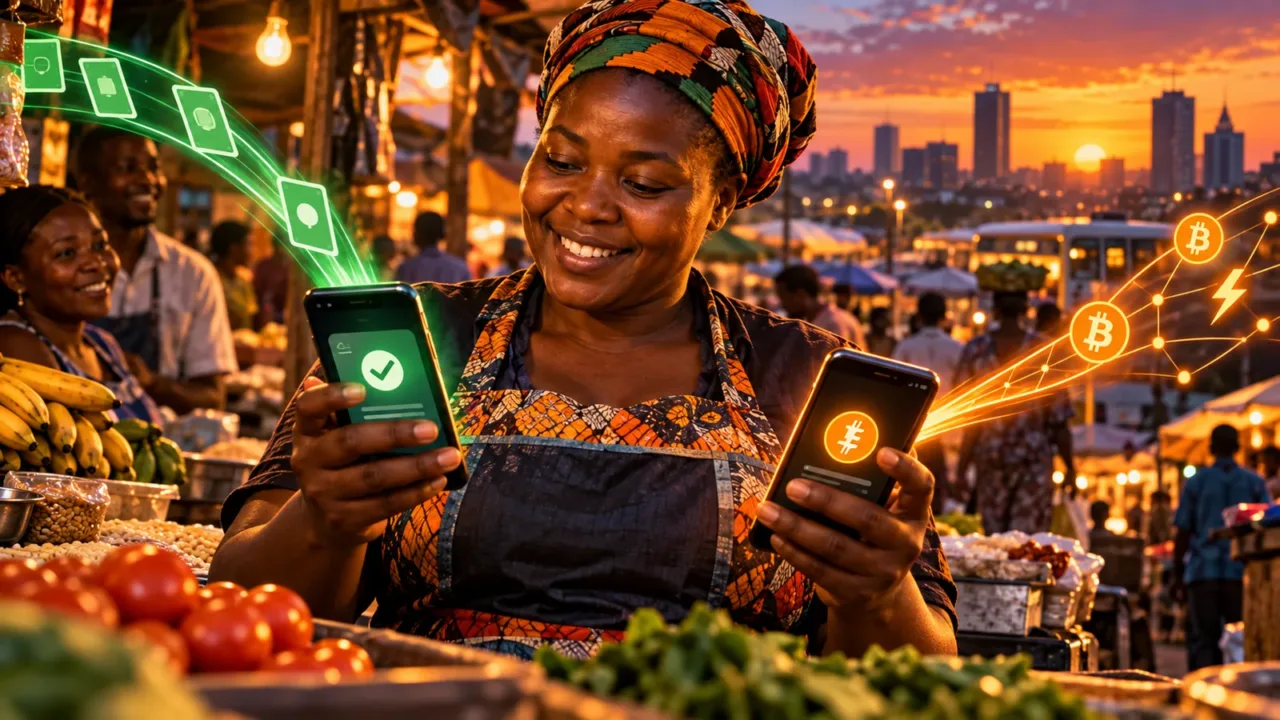
A single phone can bring together a mobile money account, an exchange app and a Bitcoin wallet. That visual proximity nevertheless masks several separate agreements. In Zambia, a customer may use MTN MoMo or Airtel Money to pay a counterparty, but that does not mean the telecom operator itself sells Bitcoin or guarantees its delivery.
Tools such as BitZed aim to connect these rails to the Lightning Network. The process may be fast, but users need to understand who receives the kwachas, who converts the money, who holds the keys and where to direct a complaint. The Bank of Zambia’s new directives for virtual asset service providers make these checks even more important.
In brief
- Mobile money is the fiat rail; the seller, converter and Bitcoin wallet are separate services.
- The Human Rights Foundation presents BitZed as a bridge to Lightning, but that alone does not prove it is licensed or permanently available.
- Compare the total cost and test the process with a small amount; keep payment records and key backups separate.
Bitcoin and mobile money: separating payment from delivery
The BrefCrypto feature on Bitcoin–mobile money bridges in Africa describes several models in which one person pays in local currency while the recipient receives satoshis or local currency. To assess the Zambian case, three events must be distinguished: sending ZMW from a mobile account, conversion by an intermediary, and delivery of BTC to an account or wallet.
The first event can be confirmed through the MTN MoMo or Airtel Money transaction history. Subject to checking the beneficiary and status, it proves that a transfer in kwachas took place. It does not show that the service subsequently bought Bitcoin, selected the correct network or that the recipient controls the BTC keys. Those elements require their own evidence.
The Bank of Zambia’s 2025 annual report states that the value of mobile money transactions rose by 83.4% during the year, while their volume increased by 65.5%. This growth confirms the phone’s broader importance in Zambian payments. It does not measure Bitcoin purchases or the number of BitZed customers; attributing all of that growth to crypto would be a statistical error.
In a simple scenario, a user sends kwachas to a provider, which then triggers a Lightning payment to a compatible address or identifier. If the seller holds the asset before payment, it may set the exchange rate and fees. If the tool only relays a transaction, custody may remain with the user. The app’s terms should explain what happens when the network is unavailable or a payment fails after the mobile money account has been debited.
BitZed and Lightning: what public information confirms
The Human Rights Foundation describes BitZed as a Zambian application connecting Bitcoin with mobile money services. According to that description, the product allows users to buy Bitcoin with mobile money and convert Bitcoin to a mobile account through Lightning. The organization presents the project as part of its financial freedom initiatives. This information concerns the functionality described by the project and its backers; it is not an independent audit of performance or regulatory compliance.
Lightning is a payment layer built on top of Bitcoin. It can enable fast, small payments without waiting for every transaction to be confirmed on the main chain. Users should not, however, confuse a fast display with successful settlement. A wallet may show a payment as pending, a provider may have limited liquidity and a transaction may require an available channel or route.
So the key question before sending is not simply, “Is Lightning instant?” Users also need to know who guarantees receipt, how fees are calculated, what minimum amount applies and whether the counterparty can convert to MTN MoMo or Airtel Money at that precise moment. An application should not present a payment promise as a universal guarantee independent of liquidity, internet connectivity or the conditions of the mobile account.
Operator availability can also change. A method shown in an old screenshot does not prove that it is still supported. Before paying, check the official interface for active networks, limits and the beneficiary’s exact name. A request to switch to a private number received by message warrants confirmation through a separate channel.
Total cost: fees, spread and conversion back
The cost is generally split among several components: the mobile transfer, the fiat-to-BTC conversion margin, the service fee, any Lightning fees and the cost of withdrawing to an external wallet. The interface may show a net amount in satoshis without specifying every element. Note the number of kwachas debited and the number of satoshis actually received, then calculate the implied value per unit.
A payment of 100 ZMW that yields 55,000 sats cannot be directly compared with another payment of the same amount without knowing the BTC/ZMW exchange rate at the exact time, the fees included and the transaction status. The amount received depends on the fluctuating price. The spread may be wider when local liquidity is low or when the service is covering conversion risk.
The exit route should be assessed before buying. If the sats remain in an app account, the customer may need to withdraw them to a Bitcoin wallet. If the customer then uses Lightning, the wallet must support that network. To convert back to kwachas, users need to identify who buys the BTC and whether the service pays directly into the customer’s MTN or Airtel account. Each step may involve a limit or commission.
The BrefCrypto guide to trading fees, spreads and withdrawals helps compare the final outcome rather than relying on a “zero-fee” promise. A fixed fee can weigh heavily on a small amount. Conversely, an apparently modest exchange spread may account for most of the cost of a repeated transaction.
Mobile money payments do not make Bitcoin less volatile. A user may buy satoshis whose dollar value changes rapidly. For a purchase planned in ZMW, that change adds risk between the purchase and the final conversion. If the need is simply for immediate local settlement, kwacha held in a mobile wallet may be simpler and more predictable.
Zambia’s directives: a mobile operator and a VASP are not the same thing
The Bank of Zambia first required providers to register through its March 2026 notice. It clarified that registration did not constitute a licence. The Directives on Virtual Assets issued in September 2026 subsequently established a licensing regime for commercial virtual asset exchange, transfer and custody activities.
MTN MoMo and Airtel Money provide payment or electronic money services. Their involvement in a transaction does not give a crypto intermediary the status of an authorised provider. Likewise, a Lightning provider using those rails may be subject to specific obligations depending on its role, structure and how it controls funds. The exact entity must be checked rather than attributing the regulated partner’s status to the entire chain.
Providers active on 18 September have a transition period to submit a licence application within twelve months. This provision does not mean that every accessible product is authorised. Users should request the legal name, terms of use, claimed status and dispute-resolution policy. For activities involving a financial instrument, Zambia’s SEC may also have jurisdiction.
Currency rules remain separate. The Bank of Zambia’s notes on the 2025 Currency Directives state that domestic transactions are generally settled in kwachas, subject to exemptions. A technology bridge to Bitcoin does not automatically turn BTC into legal tender for everyday commerce.
Avoiding fraud and protecting access
Keeping evidence separate is a practical safeguard. Retain the mobile money transaction ID, the service receipt, the Lightning payment identifier and the wallet address. Do not share your recovery phrase with the mobile operator, seller, supposed support agent or anyone claiming they need to “unlock” the funds. A non-custodial wallet has no official function that allows a third party to restore your keys from a payment.
The BrefCrypto crypto guides on wallets and security explain why an app balance and control of a key are not equivalent. If the service holds the keys, the user depends on its withdrawals and its ability to honour the balance. If users control their own keys, they assume responsibility for backups and the irreversibility of mistakes.
Do not begin with a large amount. Make a test transaction, check that it was received in the correct wallet and confirm that a withdrawal or reverse conversion is possible. A successful test does not establish a provider’s future reliability, but it can reveal an incorrect number, the wrong chain or confusion between BTC and an internal balance.
A sound mobile money–Bitcoin gateway should not create artificial urgency, guarantee returns or ask for a secret. It should display the rate, fees, responsible entity, limits, transaction status and complaint channel. If any of these elements is missing, ease of use does not make up for the lack of transparency.
Sources and limitations
- Bank of Zambia, 2025 annual report, March 2026 VASP notice and September 2026 directives (a reproduction of the Gazette text by a third-party website).
- Human Rights Foundation, public description of BitZed and its connection to Lightning/mobile money.
- Bank of Zambia, explanatory notes on the 2025 Currency Directives.
The current availability of MTN, Airtel, BitZed or any specific provider, along with its fees and individual regulatory status, has not been confirmed for a given transaction. Check directly before using the service.