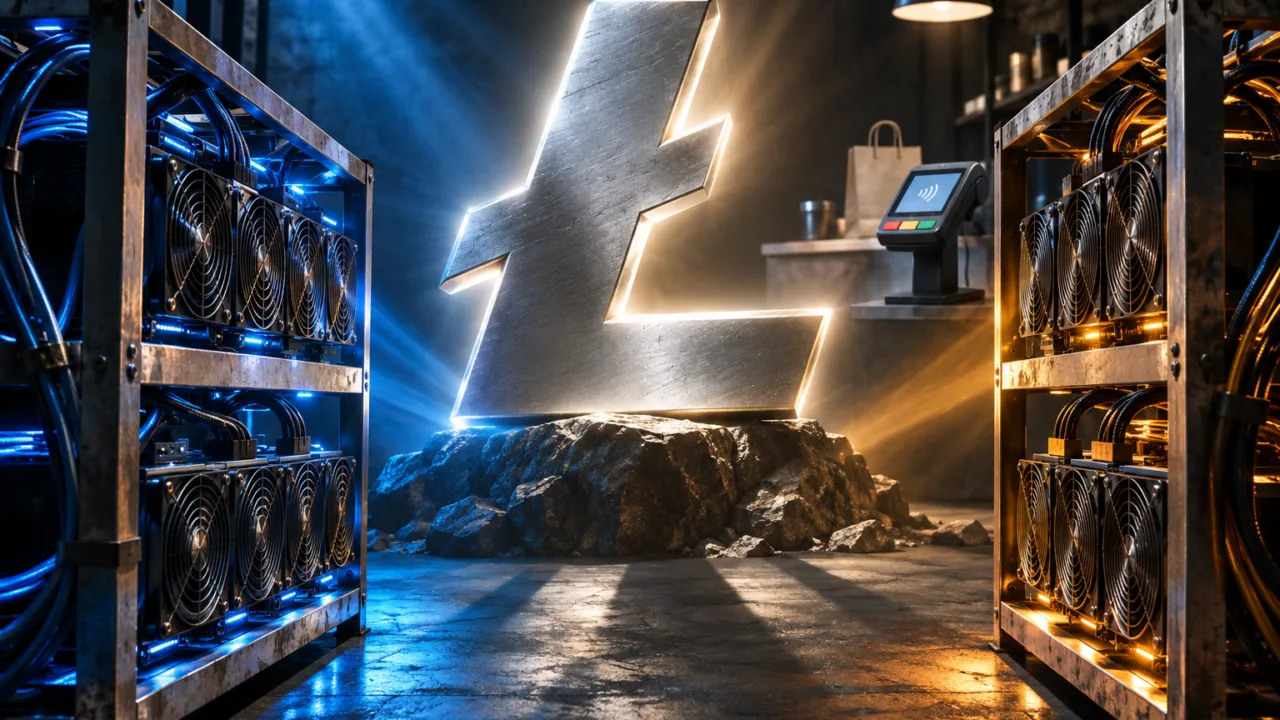
Litecoin in 2027 will reach a familiar milestone: the subsidy paid for each block is expected to fall from 6.25 to 3.125 LTC. The change reduces the production of new coins, but not the amount existing holders may decide to sell. For investors, that distinction matters just as much as the estimated halving date.
Litecoin’s relevance also depends on two other areas. The network can be used to transfer funds at a competitive cost, while its miners can earn additional rewards with the same computing power. Neither argument guarantees a price increase. Both provide ways to assess the network without simply comparing LTC with its previous all-time high.
In brief
- At the theoretical pace of one block every 2.5 minutes, daily subsidies fall from approximately 3,600 to 1,800 LTC after the halving.
- Merged mining with Dogecoin means miner profitability cannot be inferred from the Litecoin reward alone.
- To assess payments, compare the full transaction path, recurring use cases, and the ability to convert or withdraw funds.
Litecoin in 2027: what the halving really changes
The BrefCrypto crypto glossary distinguishes between the creation of new tokens, mining, and the amount already in circulation. On Litecoin, the halving changes the block subsidy. It does not halve users’ balances or determine the fees that transactions pay to miners.
The foundation’s overview of Litecoin states that the 2023 reduction brought the subsidy down to 6.25 LTC and that the next one is expected to lower it to 3.125 LTC. The network activates the change at a block height, not at a fixed time on a calendar. The estimated date shifts with the actual production rate. A useful countdown should therefore specify the observed block height and the method used to convert the remaining blocks into days.
With one block every 2.5 minutes on average, the chain produces approximately 576 blocks per day. The subsidy therefore represents 3,600 LTC before the reduction and 1,800 afterward. This calculation excludes fees and day-to-day variations. For illustrative purposes, at a constant price of 100 dollars, the difference between the two flows would be worth 180,000 dollars per day. That does not mean sell orders of this amount immediately disappear: not all miners sell all their coins at the same time, and existing holders continue to trade.
The cap of approximately 84 million units documented in Litecoin’s technical overview describes the issuance rules. It does not measure the amount available on platforms or demand at the current price. A halving can occur while investors are reducing their exposure to altcoins. It can also be priced in well before the event. In either case, the protocol’s schedule alone is not enough to identify the cause of a price move.
Merged mining changes the security equation
Litecoin uses proof of work and the Scrypt algorithm. Dogecoin’s mining documentation explains that merged mining allows compatible work to be reused to contribute to Dogecoin as well, through an adapted setup. For an operator, revenue may therefore depend on two assets, their fees, and the pool’s payout rules. Litecoin’s halving does not mechanically cut this entire revenue stream in half.
A hypothetical example helps illustrate the calculation. Suppose an operator’s daily revenue consists of 40 euros tied to the LTC subsidy, 5 euros in Litecoin fees, and 55 euros in other compatible rewards. If only the first component is halved, total revenue falls from 100 to 80 euros. This does not represent any actual mining farm. It shows why the initial share of each revenue source matters more than applying a percentage to the total. If DOGE’s price moves at the same time, the outcome may change in either direction.
To connect this calculation to network security, monitor hash rate and pool distribution over several periods. Lower revenue may put the least efficient machines under pressure, but electricity prices, pool fees, and merged-mining rewards all affect the profitability threshold. A high total hash rate does not eliminate dependence on a handful of operators or the risks associated with shared software versions. BrefCrypto’s comparison of mineable cryptocurrencies explains why hardware and fixed costs must be included in the analysis.
LTC holders do not automatically receive these rewards. Buying the token provides exposure to its price, while financing a mining operation creates exposure to hardware costs, electricity, difficulty changes, and the pool’s settlement rules. Although both activities involve the same network, they follow different financial models. Comparing their profitability based solely on LTC’s price obscures the key factors.
Payments: compare what the recipient actually receives
A payment is not defined solely by the cost shown by a block explorer. The customer may first need to convert euros, make a withdrawal, wait for the provider to credit the recipient, and then convert again. To compare LTC with another option, measure the net amount received in the desired currency and the total time until the funds are available. BrefCrypto’s guide to crypto fees and withdrawals helps separate platform commissions, network costs, and withdrawal conditions.
Hypothetical example: on a 300-euro transfer, the network fee is 0.05 euro, but conversions and withdrawals together cost 6 euros. The total cost reaches 6.05 euros, before any effect from a change in price. Another option may show a 0.50-euro network fee yet cost less overall if its conversion charges are lower. These figures are not service prices. They show why comparing isolated fees can lead users to choose the wrong transaction path.
Tracking adoption also requires a distinction between visible transactions and commercial payments. A platform may consolidate its own funds or move assets between its wallets. The ledger records a transaction, but it does not represent a new purchase at a merchant. Conversely, several payments may be bundled together. When a provider publishes figures, check how it defines a payment, the period covered, the regions included, and user behavior after a campaign.
Even if payments grow, the need to hold LTC may remain limited when providers quickly convert what they receive. BrefCrypto’s report on stablecoins highlights the distinction: some users primarily want a stable unit, while others prefer to transfer an asset they already hold directly. Litecoin may suit the second use case without winning over the first.
MWEB: privacy, maintenance, and compatibility
MWEB adds a distinct mode of use to Litecoin, aimed in particular at improving privacy. It does not make every Litecoin transaction private, nor does it guarantee that a service will accept this type of deposit or withdrawal. Before choosing a route, check the wallet, supported format, and recipient’s policy. For a large transfer, operational incompatibility matters more than a theoretical benefit.
The technical report on the 2026 MWEB incidents describes a validation error, followed by a related incident in April in which an invalid thirteen-block branch was rejected. The report states that third-party services were affected and describes the fixes that were implemented. It does not prove that every provider suffered the same loss or that all future risk has disappeared. To assess the response, consult the Litecoin Core releases and the measures taken by the service you use.
This case illustrates a useful distinction for investors: a feature can strengthen a network’s use case while also adding validation and maintenance requirements. MWEB’s value should therefore be assessed neither by its existence alone nor by considering an isolated incident out of context. It also depends on genuinely compatible integrations, the quality of updates, and the exit conditions available to users.
Three tests for deciding whether the LTC thesis holds
| Area | Useful signal | Mistake to avoid |
|---|---|---|
| Issuance | Block subsidy and new units over comparable periods | Confusing a decline in issuance with a decline in market selling. |
| Security | Pool distribution, merged-mining revenue, and software status | Halving all miner revenue after the halving. |
| Payments | Net amount received, retention, and withdrawal compatibility | Equating every visible transaction with a commercial purchase. |
To put a price into perspective, suppose there are 77 million LTC in circulation, purely for illustrative purposes. At 75 dollars per token, the market capitalization would be 5.775 billion dollars; at 150 dollars, it would reach 11.55 billion. This supply figure does not describe the current or future stock, and these prices are not targets. The exercise provides a scale for comparing a hypothesis with the market’s actual depth. Market capitalization does not measure the amount an investor could withdraw at that price.
Litecoin remains relevant in 2027 if the goal is to study a proof-of-work payment network whose issuance and security rely on distinct mechanisms. Its investment case depends on additional evidence: recurring use, usable liquidity, and the ability to maintain the network despite a lower subsidy. If only the halving date changes, the case still does not demonstrate rising demand. If all three areas evolve together, the analysis finally has evidence that goes beyond a scarcity narrative.