Mobile crypto in 2027 will have to deliver across the entire user journey: installing a legitimate app, securing private keys, understanding a signature and recovering access after losing a phone. Blockchain speed explains only part of that experience. A simple app can still depend heavily on a provider or a specific device.
Celo and Solana Mobile represent two different cases. Celo emphasizes accessible use cases and payments, while Solana Mobile also brings together a hardware experience and app distribution. For CELO, SOL and SKR, the network’s utility, the mobile product and the token’s rights must be assessed separately, rather than attributing all user growth to any one of them.
In brief
- Using an app on a phone does not mean it works without intermediaries or recovery risks.
- Paying fees can be simplified without eliminating the underlying technical cost.
- Distributed devices and installed apps do not measure the number of regular customers.
Mobile crypto in 2027: four layers not to confuse
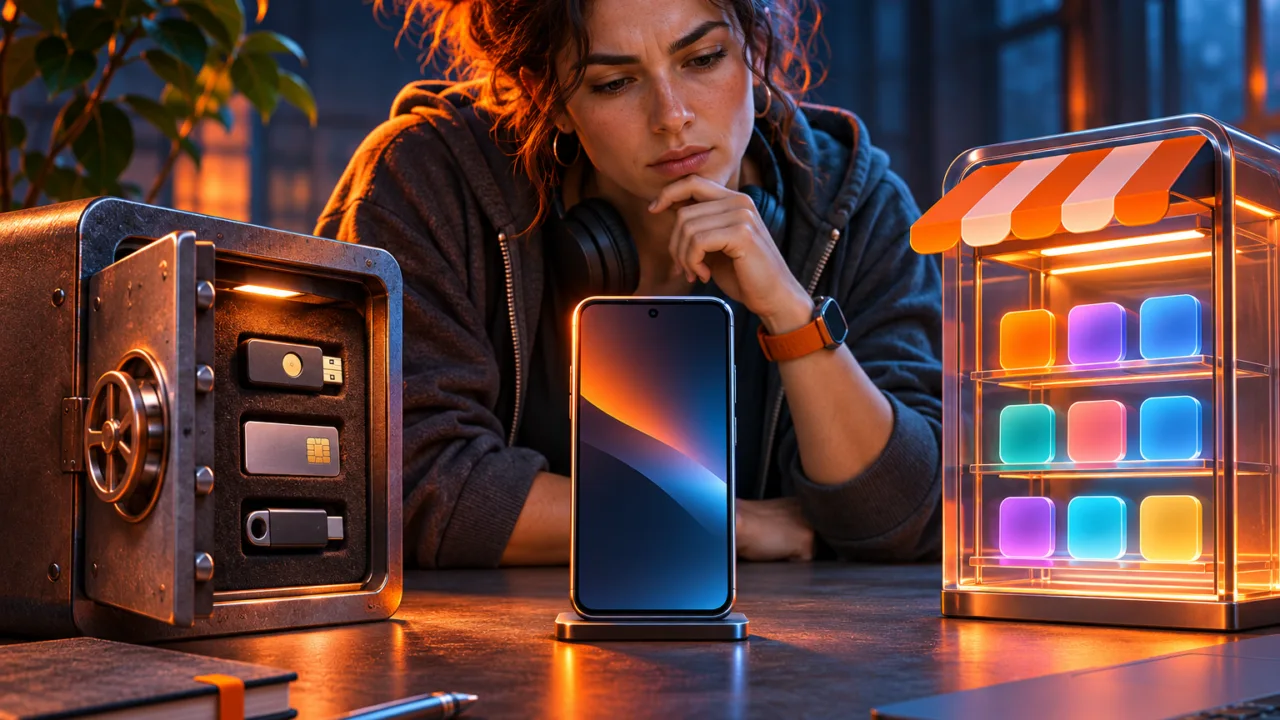
The BrefCrypto glossary distinguishes between the network, wallet and private key. On mobile, the operating system and app store must also be considered. A blockchain can remain available while the app providing access to funds is no longer accessible. A device may protect certain secrets while displaying an interface that asks the user to approve a risky signature.
The comparison should start with a use case: paying a merchant, receiving a transfer, using an app or managing a small amount of savings. Recovery and availability requirements differ. A flow designed for an experienced user can become dangerous for someone who confuses a login button with a spending authorization. Interface quality is therefore part of security, not merely a matter of convenience.
| Layer | What it provides | Control question |
|---|---|---|
| Network | Execution and settlement | Which asset, what fees and which destination? |
| Wallet | Key management and signatures | How can access be restored without exposing the secrets? |
| Device | Hardware and software environment | What updates and actual protections are available? |
| Distribution | App installation and discovery | Who verifies the app, and how can a malicious copy be removed? |
A fictional example illustrates the issue. A payment app covers the gas fee and enables quick registration. The experience appears simpler, but the customer still needs to know who pays, which limit applies and how access can be recovered. A free campaign may end. The service’s price after the promotion and the account’s portability must be understood before entrusting it with significant funds.
Celo: simplifying payments without hiding resource requirements
Celo’s current documentation describes the network as an Ethereum layer two focused on adoption and payments. This description should replace older profiles that still automatically treat it as an independent chain in its historical configuration. To analyze a service in 2027, the architecture and parameters of the network actually being used must be examined.
The Celo fee abstraction guide explains that certain operations can be paid for with accepted tokens instead of CELO. This feature can remove a conversion step for users. It does not mean that every asset is accepted or that every app builds the required transaction. The wallet and service must support the exact flow.
For CELO, the analytical consequence matters: higher payment activity does not mean every customer buys CELO to pay gas fees. The token’s role must be assessed through the current mechanisms, governance and flows. Fee abstraction can improve the product while changing how resource demand is transmitted to token holders.
A practical test is to track a payment made with an accepted asset through to its final destination. The BrefCrypto guide to USDT and Mobile Money channels recalls that digital transfer and local conversion are separate steps. A phone’s simplicity does not guarantee the net amount, withdrawal time or the recipient’s acceptance of the token.
Solana Mobile: hardware and distribution are a separate case
Solana Mobile’s documentation notably presents tools for wallet integration and app publishing. The phone, store and login interfaces are not the Solana blockchain itself. Their performance and risks must be studied separately from those of the network that executes transactions.
For a developer, dedicated distribution can provide access to an audience that already owns the hardware. But the number of devices does not show how many people use an app each week or pay for a service. Track installations, activation, retention and spending separately. A user may install an app for a reward and never open it again.
For an owner, security also depends on updates and official recovery procedures. A hardware protection component does not make every signature safe. If a user knowingly authorizes a malicious contract, key protection does not replace reading the transaction. App provenance and a clear signing message remain essential.
Support availability, warranty coverage and compatibility with ordinary apps are part of the phone’s cost. A crypto device remains a physical device that can break, lose its battery or become unavailable. Before linking it to a significant sum, check what allows access to be recovered elsewhere and what depends exclusively on the device. A sales demonstration is no substitute for a continuity plan.
SOL, SKR and CELO: separating rights from incentives
The official Solana Mobile SKR page presents an asset associated with the mobile ecosystem, its governance and app selection. It should not be confused with SOL, which has its own role on the Solana network. A phone sale does not automatically create the same rights for holders of the two assets.
To assess SKR in 2027, examine the mechanisms actually in use, participation requirements, supply and the powers held by the relevant actors. A reward distributed to users or contributors can support the launch of an ecosystem without constituting revenue paid by customers. The rights described must be linked to the available contracts and procedures, not merely to the project’s broader mission.
The same review applies to CELO and SOL: which uses require the token, who pays it and how often? Interfaces can pool fees or simplify conversion. A large financial volume may therefore correspond to a small operational token budget. The quality of the mobile product and the justification for its valuation remain two complementary investigations, not a single chart.
Fees must also be measured across the full user journey. Our crypto fees guide distinguishes between network fees, spreads and withdrawals. A payment that is almost free on-chain can become less attractive after conversion or a fixed exit cost. When comparing apps, keep the same amount and final currency, without using a promotional rate as a permanent benchmark.
The checks that will matter for adoption in 2027
Recovery should be rehearsed before an emergency. Users need to understand the required backups, legitimate points of contact and consequences of losing a device. Signs of fake support include requests for a seed phrase, screen sharing or a transfer to unlock an account. The simplicity of an integrated wallet never justifies handing these details to a stranger.
Data handling is another layer. A mobile app may request permissions that go beyond its apparent purpose. The BrefCrypto guide to KYC and data offers a method for examining purposes, recipients and retention. The fact that a feature uses a blockchain does not mean all its data remains on the device or that no provider processes it.
To measure adoption, compare active users after several weeks, the frequency of useful activity and payments that continue beyond campaigns. Add incidents, support requests and recovery quality. One million downloads do not describe these outcomes; a few recurring, well-understood services may provide stronger evidence of utility.
Also test ordinary conditions for the target audience: intermittent connectivity, an older phone, a small mobile-data allowance and a limited screen. An app may seem fast on a recent device while becoming difficult to use on another. Error messages should distinguish a network delay from a transaction that has already been sent, helping prevent repeated signatures and duplicate actions. For developers, click counts alone are therefore not enough to measure simplicity: they must observe what users understand when the connection drops or the interface does not respond immediately.
Mobile crypto in 2027 will succeed if it removes obstacles without hiding responsibilities. Celo and Solana Mobile offer different approaches to study: accessible payments on one side, hardware and distribution on the other. For CELO, SOL and SKR, a financial decision must still demonstrate a link between these use cases and token rights. A convenient phone and a popular app are not enough to promise market performance.