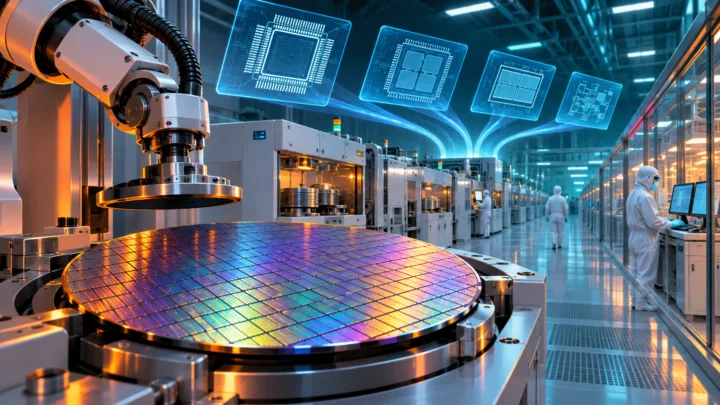
ASML makes lithography equipment used in semiconductor production. These systems do not design applications or, on their own, turn a silicon wafer into a finished processor. They form part of a sequence of industrial operations that must remain compatible and sufficiently precise.
Understanding this role helps put announcements about new chip generations into perspective. This guide separates demonstrated principles from performance claims, based on the sources consulted as of November 24, 2026. It does not attribute any automatic profitability to a technology or to the manufacturer’s stock.
In brief
- Lithography helps transfer patterns used to build circuits.
- EUV and DUV are different techniques whose applications can coexist.
- A machine must combine precision, throughput, availability and integration into the manufacturing process.
ASML and lithography in the chip supply chain
Our article on AI used in chip design covers an earlier stage. Design defines a circuit; manufacturing must then turn its structures into physical form. ASML’s overview of microprocessor manufacturing helps place lithography among the many operations required.
A wafer goes through deposition, processing, etching and inspection steps depending on the process. Lithography defines patterns on a photosensitive layer. Subsequent treatments use those patterns to build the circuit. It would therefore be misleading to describe the machine as a printer that produces a finished processor directly in a single operation.
Circuits contain multiple layers that must line up correctly. Insufficient accuracy can compromise their operation, even if each individual pattern appears fine. Industrial results therefore depend on repeatability and coordination between steps, not just on an equipment specification’s stated resolution.
This distinction changes the economic picture. Customers are not paying simply to create an impressive pattern once. They want repeatable production at a usable cost per circuit that fits their product. Laboratory performance and reliable industrial throughput therefore do not provide the same evidence.
When following the sector, always distinguish between the designer, the equipment supplier and the manufacturer. A new chip may combine progress from all three without any one of them explaining the entire improvement. Identifying these roles avoids attributing all the revenue or value created by the final product to the lithography supplier.
DUV and EUV: wavelength does not tell the whole story
ASML’s documentation on light and lasers states that EUV uses a wavelength of 13.5 nanometers. This figure describes the light used. It does not directly correspond to the commercial name of a manufacturing process or to the uniform size of every element in a circuit.
DUV technologies use other wavelengths and remain suitable for different stages. The arrival of a newer technique does not mean that all earlier equipment instantly becomes obsolete. ASML’s technology overview emphasizes that several types of systems are used depending on the layers and patterns being targeted.
Industrial choices take cost, precision and the number of required operations into account. One solution may reduce certain steps while requiring a different level of investment. Comparisons must therefore use the same quality objective and consider the process as a whole, rather than simply setting old against new.
The concept of a generation therefore requires particular caution. Similar labels do not prove that two manufacturers offer the same characteristics. Conversely, a different process name does not allow the performance gap between processors to be calculated directly. The circuit’s design and intended use also matter.
Investors should ask where the new technology delivers a demonstrated saving and how quickly customers can adopt it. A technical improvement may exist before large-scale deployment. Qualification timelines and the required investment stand between demonstration and revenue.
Optics, mechanics and metrology must work together
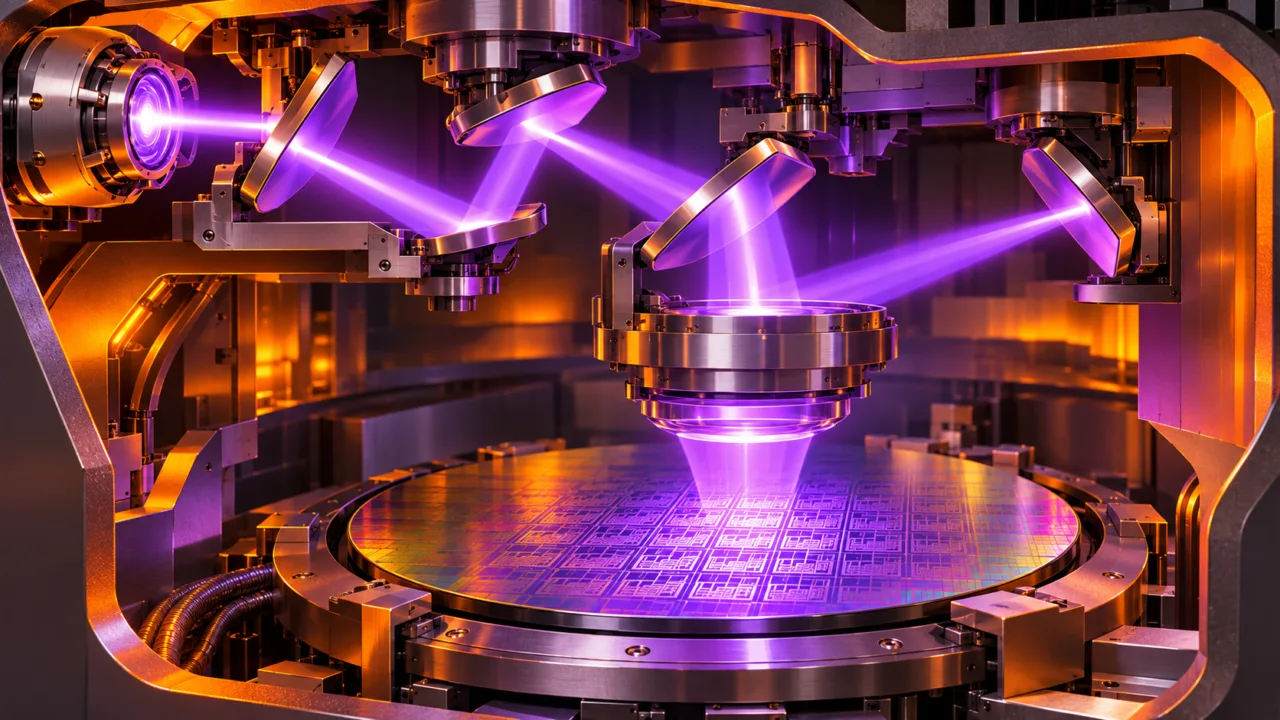
The official page on lenses and mirrors explains the use of complex optical systems. In EUV, the strong absorption of this light requires, among other things, an architecture based on mirrors and a suitable environment. These technical choices go far beyond simply having a more powerful light source.
Movements must also be controlled. The wafer and the pattern must remain in their expected positions during exposure. Physical and thermal variations can affect the result. The economics of the machine depends on its ability to maintain useful precision in a production environment, not merely under ideal conditions.
ASML’s metrology and inspection systems provide information used to measure pattern quality and identify defects. Inspection is not a formality added after production: its results contribute to process adjustments and yield assessment.
Software also plays a role in preparation and correction. Part of the work involves anticipating how a pattern will actually be reproduced and limiting deviations. This does not mean that software cancels out physical constraints. It works with them, within the limits of the equipment and available data.
Our method for checking an explanation produced with ChatGPT remains useful when faced with spectacular descriptions. Ask what is being measured and across which scope. Precision claimed for one component does not, by itself, guarantee the yield of an entire fab.
Industrial value is measured by the cost per good output
For a chipmaker, a machine represents both an investment and an operating expense. Its value depends on the good output achieved over time. Throughput, availability and maintenance must therefore be considered alongside resolution, as must installation costs and the resources required.
A hypothetical example makes the mechanism clear: a process costs 200 and produces 100 good units, or 2 per unit. A faster configuration costs 240 but delivers 160 good units, or 1.50. The higher total price may correspond to a lower unit cost, but only if the quality and production assumptions are met.
The opposite is also possible. A promising technology that is still difficult to operate may slow production or increase rework. The learning phase and support availability must be examined. Novelty does not automatically create greater value for every layer or product.
The article on the computing capacity mobilized by Anthropic highlights how digital demand depends on a hardware chain. Yet higher demand for computing does not prove that every customer must immediately purchase the same lithography system. Their processes and timelines differ.
The right comparison therefore keeps the target product, volume and quality constant. It must also state whether development costs are included. Otherwise, an apparent saving may simply shift an expense to a team or stage left outside the scope of the calculation.
A strategic piece of equipment still depends on customers and partners
A lithography system fits into a supply chain of specialized suppliers. Optics, mechanics, sources and components must arrive with the expected specifications. A supply disruption can affect delivery rates even when the commercial order book appears strong. The finished product is not simply an assembly of interchangeable parts.
The customer relationship continues after delivery: installation, qualification, maintenance and upgrades may all matter. These activities must be distinguished from new-system sales in an economic analysis. Their importance and accounting treatment must be verified rather than inferred from the existence of an installed base.
Customers must also fund the buildings and other equipment required. An order may depend on a fab’s schedule and its ability to accommodate the machine. Long-term demand therefore does not eliminate possible short-term delays or fluctuations in capital spending.
Our analysis of markets becoming concentrated around semiconductors broadens this question. Several listed companies may benefit from the same cycle and suffer its slowdown together. Adding stocks tied to different stages does not necessarily remove that shared dependence.
Trade restrictions must finally be read according to their exact wording and scope. A political announcement does not automatically make it possible to calculate lost revenue. It is necessary to know which products, customers and periods are affected, while recognizing the limits of public information.
What the technology does—and does not—tell shareholders
Understanding lithography explains why certain capabilities are difficult to replicate. It does not provide a universally fair price for ASML stock. Valuation depends on sales, margins, cash flow and the risk the market is willing to assign to future results.
Technical progress can support the business without guaranteeing a rise in the share price. If the price already assumes faster adoption, a real improvement may still disappoint expectations. Investors must therefore distinguish industrial quality, the commercial timeline and the financial assumptions embedded in their purchase.
Build a monitoring framework covering demonstrated advances, customer qualification, delivery capacity and contributions to results. Each level requires its own data. An announcement should not move directly from the technology column to the profit column as if no steps separated the two.
Also maintain a reserve regarding non-public information. You cannot know every detail about yield, pricing or contracts. That limitation does not prevent analysis; it simply means the analysis should not claim more precision than the available evidence actually supports.
ASML’s industrial role becomes easier to understand by following patterns, precision and large-scale production. Turning that understanding into a financial decision still requires examining the accounts and the price paid. The difficulty of the technology explains part of its value, never a guarantee of returns.