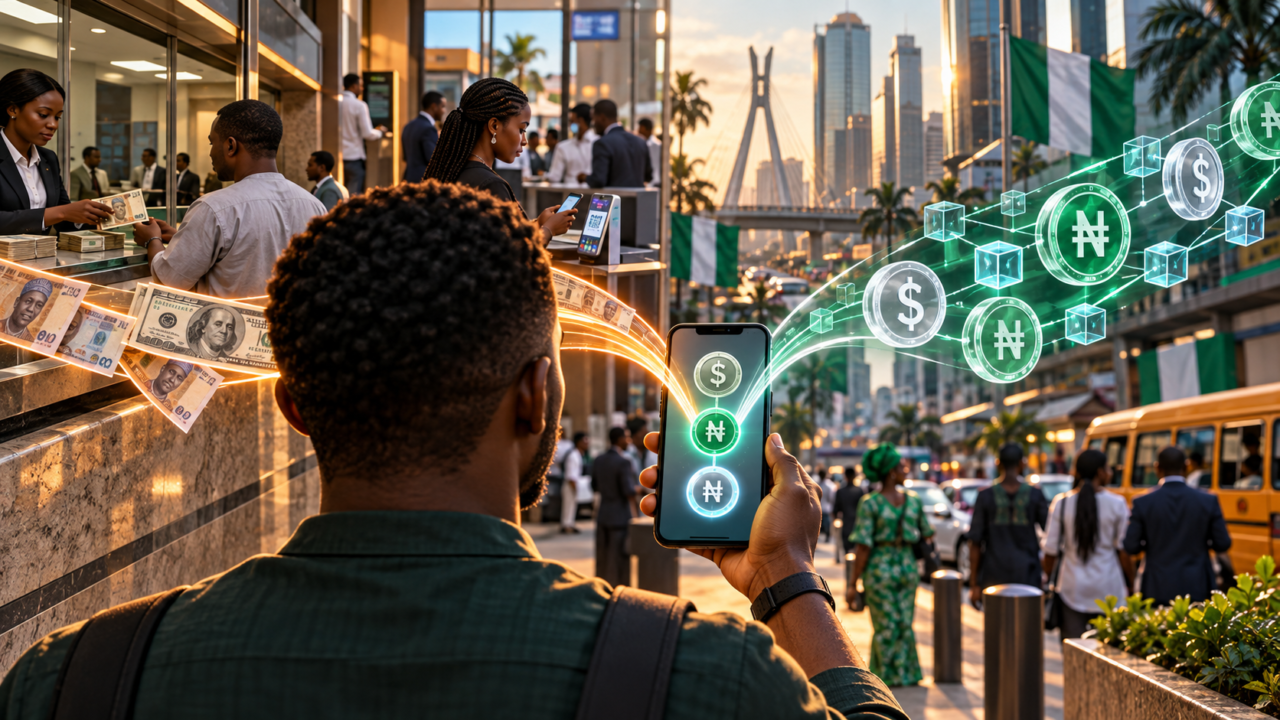
Monierate now tracks more than 90 rate providers, and HyperFX has just joined the list. Behind this relatively low-key integration lies a deeper shift in Nigeria’s foreign exchange market. HyperFX is neither a bank nor a traditional bureau de change: the Polytope Labs platform uses stablecoins and smart contracts to settle currency conversions, with cNGN serving as the naira leg. Monierate can now compare these rates with those offered by fintechs, exchanges and other providers already listed. In Nigeria, the FX market is gradually becoming a hybrid market where banking, P2P and blockchain rails converge.
Crypto Africa: Monierate now aggregates HyperFX
Monierate has added HyperFX to its rate comparison system, according to BusinessDay. The move follows strong growth in stablecoin flows in Nigeria. The Nigerian platform already tracks more than 90 providers and exchanges, with a straightforward goal: showing the actual price at which a currency is exchanged depending on the channel used.
This function is particularly useful in a market as fragmented as Nigeria’s. A company looking to convert dollars into naira may receive a different price from a bank, fintech, crypto exchange or P2P provider. Monierate is trying to bring these quotes together in a single view.
Co-founder Jeremy Ikwuje sums up the problem as follows: Africa does not lack exchange rates, but it does lack a single, reliable real-time view of those rates.
The integration with HyperFX now adds a blockchain layer to this comparison.
In this context, directly comparing a stablecoin rail with traditional FX providers becomes far more significant.
For example, Monierate recently displayed a median HyperFX rate of around 1,371.50 naira per USDC, with a spread of approximately 4.37 naira between the buying and selling prices.
The best rate can, of course, change at any time.
That is precisely the point of the comparison platform.
HyperFX turns stablecoins into FX infrastructure
Polytope Labs launched HyperFX in July 2026. Its model is based on an idea appearing increasingly often in African payments: using blockchain as settlement infrastructure without necessarily requiring end users to become crypto traders.
The protocol swaps stablecoins through smart contracts. For transactions involving the naira, the Nigerian leg is settled in cNGN, a token pegged to the local currency. Dollar currencies can notably be routed through USDC or USDT.
Polytope Labs presents HyperFX as a fully on-chain FX engine capable of aggregating multiple liquidity providers. The company says it offers settlement in a matter of seconds and charges a fixed 0.05% fee per swap. These figures come from Polytope Labs and should therefore be understood as the product’s stated characteristics, not as a guarantee that the total cost will always be lower than that of every competitor.
Network fees, spreads and other potential costs may still affect the actual outcome of a transaction. Monierate itself makes this clear when displaying HyperFX quotes.
The target audience is not primarily the individual looking to convert 100 dollars.
HyperFX mainly targets fintechs, neobanks, remittance operators, wallets and off-ramp platforms. These companies can integrate the service through an API or SDK and use stablecoins as an invisible settlement layer behind their own interfaces.
This is an important shift: the stablecoin becomes less an asset to speculate on and more a piece of financial plumbing.
cNGN finally gains a new use case
The role of cNGN deserves close attention.
Since its launch, the stablecoin has sought to build genuine utility around a privately issued digital naira. One cNGN is designed to represent one naira, and its reserves are held with licensed commercial banks, according to Wrapped CBDC Limited. The company also says it regularly publishes information about its reserves.
The amount shown on its transparency page recently reached approximately 168.8 million cNGN.
The scale remains modest compared with the billions of dollars circulating in USDT and USDC, but HyperFX provides precisely what local-currency stablecoins often lack: repeated use.
Bref Crypto had already noted that cNGN adoption remains tiny compared with dollar-pegged stablecoins, despite efforts to connect it to more blockchains and payment systems.
With HyperFX, cNGN can serve as the settlement leg in a USDC/NGN or USDT/NGN conversion.
This slightly changes the equation. A company no longer needs to buy cNGN simply because it believes in the token. It can use it temporarily because it enables settlement denominated in naira.
This is much closer to monetary infrastructure.
Its regulatory status must nevertheless be described accurately. Wrapped CBDC Ltd is listed in the Nigerian SEC’s incubation ecosystem as a stablecoin operator, and the SEC granted it an Approval-in-Principle under the ARIP.
This is not yet a final license. The SEC explicitly states that an AIP remains conditional on compliance with regulatory and supervisory requirements.
Nigeria has already reshaped its FX market
HyperFX is also entering a market that is no longer the same as it was in 2022 or 2023.
Nigeria has moved away from its fragmented exchange-rate system toward a more unified market driven more heavily by supply and demand. The IMF estimates that the reform has restored efficiency to monetary policy, even though fluctuations in the naira now transmit their effects to inflation more quickly.
The central bank then accelerated digitization.
The Electronic Foreign Exchange Matching System, or EFEMS, uses Bloomberg BMatch for USD/NGN interbank transactions and provides the regulator with greater visibility. The minimum tradable amount is set at 100,000 dollars, with additional increments of 50,000 dollars.
Regulated bureaux de change have also been brought back more directly into the official market. Since February, they have been able to buy foreign currency from licensed banks at market rates, subject to compliance procedures.
In July, the CBN went further with the FX BDC Purchase Tracker, a portal enabling the electronic monitoring of dollar purchases made by BDCs.
The result is a more formalized and more closely monitored market than it was a few years ago.
Between March and June 2026, the NFEM and interbank markets together accounted for 46.37 billion dollars in transactions, including 38.61 billion dollars for the NFEM.
HyperFX is therefore not filling a gap left by a nonexistent official market.
It is attaching itself to a market that is already modernizing rapidly.
Stablecoins still address a real problem
Why build a new blockchain rail if the official market is functioning better?
Because cross-border frictions have not disappeared.
A Nigerian company working with a foreign supplier still has to manage currency availability, settlement times, correspondent banks and differences in exchange rates. Fintechs and payment platforms are therefore seeking solutions capable of transferring value more quickly without tying up as much capital.
HyperFX promises precisely to reduce the need for prefunded accounts by using available on-chain liquidity.
The stablecoin then acts as a digital representation of the currency.
A fintech receives digital dollars.
The smart contract executes the swap.
Settlement in naira goes through cNGN.
The entire process can then be integrated with other payment or off-ramp systems.
This architecture is part of a much broader movement across Africa. DCS Pay and Kotani Pay, for example, are building rails connecting USDT and USDC to local currencies and mobile money across six African markets.
The use cases are converging.
Conversion.
Remittances.
Merchant payments.
Corporate treasury.
Cross-border settlement.
Nigeria is a particularly logical test case. Stablecoins already represent a significant share of the country’s cross-border crypto activity, precisely because digital dollars make it possible to preserve relatively stable value and transfer funds without relying entirely on traditional channels.
HyperFX is trying to turn this existing demand into professional infrastructure.
Monierate can make spreads far more visible
The other development is not coming from blockchain.
It is coming from data.
In a highly fragmented market, one of the main difficulties remains determining which rate is actually available. A provider may advertise an excellent conversion rate and then apply a large spread to the transaction. Another may offer a less striking price but charge a lower commission.
Consumers and businesses rarely look at the full cost.
Monierate is specifically trying to make this market easier to compare.
The platform notably retains opening, high, low and closing data for certain pairs. For HyperFX, it currently tracks various markets involving USDT, USDC and the naira.
This may seem unremarkable to a trader accustomed to TradingView.
It is far less ordinary in an environment where some exchange-rate information still circulates through messaging apps, physical offices or over-the-counter negotiations.
Greater visibility can reduce information asymmetry.
Take three providers.
The first sells the digital dollar at 1,400 naira.
The second at 1,380.
The third at 1,374.
Without comparison, each customer sees only their own price. With a shared data layer, the most expensive provider must do more to justify its spread through better service, greater liquidity or stronger security.
Competition becomes more visible.
BusinessDay emphasizes precisely this transformation: the question is no longer only where to obtain foreign currency, but how much each option actually costs at the same moment.
This is probably where the HyperFX integration is most interesting.
It places a blockchain protocol in the same comparison as much more traditional financial rails.
Regulation remains the major frontier
It would nevertheless be premature to present HyperFX’s arrival on Monierate as broad regulatory validation of its model.
BusinessDay takes care to make this clear: being listed on Monierate does not constitute approval or a recommendation of HyperFX. The comparison platform simply displays its rates alongside those of other providers.
The distinction is important.
Nigeria is formalizing its crypto sector at speed. The SEC is gradually imposing greater capital, reporting, security and oversight requirements on digital-asset operators. Bref Crypto recently examined how new payment and compliance requirements are already beginning to weigh on a Nigerian crypto market estimated at several tens of billions of dollars.
In this context, using a stablecoin with an AIP does not automatically exempt every company building on it from its own obligations.
Wrapped CBDC Ltd says so itself: cNGN provides the stablecoin, but companies using its infrastructure remain responsible for obtaining the licenses required for their own services.
This regulatory architecture could become one of the major tests for Africa’s on-chain finance sector.
Stablecoins promise open infrastructure.
States require KYC, anti-money-laundering controls, oversight and intermediary accountability.
The two models must now coexist.
The real shift is taking place in infrastructure
HyperFX’s addition to Monierate does not, by itself, represent a revolution in Nigeria’s foreign exchange market.
Monierate is not becoming an exchange.
HyperFX is not replacing the central bank.
And cNGN remains far from the international liquidity of USDT or USDC.
The development becomes much more interesting when viewed alongside the sequence of recent changes.
Nigeria has reformed its official market.
BDCs are returning to the NFEM.
The CBN is further digitizing transaction monitoring.
Dollar stablecoins already account for a major share of cross-border crypto flows.
A naira stablecoin is beginning to seek professional use cases.
And now a fully on-chain FX protocol is appearing in a comparison platform used to view the same prices offered by traditional players.
The market is not becoming “crypto” overnight.
Rather, the two worlds are beginning to overlap.
A fintech can use a stablecoin without presenting its product as a crypto application. A company can search for the best rate and encounter a quote generated by a blockchain protocol. A user can receive naira even though the infrastructure behind the payment used USDC and cNGN for a few seconds.
This is often how financial technologies ultimately gain traction: when users no longer need to know that they are there.
Monierate is making this transition visible today.
More than 90 providers.
Banks.
Fintechs.
Exchanges.
P2P.
And now HyperFX.
In Nigeria, the foreign exchange market is no longer merely digital. It is also beginning to move on-chain.