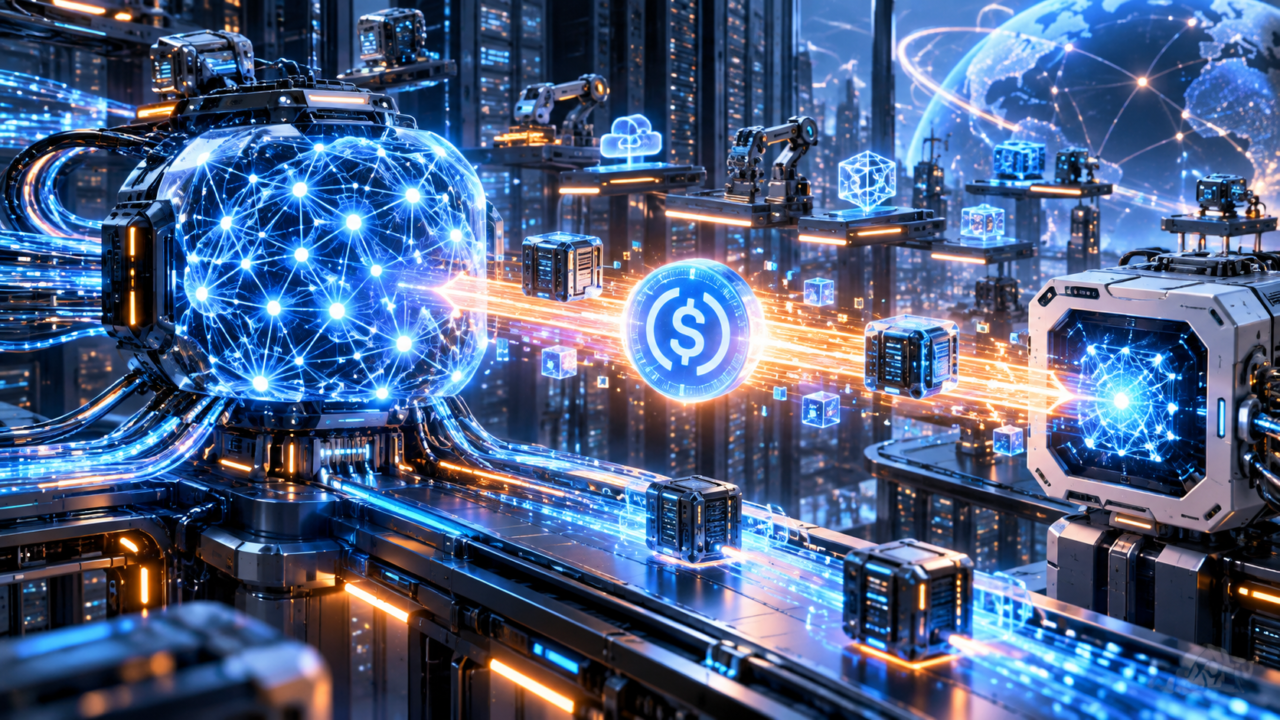
AI agents will need to make payments
The thesis echoes a trend already followed by BrefCrypto: Visa now sees stablecoins and AI agents as a potential new layer of payments, although the group remains cautious about their short-term impact.
BlackRock Investment Institute takes the economic logic further. An AI agent capable of automatically ordering storage, APIs, data or computing power must also be able to pay without waiting for a human to open an account, enter bank details or authorize each transaction.
Traditional infrastructure can already automate some of these payments. BlackRock nevertheless highlights its limitations for highly frequent transactions, some of them worth less than one cent: merchant fees, identification procedures and varying settlement times.
Stablecoins, native cryptocurrencies and tokenized assets operate 24 hours a day and are programmable. They may therefore be better suited to these machine-to-machine exchanges. BlackRock estimates that several digital assets could play this role, while arguing that stablecoins should dominate transactional use cases.
Stablecoins are already moving beyond trading
The idea comes as stablecoins have become one of the main crypto narratives of 2026. Their role is no longer limited to parking capital between two trades.
BlackRock’s report cites more than $11 trillion in adjusted stablecoin transaction volume in 2025. The figure excludes some non-economic movements in order to better measure actual payments.
AI agents could accelerate this shift. Coinbase is developing x402 to enable software to pay directly for resources on the internet. Stripe and Tempo are working on their Machine Payments Protocol. Circle has launched USDC wallets and tools designed for agents.
Programmable money is therefore beginning to find its ideal user: software that is itself programmable.
And this market would not be limited to payments. BlackRock also envisions agents capable of automatically purchasing computing power based on price, latency or available performance.
BlackRock sees beyond stablecoins
The most ambitious aspect concerns compute itself.
Demand for computing power is surging with AI. BlackRock believes rights to this computing capacity could be tokenized, traded and even used as collateral. A provider could thus represent a quantity of available computing power in the form of a digital asset, while an AI agent would automatically purchase the resource it needs.
This vision fits naturally with the strategy already visible at the asset manager. BlackRock is experimenting with tokenization alongside JPMorgan and the DTCC, while also serving as one of the founding validators of Arc, Circle’s new blockchain designed for payments, stablecoins and tokenized financial assets.
BlackRock nevertheless remains cautious: it does not claim that this autonomous economy already exists at scale. Its study primarily presents a potential trajectory. Identity standards, regulation and interoperability still need to catch up.
The shift in perspective is already significant. For a long time, AI and crypto were presented as two major competing technology trends for capital. BlackRock now sees them as complementary: AI provides the economic agents, while blockchain could provide their payment rails.