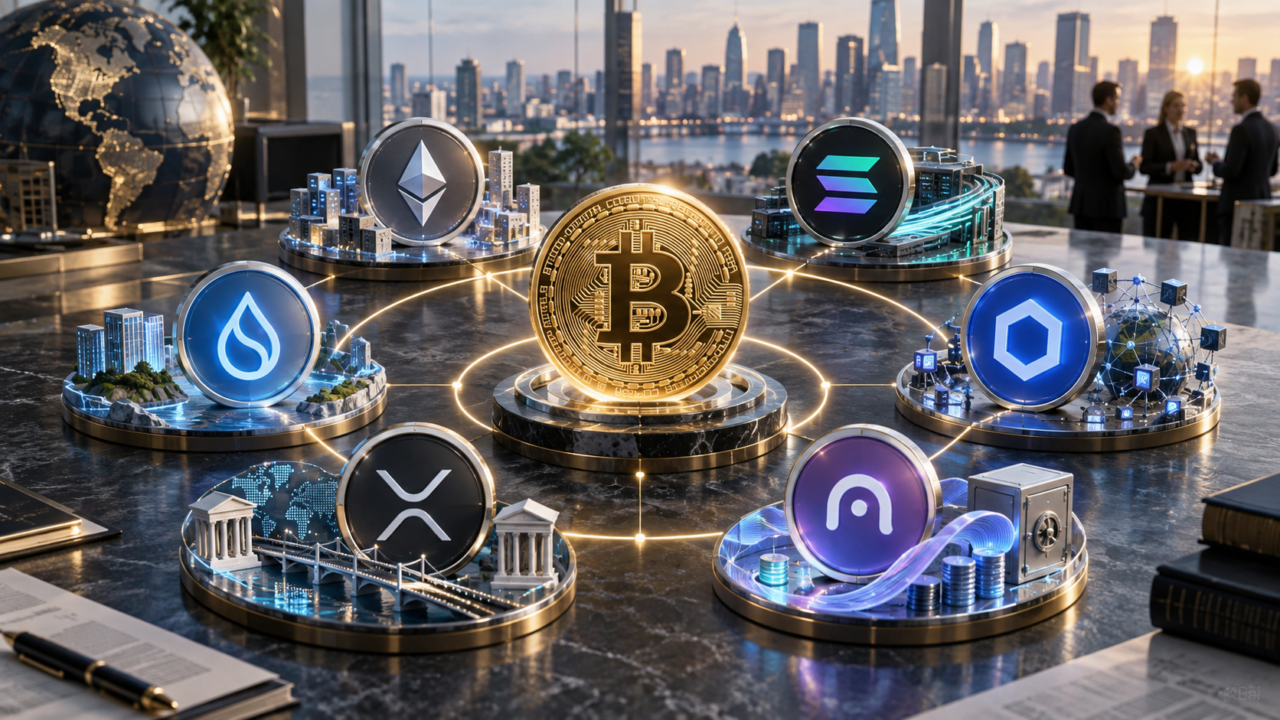
2027 could mark a decisive break from the old altseasons, when almost everything eventually moved higher.
Traditional finance now has a much stronger presence. Bitcoin and Ethereum ETFs already manage billions of dollars. Solana, XRP and SUI ETFs have opened new access channels for U.S. investors. Tokenization is gradually moving beyond the laboratory. Stablecoins are entering payment infrastructure. And institutions such as BlackRock, DTCC, Visa, Western Union and JPMorgan are now working directly with blockchain technologies.
That does not mean seven tokens will automatically explode in 2027.
Quite the opposite.
The more mature the crypto market becomes, the more important the distinction between a popular token and genuinely used infrastructure becomes. A project can have a huge community while capturing almost no economic value. A protocol can generate significant revenue while its token remains poorly designed. A blockchain can process millions of artificially subsidized transactions.
The choice of the best cryptocurrencies to invest in for 2027 should therefore start with fundamentals, not simply with 2026 performance.
2027 should be much more selective
The first rule is not to look for “the next Bitcoin.” The crypto market is already becoming much more selective across Bitcoin, altcoins, stablecoins, AI and RWAs. This fragmentation should intensify further in 2027.
Several criteria help separate solid investment cases from noise.
First, usage must be examined. Is a blockchain actually being used to move capital, settle payments, borrow, tokenize assets or run applications? Then comes value capture: does this activity genuinely increase demand for the token?
Tokenomics also matter. A crypto can have remarkable technology and still face heavy selling pressure if billions of tokens have yet to be unlocked.
Liquidity is another filter. Bitcoin, ETH and SOL can absorb far more capital than a small altcoin. That limits their explosive potential, but also reduces some exit risks.
Finally, 2027 arrives at a particular time. Bitcoin will gradually move closer to its next halving in 2028. Ethereum must continue its technical roadmap. Tokenization infrastructures launched in late 2026 will have several months to demonstrate their real-world usefulness.
The market will therefore have no shortage of catalysts.
The main challenge will be choosing those that actually generate activity.
Bitcoin remains the top choice for 2027
In my view, Bitcoin remains the strongest cryptocurrency for forming the core of crypto-sector exposure in 2027.
It is not necessarily the asset that will deliver the largest multiple.
That is precisely what makes it strong.
The Bitcoin network still relies on a maximum supply of 21 million BTC, a global Proof of Work network and a monetary policy known in advance. No board of directors can suddenly decide to double its issuance.
The main difference from previous cycles lies in the financial infrastructure built around BTC.
BlackRock’s iShares Bitcoin Trust, IBIT, still managed nearly $60 billion in assets in mid-September 2026. That is just one product among all the Bitcoin ETFs available in the United States.
This institutionalization is gradually changing the structure of demand.
A pension fund, wealth manager or brokerage-account investor no longer needs to open an account on an exchange, buy BTC directly and manage private keys to gain exposure.
This channel did not exist during the first cycles.
For 2027, Bitcoin therefore retains a combination that is difficult to find elsewhere: verifiable scarcity, global liquidity, regulated infrastructure and no central company on which the network directly depends.
2027 is already setting the stage for the 2028 halving
The next Bitcoin halving is expected in 2028, at block 1,050,000. The block reward will then fall from 3.125 BTC to 1.5625 BTC. The precise date remains variable because Bitcoin does not produce exactly one block every ten minutes, but the mechanism itself is written into the protocol.
2027 will therefore be a pre-halving year.
Historically, the market watches these periods because they precede another reduction in newly created supply. However, the four-year Bitcoin cycle should not be treated as a law of nature.
ETFs have changed demand.
Companies hold more BTC.
Derivatives markets are much deeper.
The weight of institutional capital is incomparable with 2016 or 2020.
This could produce less mechanical cycles.
One thing, however, is unchanged: issuance automatically falls every 210,000 blocks, regardless of the Fed, investors or the price.
For a 2027 investor, this visibility is a considerable advantage.
Bitcoin’s main weakness paradoxically stems from its size. An asset already valued at several trillion dollars requires enormous capital inflows to rise fivefold or tenfold.
Its absolute potential is therefore probably less spectacular than that of a small cryptocurrency.
But focusing only on potential multiples means forgetting about risk.
An altcoin capable of rising tenfold is often also capable of losing 90%.
Bitcoin offers a different proposition: less potential explosiveness, but far greater historical robustness.
Ethereum remains the major financial infrastructure
If Bitcoin is the monetary bet, Ethereum remains the most comprehensive bet on the on-chain economy.
The distinction is important.
ETH is not merely trying to become scarce money. It is used to pay for operations on Ethereum, secure the network through staking and serve as collateral across a huge part of decentralized finance.
Above all, Ethereum remains extremely well positioned in tokenization.
Ethereum’s institutional documentation estimates that its ecosystem hosts more than 75% of tokenized real-world assets and more than 60% of the global stablecoin supply, including its central role in the on-chain ecosystem. Ethereum L1 alone hosts approximately $160 billion in stablecoins, according to the data currently displayed.
This gives Ethereum an advantage that goes beyond transaction counts.
The liquidity is already there.
The developers are there.
The DeFi protocols are there.
The stablecoins are there.
Tokenized assets are arriving.
And traditional finance already knows how to interact with this environment.
Institutional interest is also visible in ETFs. BlackRock’s ETHA ETF managed approximately $8.7 billion as of September 10, 2026. Its staked Ethereum ETF, ETHB, launched in February 2026, had already surpassed $1 billion in assets by September.
Ethereum is no longer merely a blockchain used by DeFi.
It is gradually becoming institutional financial infrastructure.
Ethereum has a genuine catalyst in 2027
The roadmap provides another reason to watch ETH.
After Pectra in May 2025 and Fusaka in December 2025, Ethereum is developing Glamsterdam for late 2026. The next stage, Hegotá, appears on the roadmap for 2027, although Ethereum emphasizes that its schedule remains community-driven and subject to change.
The overall objective remains clear: significantly increase mainnet capacity, improve the blobs used by Layer 2 networks and enhance the user experience without sacrificing the network’s fundamental properties.
The Ethereum Foundation now explains that its “North Star” is to advance L1 and L2 simultaneously rather than treating rollups as a completely separate economy.
This matters for ETH’s value.
For several years, one criticism came up repeatedly: if all activity moves to Arbitrum, Base or Optimism, will Ethereum itself capture enough value?
The current roadmap is specifically designed to strengthen that relationship.
Ethereum nevertheless remains far from a risk-free investment. Its architecture is becoming complex. Layer 2 networks fragment liquidity. Solana and other networks are advancing rapidly. ETH’s price has also shown that a heavily used infrastructure does not automatically lead to the token’s permanent outperformance.
For 2027, Ethereum nevertheless remains the second project I would place at the heart of this selection.
Not because it is certain to outperform Bitcoin.
Because its position in on-chain finance remains difficult to replace.
Solana has the strongest growth profile
Solana ranks third, with greater potential and greater risk.
Its evolution since 2022 has been remarkable.
The network, once primarily associated with NFTs and meme coins, is gradually becoming infrastructure for payments and financial markets.
Data published by the Solana Foundation indicates approximately $10 billion in stablecoins on the network and $200 billion in monthly stablecoin transfers. Advertised median fees remain close to $0.0013.
These are no longer merely crypto experiments.
Visa has used Solana for USDC settlements.
Worldpay supports USDG.
Fiserv brought FIUSD into the ecosystem.
Western Union chose Solana for USDPT, its stablecoin intended to support its international transfer infrastructure.
In May 2026, the value of RWAs on Solana had exceeded $2.8 billion, while spot SOL ETFs had collectively surpassed $1 billion in assets under management, according to the Solana Foundation.
The institutional market has therefore arrived.
An SEC filing notably confirms the listing of the 21Shares Solana ETF on Cboe BZX.
For 2027, SOL is no longer merely a bet on a fast blockchain.
It is a bet on the adoption of low-cost financial rails.
Solana must now prove that its activity is sustainable
The story becomes less comfortable when the risks are examined.
Solana has benefited enormously from speculative cycles. Meme coins, bots, high-frequency trading and highly transactional applications generate impressive activity, but not every transaction has the same economic value.
A blockchain can report billions of operations without this automatically translating into durable demand for its token.
The second risk is competition.
Ethereum is seeking to drastically reduce the costs of its Layer 2 networks. SUI is advancing in payments. Base benefits from Coinbase. XRP Ledger is pushing institutional tokenization. Several specialized blockchains are emerging.
Solana must therefore maintain a sufficiently significant lead in UX, liquidity and developers.
The third point concerns valuation. When the entire market already considers SOL one of the winners of the next cycle, part of the positive scenario may already be priced in.
That is why I would place it behind BTC and ETH in terms of robustness.
But ahead of most altcoins in fundamental potential.
BrefCrypto was already tracking the support ETFs were providing to SOL. The question in 2027 will be whether these institutional products are accompanied by sustainable growth in payments, stablecoins and RWAs.
If so, Solana could become much more than a bull-market blockchain.
Chainlink is the bet on tokenization as a whole
Chainlink is probably the least visually spectacular choice in this selection.
And perhaps one of the most interesting.
LINK is not a new blockchain seeking to replace Ethereum or Solana. Chainlink provides oracles, interoperability, data and now orchestration tools that allow multiple networks and financial institutions to communicate.
It occupies the position of an infrastructure provider.
As of September 2026, Chainlink reported $34.18 trillion in Transaction Value Enabled, $56.6 billion in secured value and more than $24.1 billion in cumulative volume transferred through CCIP. These figures come directly from Chainlink and should therefore be read as metrics for the ecosystem itself.
The most interesting element, however, comes from DTCC.
In May 2026, the U.S. post-trade giant announced that it would use the Chainlink Runtime Environment and Chainlink data in its Collateral AppChain, an infrastructure designed to enable near-real-time collateral management, 24 hours a day. The launch was scheduled for the fourth quarter of 2026.
In July, DTCC then carried out actual transactions involving tokenized assets, with more than 30 financial institutions taking part. BlackRock, Goldman Sachs, CME Group, Circle and Chainlink were among the participants.
If tokenization accelerates in 2027, Chainlink does not need to guess which blockchain will win.
It can connect several winners.
LINK still needs to capture more of this adoption
This is also Chainlink’s main limitation.
A protocol can be incredibly useful without the token benefiting proportionally from all that activity.
This question of value capture should be central in 2027.
The LINK network has functions notably related to service payments, economic security and staking. But investors must verify that greater use of Chainlink actually creates additional structural demand for LINK rather than merely growing the company and the associated technology.
The risk is particularly important with “infrastructure tokens.”
A major announcement involving a bank does not automatically mean that the bank will buy several hundred million dollars’ worth of LINK.
That said, the accumulation of integrations is becoming difficult to ignore.
In 2026, Coinbase selected Chainlink to connect new tokenized stocks to DeFi. Robinhood Chain adopted Chainlink. The Wyoming Stable Token Commission uses its infrastructure. DTCC employs it on its Collateral AppChain.
This multiplication of connections creates a genuine 2027 thesis.
BrefCrypto is already tracking the rise of tokenization at BlackRock, JPMorgan and market infrastructures. LINK represents an indirect way to bet on this trend rather than on a single network.
Less spectacular than a meme coin.
Much easier to defend fundamentally.
Aave remains the major DeFi bet
AAVE belongs to a different category.
It is not a currency like Bitcoin.
Nor is it the native currency of a blockchain.
Aave is primarily a lending protocol. Users deposit assets, borrow against collateral and pay interest. The AAVE token is linked to the protocol’s governance and economics.
The strength of the investment case comes from its product-market fit.
After several cycles, Aave continues to exist, manage billions of dollars and expand its markets.
That simple fact already eliminates many competitors from previous cycles.
The protocol also has GHO, its stablecoin, and is developing Aave V4 as well as an application intended to bring the DeFi experience closer to a mainstream financial product.
Financial figures nevertheless add a necessary nuance. A DAO report published in February 2026 indicated approximately $142 million in revenue in 2025, but noted that borrow fees had fallen by about 25% from their peak. The DAO had then proposed reducing the annual AAVE buyback budget from approximately $50 million to $30 million.
An incident involving rsETH then led to the temporary suspension of those buybacks in April 2026 in order to protect the DAO’s balance sheet.
Aave therefore has real revenue.
And real risks.
That is precisely what makes it an interesting project to analyze.
Horizon could turn Aave into an institutional bridge
The most interesting part of the 2027 story is called Aave Horizon.
Horizon allows qualified investors to use tokenized securities and other RWAs as collateral to borrow stablecoins. Aave Labs stated in February 2026 that the product had already surpassed $440 million in deposits just months after launch.
A May update even reported that TVL had exceeded $500 million.
The concept is powerful.
Tokenization puts Treasuries, funds and other financial instruments on-chain.
Aave then provides the credit market.
An investor can provide the tokenized asset as collateral and borrow liquidity without selling the position.
This brings DeFi closer to mechanisms that are extremely common in traditional finance.
Horizon now plans to gradually expand the range of assets beyond tokenized Treasuries, with each new asset going through Aave’s governance process.
AAVE’s risk nevertheless remains higher than ETH’s.
An exploit involving a bridge, poor collateral or a risk-management error can cause losses.
The protocol provided another reminder of this in 2026.
AAVE is therefore, in my view, a DeFi growth cryptocurrency.
Not a substitute for Bitcoin.
XRP returns with a genuine institutional thesis
XRP deserves a place in this selection, even though it remains one of the market’s most polarizing investment cases.
For years, its thesis revolved mainly around cross-border payments.
In 2026, the XRP Ledger is seeking much more clearly to become infrastructure for institutional tokenization, stablecoins, credit and regulated DeFi.
Ripple says the XRP Ledger has processed more than $1 trillion in value since its launch and now highlights specific functions for tokenized assets, escrow, payments and compliance.
More importantly, Aviva Investors announced in February 2026 that it was working with Ripple on tokenizing traditional fund structures directly on XRPL.
Ripple subsequently invested in several financial-market infrastructures, including ZILO and Licuido, to strengthen issuance, transfer, custody, transfer agency and collateral mobility on the XRP Ledger.
Traditional investors also have more vehicles for gaining exposure to XRP. SEC filings notably show the listing of an XRP ETF on Nasdaq in June 2026.
For 2027, XRP is therefore no longer merely the old bet that “banks will use Ripple.”
The institutional case has broadened considerably.
XRP nevertheless remains harder to assess
There is an important difference between adoption of the XRP Ledger, activity by Ripple and structural demand for XRP.
The three concepts are often conflated.
A bank can use a tokenization solution on XRPL without necessarily buying a huge quantity of XRP.
Ripple can sign new clients without every dollar of company revenue automatically flowing to token holders.
This is the same value-capture issue observed with several infrastructure projects.
The supply of XRP and its distribution history must also be examined. A large share of the tokens was created from the outset, with a structure very different from Bitcoin’s.
This difference does not make XRP useless.
It simply changes its monetary thesis.
For 2027, I would therefore place XRP behind BTC, ETH, SOL and LINK in terms of fundamental conviction.
Its bullish scenario nevertheless remains credible if three trends converge: institutional adoption of XRPL, growth in tokenized assets and greater use of XRP as a liquidity asset.
The market will also watch whether the expansion of ETFs actually translates into sustained flows.
XRP now has much more mature institutional infrastructure.
It must now prove that the token captures this new activity.
SUI is the most aggressive bet in this selection
SUI is the investment case I would classify as high potential, high risk.
The network is much younger than Bitcoin or Ethereum.
But its progress in payments and finance deserves attention.
In May 2026, Sui launched gasless stablecoin transfers for users. Users can send certain stablecoins without first holding SUI to pay for the transaction. For a retail payment application, removing this friction is far from insignificant.
Sui currently highlights approximately $36 billion in monthly stablecoin usage in April 2026, near-300-millisecond finality and an architecture specifically designed for highly transactional applications. These metrics come from the project itself.
Institutional adoption is also arriving.
In August 2026, tZERO announced the full integration of its digital-securities infrastructure with Sui for issuance, custody, trading, transfer agency and settlement.
Even more surprisingly, several SUI ETFs now exist in the United States. The 21Shares Sui ETF is listed on Nasdaq, as confirmed by documents filed with the SEC.
This gives SUI extremely rapid institutional exposure for such a young network.
SUI’s potential comes with substantial risks
Investors should nevertheless not confuse rapid growth with a permanent advantage.
Sui is competing on the same ground as Solana, Ethereum L2s, Base and several other high-performance blockchains.
Technical advantage alone is not enough.
It needs developers.
Users.
Liquidity.
Stablecoins.
Applications that are difficult to move elsewhere.
The second risk concerns supply.
SUI’s tokenomics set a maximum supply of 10 billion SUI. Not all tokens are circulating yet, meaning that the growth of available supply must remain part of an investor’s analysis.
A project can double its activity while its price stagnates if liquid supply increases quickly enough.
The arrival of ETFs does not eliminate this problem.
It provides a new potential source of demand.
The third risk lies in the network’s youth. Bitcoin has more than fifteen years of history. Ethereum has more than a decade. Sui must still prove that it can withstand several bear markets, technical incidents and narrative rotations.
That is why SUI would not have the same place as BTC in a balanced portfolio.
Its role would be that of an asymmetric bet.
If its payments and tokenization infrastructure gains a real foothold in 2027, the potential could be significant.
If Solana and Ethereum absorb the market, the scenario changes radically.
Stablecoins are not the best cryptocurrencies to buy for price appreciation
USDT, USDC, EURC and other stablecoins will probably be even more important in 2027.
That does not mean they are good investments for seeking substantial capital appreciation.
A successful USDC still remains worth approximately one dollar.
A successful EURC still remains worth approximately one euro.
Their value lies elsewhere.
They are becoming payment rails.
Settlement assets.
Collateral.
A temporary reserve between two positions.
Programmable money used by companies or potentially by AI agents.
The stablecoin market has already taken a major place in crypto liquidity.
For investors, they can help temporarily reduce volatility or wait for an opportunity.
However, the risks described in our guide to stablecoins must be kept in mind.
Issuer.
Reserves.
Regulation.
Smart contracts.
Network used.
A stablecoin is not cash in a personal safe.
Above all, it is important to distinguish economic importance from appreciation potential.
USDC could become ten times more widely used in 2027 while remaining at $1.
Its success would benefit the companies, blockchains and protocols built around this activity more than holders hoping for the token itself to rise.
Meme coins remain bets, not a foundation
DOGE, SHIB, PEPE, BONK and future meme coins will probably continue to make headlines in 2027.
Some may even outperform all the cryptocurrencies mentioned above for a few weeks.
That is not enough to consider them the best fundamental investments.
The main driver of a meme coin is often attention.
Community.
Narrative.
Influencers.
Speculative liquidity.
Listings.
The mechanism can be extremely powerful in a bull market.
It can also disappear very quickly.
The debate between Bitcoin and meme coins clearly illustrates the difference between a monetary thesis built on a network and an asset whose demand depends heavily on internet culture.
That does not mean no meme coin will survive.
Dogecoin has existed for more than a decade.
It has its own blockchain and considerable liquidity.
But an asset’s role in a portfolio should be proportional to the strength of its thesis.
An investor can accept a small speculative exposure.
Building an entire 2027 strategy around the next viral token amounts to using the market as a casino.
A few winners will be extraordinary.
Most will not be.
AI cryptocurrencies also require caution
Artificial intelligence will probably be one of the major narratives of 2027.
This is already creating a rush toward tokens that add “AI,” “agent” or “compute” to their descriptions.
Some of these projects will be legitimate.
Others will simply use the dominant theme to attract capital.
The distinction must be based on the real economy.
Does the application have users?
Is the token essential to its operation?
Why pay with the token rather than USDC?
Who receives the revenue?
How much still needs to be unlocked?
Would the protocol remain useful if the token price fell 80%?
These questions quickly eliminate many projects.
The paradox is that one of the best ways to benefit from AI’s growth in crypto may not be to buy a token branded “AI.”
If autonomous agents use stablecoins to pay for computing, the main beneficiaries may be Ethereum, Solana, Chainlink or other infrastructure that carries and secures those payments.
Infrastructure sometimes gains more than the fashionable application.
That is a principle 2027 could remind investors of harshly.
A 2027 portfolio does not need twenty cryptocurrencies
Crypto diversification is often misunderstood.
Owning BTC, ETH, SOL, SUI, AVAX, NEAR, APT, SEI and ten other Layer 1 tokens does not necessarily amount to meaningful diversification.
They are often bets on the same scenario: more on-chain activity and more value captured by programmable blockchains.
The same problem applies to holding ten DeFi tokens.
When the market falls, correlations can suddenly return toward 1.
A more coherent approach is to think in terms of economic functions.
Bitcoin represents scarce money.
Ethereum and Solana represent execution infrastructure.
Chainlink provides connectivity and data.
Aave represents on-chain credit.
XRP is focused on institutional markets and payments.
SUI represents a growth bet on new infrastructure.
This method reduces the temptation to add a token simply because it is missing from the portfolio.
For a cautious investor in the highly risky crypto universe, BTC and ETH are already enough to create meaningful exposure.
Adding SOL increases both potential and risk.
LINK diversifies the thesis further.
AAVE, XRP and SUI each add a more specialized bet.
There is no obligation to own all seven.
Sometimes understanding three assets is better than owning twenty.
Buy in 2027 or before 2027?
The timing question is unavoidable.
Waiting until January 1, 2027 obviously has no particular economic rationale.
The market does not reset its chart when the year changes.
A better method is to define an acceptable valuation range and build the position gradually.
This avoids the classic scenario: waiting for a huge correction that never comes, panicking as the market rises and then buying after a vertical move.
DCA can be useful in this context.
It reduces dependence on a single entry point.
It does not guarantee profitability, however.
Buying a bad token every month simply builds a bad position gradually.
DCA works mainly when the fundamental thesis remains valid.
For Bitcoin, the horizon may be particularly interesting as 2028 approaches.
For Ethereum, investors should monitor the growth of tokenization and the roadmap’s effectiveness.
For Solana, payments and stablecoins.
For Chainlink, institutional adoption and value capture by LINK.
For Aave, revenue and Horizon.
For XRP, the real-world use of XRPL.
For SUI, organic activity relative to unlocks.
The calendar is secondary.
The data remains the priority.
What could invalidate this selection in 2027?
No selection should be published without an invalidation scenario.
For Bitcoin, a coordinated global regulatory shock appears less likely today than in the past, but a liquidity crisis or a sharp reduction in risk appetite could still trigger a violent correction.
Ethereum must prove that its L1 plus L2 strategy creates enough value for ETH. A sustained loss of market share to competing chains would be an important signal.
Solana must continue attracting activity that is not purely speculative.
Chainlink must turn institutional adoption into economic demand for LINK.
Aave must avoid systemic losses linked to collateral or bridges and maintain a healthy token economy.
XRP must show that growth at Ripple and the XRP Ledger concretely benefits the token.
Sui must absorb the increase in circulating supply while continuing to gain users.
The macroeconomic environment must also be monitored.
A sharp rise in rates, an economic crisis, reduced global liquidity or a major crypto bankruptcy could alter all these scenarios within weeks.
The crypto market remains capable of extremely rapid moves.
Even the strongest theses can experience drawdowns of 40%, 50% or 70%.
The quality of a project never guarantees a good entry price.
Which are ultimately the best cryptocurrencies for 2027?
If I had to build a hierarchy based on the information available at the end of September 2026, Bitcoin and Ethereum would clearly form the first group.
Bitcoin remains the most robust choice. Its scarcity, liquidity, ETFs and the approaching 2028 halving give it a thesis that is easy to understand.
Ethereum follows immediately, thanks to its dominant role in stablecoins, DeFi and tokenization. Its 2027 roadmap adds a concrete technical catalyst.
Solana and Chainlink then form the growth group.
Solana probably offers the best combination of potential mainstream adoption, payments, stablecoins and institutional infrastructure.
Chainlink is pursuing a different strategy: becoming the connectivity layer used by tokenized finance regardless of which network wins.
Aave, XRP and SUI come next.
AAVE offers exposure to DeFi credit and the arrival of RWAs.
XRP has a much stronger institutional thesis than it did several years ago.
SUI probably offers the most asymmetric profile, with greater potential if adoption accelerates and greater risk if competition or dilution take over.
This hierarchy is not a performance promise.
It reflects the quality of the theses available today.
And it can change.
2027 probably will not be the year of “all cryptocurrencies”
The market long operated on a simple idea: Bitcoin rises, Ethereum follows, then money gradually moves into altcoins until almost any token delivers a multiple.
This model could become less reliable.
Institutional capital does not select 5,000 tokens.
Banks do not tokenize their funds on 200 blockchains.
Large payment companies cannot integrate every network.
Concentration should therefore increase.
The winners could become much larger.
The losers may never regain their previous highs.
That is why the search for the best cryptocurrencies to invest in for 2027 should look less like a hunt for the next 100x token and more like an infrastructure analysis.
Bitcoin has a monetary policy that no one can change unilaterally.
Ethereum already holds a large share of on-chain finance.
Solana is gaining ground in payments.
Chainlink is gradually connecting blockchain to traditional financial infrastructure.
Aave is turning on-chain assets into a credit market.
The XRP Ledger is seeking its place in institutional finance.
Sui is trying to build a new generation of payment rails.
These are theses.
Not certainties.
A portfolio capable of surviving 2027 will probably need to do more than look for the token with the best chart.
It will need to examine where money is actually flowing.
Who uses the network.
Who pays for the service.
How many tokens are still entering the market.
And above all, whether the economic activity created by a project genuinely benefits the token being purchased.
This final question will probably separate many of the winners and losers of the next cycle.