How buying USDT with Mobile Money works
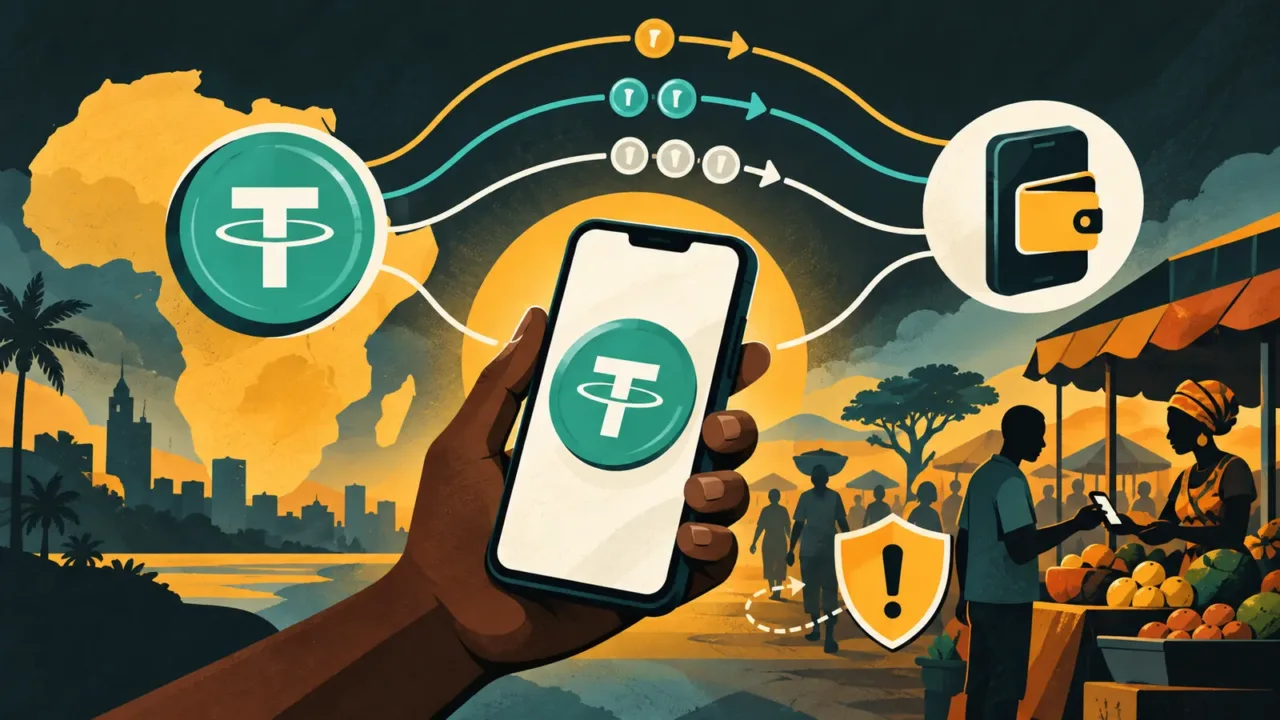
The process is similar to the one described in our guide to buying cryptocurrencies with Mobile Money: the user selects an amount, pays from their mobile wallet and receives USDT on a platform or blockchain address. In practice, three intermediaries may be involved: the Mobile Money operator, the crypto platform and, on a peer-to-peer marketplace, the seller.
USDT aims to maintain a value close to one US dollar. It is neither a dollar bank deposit nor a guarantee that it can be converted at a central bank’s official rate. Its price in local currency often includes a premium linked to currency availability, market liquidity and the risk taken by the seller.
The first decision concerns the channel. A platform that directly supports mobile payments makes the transaction easier, but usually applies its own exchange rate. A P2P marketplace connects the buyer with a seller and temporarily locks the USDT in escrow. P2P can offer more choice, but requires users to check the seller’s profile, limits, order count and quoted rate.
Check the total price before confirming
The amount shown in USDT is not enough. The right metric is the effective cost of one USDT, calculated as follows: the amount debited in local currency divided by the net amount received. If 62,000 FCFA is debited and 96.5 USDT actually arrives, the effective cost is approximately 642.49 FCFA per USDT.
This figure should then be compared with the reference rate available on the same day. The difference represents the spread. Mobile Money deposit fees, P2P commissions, platform withdrawal fees and blockchain network fees may also apply. An offer advertised as “fee-free” may therefore still be more expensive if its exchange rate is unfavorable.
Conditions vary significantly from one country to another. The practices described in our reports on crypto in Senegal and crypto in Côte d’Ivoire should not automatically be applied to Kenya, Nigeria or Cameroon. Payment methods, platform availability and local rules differ.
Choose the right network to receive USDT
USDT exists on several blockchains. A TRON address is not an Ethereum address, even though both represent the same economic asset. The network selected for a withdrawal must exactly match the network supported by the receiving wallet.
Before making a first transfer, it is wise to check four things: the network name, the address format, the minimum amount and fixed fees. A small test transaction limits the consequences of an error. Copying an address from the transaction history without checking it again also creates exposure to malware that replaces clipboard addresses.
The cheapest network is not always the most suitable. Users must consider wallet compatibility, the liquidity available for a future withdrawal and the recipient’s ability to return the funds on the same network. USDT that is difficult to resell locally may cost more to convert than a slightly more expensive initial transfer.
Cash out USDT to Mobile Money
The withdrawal process follows the reverse path. On a P2P marketplace, the user posts or accepts a sell offer, receives a Mobile Money payment and then releases the locked USDT. Funds should be released only after the balance has been verified in the operator’s official app—not on the basis of an SMS, screenshot or message from the buyer.
The payer’s name must comply with the platform’s rules. Third-party payments can complicate a dispute. Users should also retain the transaction ID, the conversation within the platform interface and proof of the amount received. Leaving the platform’s messaging system often reduces the protection provided by its dispute mechanism.
Liquidity varies depending on the time and amount. Splitting a very large sum may improve execution, but it also multiplies fees and counterparties. Conversely, accepting an unusually attractive offer increases the risk of fraudulent or reversible payment.
Risks to check before every transaction
The first risk is impersonation. A fake customer-support representative may ask for a seed phrase, one-time code or remote approval. No legitimate intermediary should receive a wallet recovery phrase. The second risk is choosing the wrong network, which can make recovery impossible or costly.
The third risk concerns custody. Keeping all USDT on a platform over the long term means relying on its security, solvency and withdrawal terms. Holding the keys personally reduces this counterparty risk, but transfers full responsibility for backup and security to the user. Our guide to securing cryptocurrencies explains this distinction in detail.
Finally, stablecoins carry their own risks: a temporary loss of the peg, address freezes, regulatory changes and dependence on the issuer. The GSMA records more than one billion registered Mobile Money accounts in sub-Saharan Africa, which explains the channel’s appeal. However, its scale does not turn a crypto transaction into a guaranteed bank payment.
Key takeaways
- Compare the effective cost per USDT, not just the advertised commission.
- Check the network, address and received payment before releasing the funds.
- Adapt the method to the country, local liquidity and acceptable level of risk.
USDT and Mobile Money address a practical need for conversion and transfers. The process becomes safer when each step is checked separately: the platform’s identity, total cost, blockchain network, proof of payment and custody solution.