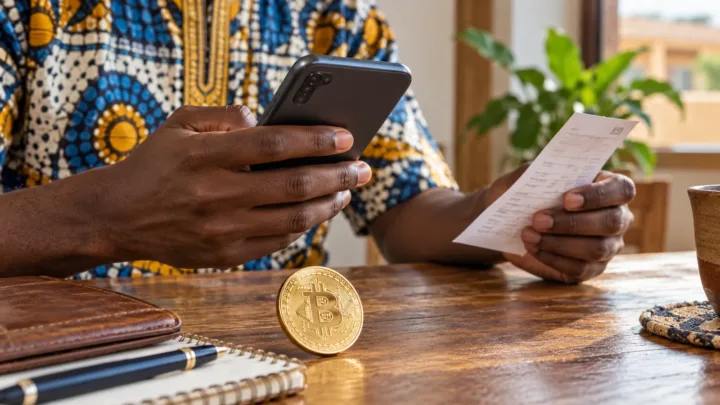
The process should clearly state a price in XOF, the exact asset and a compatible destination. You must then track both the payment and the credit without repeating an order that has already been debited. This guide organizes those checks and the potential claims process. No seller or individual account has been tested for readers, and the cost examples remain fictional.
In brief
- The Moov Money wallet and the account receiving USDT are covered by two different services.
- A process described as “crypto” may initially credit another token: check the quote’s final result.
- The net price, network and references for both stages must be checked before approval.
Distinguishing Moov Money balances from USDT tokens
Our guide to buying crypto with Mobile Money explains why two balances do not automatically come with the same protections. The mobile balance is used for monetary payments, while the token moves through another system. An offer that accepts Moov as a payment method does not prove that the wallet issuer holds or refunds USDT purchased from a third party.
The general terms for the Moov Money Benin service identify the issuer and the electronic-money account. This contractual relationship is not a general promise to hold cryptoassets in custody. You must therefore separately identify the provider receiving the XOF and the party delivering the tokens. Their names may appear on two different receipts.
The BCEAO list of electronic-money institutions provides another reference for the payment side. It does not confirm all authorizations held by a crypto platform that uses this payment method. Readers should keep evidence separated by service and avoid transferring the reputation of a known issuer to an unknown counterparty. This distinction is especially important for offers shared on social media.
A personal USDT wallet also requires a receiving network. A Moov number does not replace that address, and a blockchain address does not become a mobile-payment number. If the seller mixes the two in its instructions, asking for a clear description of the process can prevent an error. The simplicity users want should not come at the cost of essential information.
The context provided by the crypto landscape in Benin helps clarify the obligations of professionals. A seller that regularly converts funds for clients must assess its own status. Using Mobile Money does not automatically authorize that business. For individuals, understanding this limitation makes it possible to request evidence without confusing a successful payment with a confirmed regulated service.
Reviewing the proposed process before sending funds
Two main models may be available: an integrated order and a P2P listing. The first organizes payment and credit within a commercial process; the second involves a seller whose terms must be reviewed. Readers should know the dispute procedure and the identity of the beneficiary in the process actually being used. A generic tutorial is not enough to make the two transactions equivalent.
Binance’s Mobile Money documentation mentions Moov and XOF for Benin, but describes a credit that may involve USDC. This detail makes it impossible to promise USDT without checking the confirmation screen. If an additional conversion is required, it introduces another quote and potential fees. The desired outcome must remain clear through the final step.
For a P2P listing, check the minimum amount, maximum amount, price, payment method and seller’s terms. A verified account does not eliminate every risk. Requests to pay a third party or leave the official conversation make disputes harder to resolve. A better exchange rate may conceal the loss of the evidence mechanisms that make a claim possible.
The Moov account holder and the person placing the order must meet the process’s identity requirements. A payment made by someone else may require special handling or be refused. Do not solve this problem with a false declaration. The guides on KYC checks and remedies explain how to prepare consistent information using only genuine channels.
Before confirming, save the dated quote and the key terms. The price may depend on current liquidity, while limits may vary by account. A previously successful transaction does not guarantee that the same service is available today. If an expected feature is missing, requesting a documented explanation is safer than sending a payment to a number received outside the order.
Comparing the cost through to the USDT available at the destination
The reference amount must cover all XOF debited. The reference quantity must match the USDT actually delivered to the selected network and account. Our guide to crypto costs in Africa shows why this formula makes it possible to compare processes presented in different ways. A zero fee at one stage does not necessarily mean zero total cost.
Suppose, in a fictional example, that 40 000 XOF pays for an order of 64 USDT. A separate monetary fee of 400 XOF brings the total debit to 40 400. The withdrawal then deducts 1 USDT, leaving 63 units in the wallet. Each USDT delivered costs approximately 641.27 XOF. This is neither a current exchange rate nor an official tariff from Moov or any platform.
A second fictional quote could require 40 800 XOF, including all fees, to deliver 64 USDT to the same destination. Its net price would be 637.50 XOF. In this case, the reader pays slightly more to receive more usable units. Comparing only the 40 000 XOF displayed at the start would lead to the opposite conclusion. The final quantity must therefore remain visible in the calculation.
The public Moov Money fee schedule distinguishes transfers, withdrawals and other services. It does not justify assuming the same charge for every crypto purchase. An integrated payment may follow a different mechanism from a transfer between individuals. Check what the quote includes, then add only the fees that actually apply to avoid overstating the cost through double counting.
If a USDC-to-USDT conversion is involved, record the amount before and after the conversion. The effective price may change between the initial payment and the conversion. For a need denominated in XOF, the dollar’s value and resale conditions introduce another uncertainty. A stablecoin does not eliminate local exchange rates or the seller’s liquidity premium. The budget should reflect the economic result, not just the token’s intended stability.
Checking the network and tracking a debit without a credit
The withdrawal network must match the recipient’s network. Tether’s protocol documentation helps review official issuances, but the receiving wallet or exchange also determines which networks it accepts. A similar-looking address does not guarantee compatibility. The network must be selected before sending, since recovery may be difficult or impossible depending on the destination.
For a self-custody wallet, also check the resources required for a later transfer. Depending on the network, users may need a native asset or specific resources to pay for execution. Receiving USDT therefore does not always mean being able to send it immediately. Our wallet security guide helps users prepare backups and retain control of their keys without handing them to the seller.
If Moov debits the account without a crypto credit, start by matching the two transaction histories. Record the payment reference, order reference, times and statuses. A frozen screen may conceal a transaction that is still processing. Paying again immediately could create a second debit. Follow the procedure provided for the order when filing a claim, clearly describing which part of the process was not completed.
A payment receipt and a blockchain transaction ID prove different things. The first documents the monetary transaction; the second makes it possible to examine a broadcast token transfer. If no transfer has left the platform, a blockchain explorer will not resolve the payment reconciliation issue. Support should examine the evidence from the system concerned rather than asking the reader to guess where the process failed.
Secret codes do not belong in a claims file. Support may request an amount, date or reference, but not the means to empty the mobile account or wallet. Hide sensitive information in screenshots. If someone demands a private payment to “activate” the tokens or “unlock” a receipt, end the exchange and verify the request through another official channel.
Preparing for resale, limits and proof of origin
The purchase is not the end of the analysis if the ultimate goal is to obtain XOF. Request an exit quote, its limits and the net amount credited to the Moov account or another authorized destination. The buy-sell spread can absorb a significant share of a small transfer. A subsequent cash withdrawal adds a cost and a local availability constraint that the digital balance does not show.
The terms for redemption with the USDT issuer should not be confused with a local sale to an intermediary. The intended dollar peg does not promise an unconditional refund to every holder in Benin. Readers often depend on the liquidity and contract governing their exit process. These points should be checked before using the token for an urgent expense or professional commitment.
Regulatory and operational limits must be read together with their dates. The new BCEAO instruction published in October 2026 provides for later application in November; it does not guarantee an immediate change to every account limit. The service may request an identity update. Following the official procedure is preferable to opening multiple accounts or arranging payments intended to avoid a check.
Keep a record of the transaction: XOF debit, any intermediary credit, conversion, network, withdrawal and resale. The quantities should allow reconciliation without counting a transfer between your own accounts twice. The file makes it easier to calculate fees and respond to a legitimate request for supporting documents. It does not replace tax advice tailored to your residence and the nature of the activity.
USDT with Moov Money in Benin should therefore result in a verifiable outcome, not merely a payment notification. The full chain connects an identified beneficiary, a net quantity and a compatible network. If any of these elements remains uncertain, pausing the order offers more protection than repeating the debit. The simplest process is the one whose every step the user can explain and whose every piece of evidence can be retrieved.