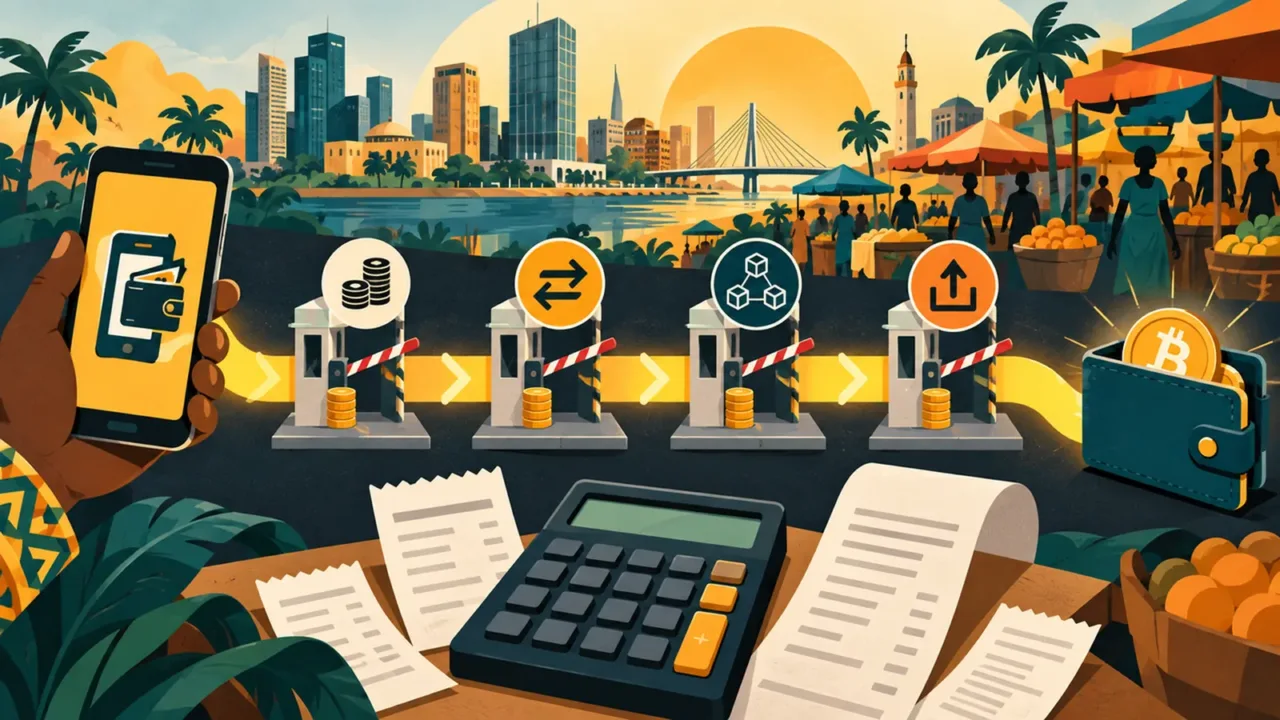
The six costs of buying crypto
The process outlined in our guide to buying crypto with Mobile Money involves several layers. The first is the cost of the payment method: deposits, transfers or cash withdrawals. The second is the conversion between the local currency and the dollar when the crypto price is quoted in USD.
The third is the spread — the difference between the buying and selling prices offered at the same time. The fourth is the explicit fee charged by the platform or P2P seller. The fifth is the withdrawal fee. The sixth is the cost of the blockchain network, which may be included in the withdrawal fee or charged separately.
These costs are not always visible on the same screen. An app may advertise zero commission while building its margin into the exchange rate. Another may offer a favorable price but impose a fixed withdrawal fee that penalizes small transactions.
Calculating the effective price per unit
The most useful formula is straightforward: total amount debited divided by the net quantity received. If a user pays 100 000 FCFA and receives 0,00178 BTC in their own wallet, their effective price is approximately 56,18 million FCFA per bitcoin.
This result should be compared with the benchmark price at the same time, converted using a consistent exchange rate. The percentage difference measures the overall premium. It makes it possible to compare two services even when one charges a percentage and the other a fixed amount.
The calculation is the same for a stablecoin. If 65 000 FCFA buys 98 USDT net, each USDT costs 663,27 FCFA. The official dollar/FCFA exchange rate is not enough to draw a conclusion: local liquidity and the practical ability to obtain that rate through an accessible channel must also be considered.
Mobile Money, cards and bank transfers
Mobile Money is fast and widely available, but the cost depends on the operator, account level and amount. A transfer to a P2P seller may also use up part of the daily limits. The GSMA documents the scale of Mobile Money in sub-Saharan Africa, but it does not certify the crypto intermediaries using this channel.
Bank cards can sometimes simplify direct purchases, but they may include international fees, currency conversion costs and an acquirer commission. Bank transfers are often cheaper for larger amounts, at the cost of longer processing times and additional banking requirements.
The best payment method therefore depends on the amount. A fixed fee weighs heavily on a 10 000 FCFA purchase and becomes marginal at 500 000 FCFA. A percentage-based fee has the opposite effect.
P2P spreads vary by country
On a P2P marketplace, each advertiser sets their own rate, limits and conditions. The price reflects the availability of the local currency, demand for stablecoins, fraud risk and the speed of the payment method.
The markets covered in our articles on crypto in Nigeria and crypto in Kenya do not have the same currencies or infrastructure. Comparing a spread in naira with one in shillings without taking the foreign-exchange market into account can lead to a misleading conclusion.
The advertised rate must also be distinguished from the executable rate. A highly attractive offer may have a low limit, require a specific type of account or provide only a small quantity. The order book actually available around the desired amount is more relevant than the first listing on the page.
Withdrawals and network selection
Withdrawing to a personal wallet gives users greater control over their assets, but it adds a cost. Some platforms charge a fixed amount that exceeds the network’s actual fee. For a small purchase, temporarily leaving the funds on the platform can avoid several withdrawals, while increasing counterparty risk.
The selected network must be compatible with both the wallet and the off-ramp service. A wrapped token or stablecoin on a blockchain that is little used locally may cost less to receive but more to convert back. Users should check the symbol, token contract and blockchain — not just the commercial name.
Our guide to crypto wallets explains the difference between keeping assets on a platform and having direct control of the keys.
Compare offers using a standard table
For each service, it is useful to record the amount debited, quantity purchased, quantity received after withdrawal, processing time, network, benchmark price and immediate resale value. The latter reveals the round-trip cost, which is often more informative than the entry cost alone.
Suppose two offers are available for 100 000 FCFA. The first delivers 151 USDT to the platform and then charges 3 USDT for the withdrawal: 148 USDT net. The second delivers 149,5 USDT and charges 0,5 USDT: 149 USDT net. The first looks better before withdrawal, while the second is better after the transaction is completed.
A history of several purchases can also help identify the times or days when liquidity is better. However, an urgent transaction should not be delayed solely to save a fraction of a percentage point if price risk becomes greater.
Key takeaways
- Calculate the cost using the amount debited and the net quantity received.
- Factor in the spread, payment method, withdrawal and network.
- Compare complete transactions for the same amount and country.
The platform that looks cheapest in an advertisement is not necessarily the cheapest once the funds reach the final wallet. A standardized calculation, kept alongside supporting documents, makes comparisons more reliable and also helps with tax tracking.