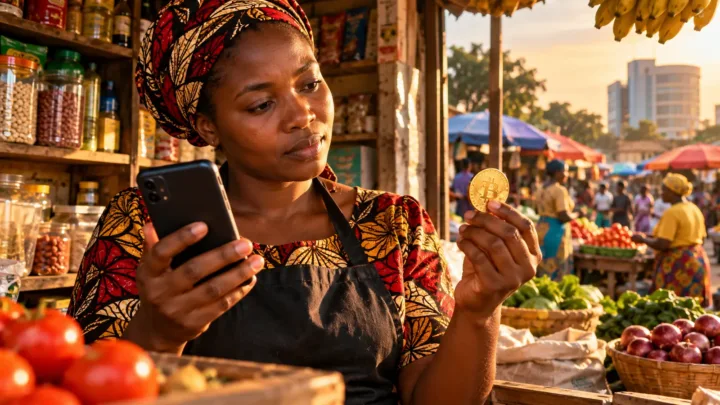
This guide explains units, theoretical conversion into MWK, keys and transaction proofs. It does not recommend any local platform or provide a current price. Technical knowledge does not replace checking service terms, foreign-exchange rules and the rights actually available to the holder.
In brief
- A fraction of bitcoin uses the same asset; its smaller decimal notation does not give it a different status.
- The economic price depends on the net amount received and all the kwacha spent.
- An application balance, a private key and an on-chain transaction are different types of information.
Bitcoin in Malawi: start by understanding key control
A wallet does not contain coins in a physical sense. Our guide to crypto wallets and their functions explains the role of signing mechanisms. The ledger tracks movements, while keys produce the technical authorizations required, depending on the type of wallet used.
With a custodial platform, users generally request that the company make a transfer. With a personal wallet, they take more direct responsibility for backups and checking destinations. These models do not distribute risk in the same way. An interface’s simplicity does not, by itself, reveal the underlying model.
Bitcoin.org’s guidance on essential precautions highlights volatility and the caution required for payments. It describes general technical features, not any specific right to offer a service in Malawi. Readers should maintain this distinction when moving from learning to an actual transaction.
The first practical question is therefore who can move the funds. A service may display an address without giving the customer control of the keys. Conversely, possessing a backup does not guarantee that it was created and protected correctly. The procedure should be understood before entrusting it with a significant amount.
A teaching demonstration does not require handing over secrets to an instructor. Anyone asking for a recovery phrase to check a wallet could obtain the means to control the assets. Support should explain the concepts without requesting information that authorizes transactions by the owner.
From BTC to satoshis, then to kwacha
One bitcoin is divisible into 100 million satoshis. An amount of 0.0004 BTC therefore represents 40,000 satoshis. It is not a copy of Bitcoin or a separate token. Changing units changes how the amount is displayed, not the network rules to which it relates.
To create a kwacha reference, combine a BTC-to-dollar price with an MWK-to-dollar exchange rate. For this exercise only, assume 50,000 dollars per BTC and 2,000 MWK per dollar. The reference value would reach 100,000,000 MWK per BTC, or 40,000 MWK for 0.0004 BTC.
These assumptions are not a current quote. They are intended to make the calculation verifiable. An official rate, an application estimate and a commercial offer should not be silently mixed in the same comparison. Their date, nature and access conditions may differ.
Our method for calculating the full cost of a crypto purchase adds another question: how much money actually leaves the account? If a hypothetical expense of 44,000 MWK results in 0.0004 BTC available, the economic cost reaches 110,000,000 MWK per BTC. The division highlights the difference from the earlier reference.
This difference, on its own, does not justify accusing a provider. It must be explained: a margin, payment fee, commission or withdrawal charge may be involved. A proper record does more than note a gap; it identifies the conditions that produced it and whether they were disclosed before payment.
Understanding a decline without confusing quantity and value
Holding the same quantity does not guarantee the same purchasing power. In the previous example, a fall in BTC from 50,000 to 40,000 dollars represents 20%. With the exchange rate held constant for the demonstration, 0.0004 BTC would then represent a reference value of just 32,000 MWK.
The number of satoshis has not changed. This distinction helps explain why a wallet can show the same quantity while displaying a different monetary value. It also prevents a price decline from being mistaken for theft or an invisible fee without examining the data.
Currency movements can amplify or reduce the change expressed in kwacha. If both variables move at the same time, the result cannot be derived from the BTC-dollar percentage alone. Tracking should preserve both reference points and their dates, then compare values in the currency actually relevant to the intended spending.
A strategy based on a certain short-term repayment must account for this variability. An invoice set in MWK does not automatically decrease when Bitcoin falls. Committing its amount to a volatile asset can therefore create a shortfall at settlement, even when the technology is working normally.
The size of the fraction does not reduce the proportional market risk. A small amount experiences the same percentage change as a large one, all else being equal. Fixed fees, however, can weigh more heavily on a small amount. These two effects must be separated to avoid misleading comparisons.
Read a transaction instead of relying on a screenshot
A public transaction can be examined using its identifier and outputs. The relevant details for the case at hand should be checked, particularly the destination and expected amount. A real identifier may correspond to another operation; its existence does not automatically prove that the user was paid.
The status shown by a service also depends on its validation rules. Network confirmations and a platform’s internal conditions do not answer exactly the same question. No universal crediting time should be promised based on a single experience or a marketing message.
On a custodial system, some customer-to-customer transfers may be recorded in the service’s accounts without generating an individual public transaction. This should be explained honestly. A blockchain identifier should not be invented to give an internal movement the appearance of stronger proof.
The guide to mobile-money payments and crypto details another risk of confusion. A kwacha payment receipt documents the first leg of the process. The delivery of BTC is a separate step. The record should connect the two without presenting the mobile operator as an implicit guarantor of an independent seller.
In the event of a dispute, keep the references, terms and correspondence in the designated channels. Posting account information in a group can attract fake support agents. Supporting documents should show the problem without giving a stranger the means to move the remaining assets.
Organize custody around your actual capabilities
Bitcoin.org’s wallet-security documentation provides useful principles for backups and caution. Their application nevertheless depends on the model chosen and the owner’s skills. Buying a specialized device does not replace understanding the recovery process.
A backup must remain accessible to the rightful owner while staying secret from others. Keeping it only on the phone used every day can create a single point of failure. Duplicating it without a method, on the other hand, can increase the number of places where it may be copied or lost.
Sharing within a family requires the same consideration. A relative may need to know that instructions exist in case the holder becomes unable to act, without immediately receiving all the secrets. Continuity should be prepared within an appropriate framework, not improvised by sending a photograph of the backup into a group chat.
Choosing a custodian instead requires reviewing the contract and available recourse. Our overview of crypto platforms and their criteria helps identify who is responsible for the account. Reputation proves neither Malawian authorization nor the permanent availability of withdrawals.
Self-custody does not resolve every legal question either. It describes technical control. On its own, it does not determine the compliance of an acquisition, commercial service or international transfer. A wallet characteristic should not be treated as a general authorization to operate.
Connecting learning with Malawi’s regulatory framework
The RBM strategy for 2026–2030 includes work relating to virtual assets and their providers. Such a timetable should be read as a reform program, not proof that a company already holds the necessary authorizations. The identity of the operator and the nature of the product remain essential.
A service may also request documents concerning residency and the source of funds. Our guide to KYC and recourse options helps users prepare consistent information. Lending an account or falsely claiming residency complicates the situation rather than securing a later exit.
This guide is based on documentary research conducted on October 20, 2026. No local purchase, withdrawal or authenticated price was tested. It therefore does not recommend a commercial route or promise any particular tax treatment. The numerical examples remain exercises, separate from actual market conditions.
To understand Bitcoin in Malawi, the useful endpoint is being able to explain the quantity held, its net price, who can move it and what evidence is available. If one of these answers is missing, the next step is further verification or learning, not a rushed payment.