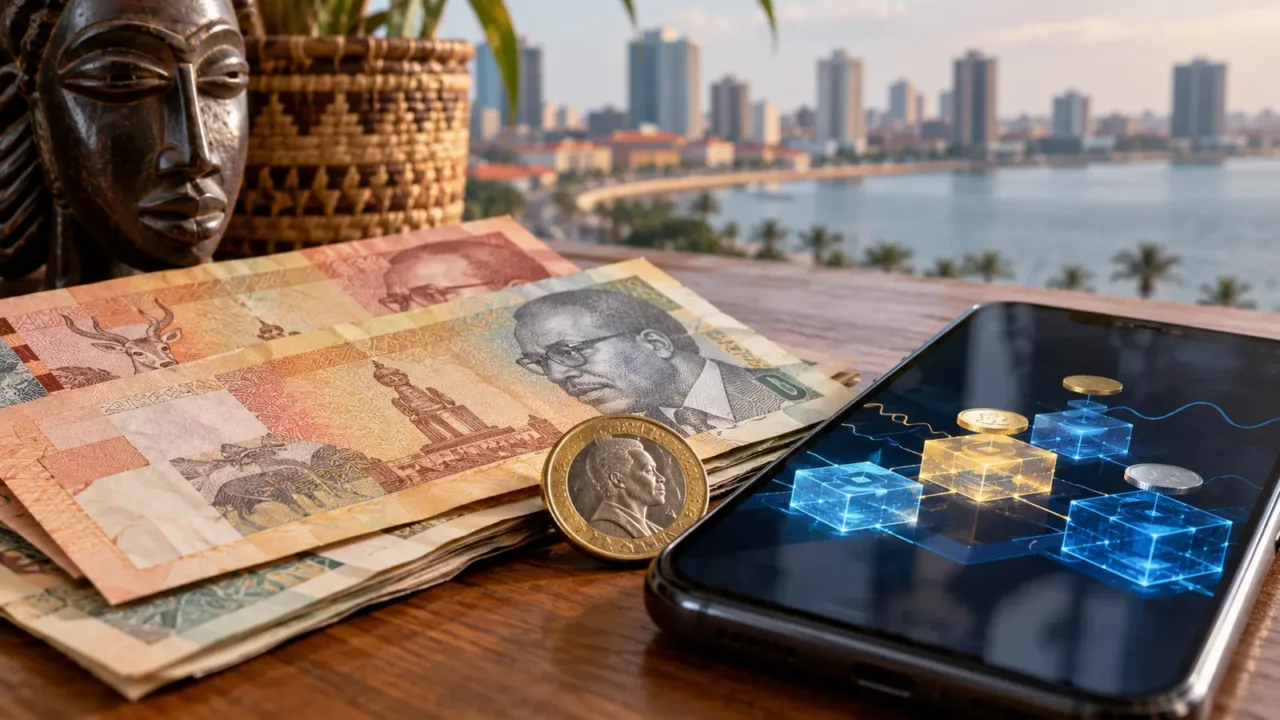
Before treating a stablecoin as a store of value or a means of transfer, five distinct layers need to be examined: the reference asset, reserves, redemption rights, the underlying network and the local exit channel. For holders in Angola, this also includes the exchange rate against the kwanza and the rules applicable to virtual-asset service providers.
In brief
- A targeted dollar peg does not guarantee that every user can redeem the token immediately for one dollar.
- Reserves, the issuer, blockchain, custodian and local market each create different risks.
- Angolan law distinguishes between the prohibition on mining and the supervision of service providers.
Stablecoins in Angola: what the peg actually targets
The overview of crypto in Angola provides the local context; the following analysis examines the risks specific to tokens and their issuers.
A dollar-pegged stablecoin seeks to maintain a value close to one dollar. Bref Crypto’s guide to crypto purchase and conversion fees helps show why a token’s stability does not guarantee a favorable exit rate. Depending on the model, the issuer may hold reserves, use digital collateral or adjust supply through market mechanisms. The models are therefore not all alike. Even a highly liquid token can temporarily trade above or below its reference value.
The price on a platform is a secondary-market price between buyers and sellers. Redemption by the issuer is a separate relationship, governed by contractual terms and sometimes limited to verified customers or large amounts. As a result, a holder may not have a direct right to convert every unit into fiat currency. The official Tether terms page explains that purchases and redemptions are subject to account and compliance requirements, and that minimums and fees may apply.
This distinction is crucial for anyone who reads “1 USDT = 1 USD” as a bank guarantee. The issuer is not necessarily a deposit-taking bank, the token is not legal tender, and holders do not automatically receive the protections that apply to covered deposits. A study by the Bank for International Settlements’ Financial Stability Institute examines measures intended to preserve the peg, including reserve management and redemption rights. Its conclusions reflect the analysis of its authors.
A stablecoin can therefore maintain its target value for years and still remain vulnerable to a rare event: a loss of confidence, difficulties at a custodian, a technical suspension, a regulatory change or a mass sell-off. Past performance does not ensure identical behavior under future stress. Sound analysis distinguishes normal operation from a stress scenario.
Assessing reserves and redemption rights
The word “reserved” is not enough to establish the quality of a mechanism. It is necessary to examine the composition of the assets, their liquidity, the custodian, the frequency of disclosures, the scope of an attestation and the legal risks surrounding access. A periodic attestation is not always equivalent to a full audit, and a reserve table does not prove that every user can request a direct redemption.
The transparency information published by Tether describes reserves and tokens in circulation according to the issuer’s methodology. To use this data, readers must check its date and scope and distinguish it from a public guarantee. An issuer may also change its terms, list of supported networks or service procedures.
Redemption terms matter just as much as reserves. Tether’s fee page states that direct redemptions require a high minimum, prior verification and fees that may be changed. This means a small holder trading on the secondary market should not assume they can go directly to the issuer and recover dollars. They may depend on a platform, market maker or individual, each carrying its own counterparty risk.
It is also important to know who controls the account. A custodial wallet can be frozen or made subject to the platform’s terms. A self-custodial wallet gives its holder greater technical control, but it does not create a redemption right and places responsibility for backup and recovery on the user. Bref Crypto’s guide to how wallets work explains the difference between third-party custody and control of the keys. Its platform assessment methodology complements the review of counterparty risk.
Network risk remains separate from issuer risk
The same asset can exist on several blockchains. The token’s name may be identical, but the networks, contracts, fees, compatible wallets and confirmation rules differ. Choosing the wrong network or address can make funds difficult or even impossible to recover. Confirmation on the chain does not guarantee that a platform will subsequently credit the account.
A bridge between networks adds another layer of risk. It may depend on smart contracts, validators or a custodial mechanism. A bridge failure or vulnerability does not necessarily mean that the stablecoin issuer is insolvent, but the result for the user may still be a loss of access. Asset risk, network risk and transfer-tool risk must therefore be kept separate.
Fees vary with congestion. Some networks require a native asset to pay transfer costs; a wallet holding only stablecoins may not contain the token needed to pay the fee. Other services offer fee-free internal withdrawals, but shift trust toward the operator. An instant transfer displayed on screen may remain a movement within a private database rather than public settlement on the blockchain.
Practical details should come from official technical documentation, not from a message sent by an improvised support account. Issuer documentation often specifies the networks on which the token is officially issued or redeemed. An address received through messaging is not proof of authenticity. Verify the token contract through a reliable source and never share your recovery phrase.
A dollar stablecoin does not protect against AOA exchange-rate risk
For a resident who thinks in kwanzas, a dollar-pegged token adds exposure to the US dollar. Its local value depends on the USD/AOA exchange rate and the spread available when converting back into the national currency. Even if the stablecoin remains exactly close to one dollar, an exchange-rate movement can change its value in AOA.
The BNA reference rate helps track the monetary context, but it does not automatically set the rate for a private transaction. A bank may apply its own pricing and conditions. A platform may convert at the rate in its order book, with a margin. An informal intermediary may quote a rate without guaranteeing settlement. The BNA converter provides a public reference, not a commitment to buy or sell stablecoins.
Risk calculations should therefore use the achievable exit amount, not just the theoretical value. For the same portfolio, record the reference rate, the actual purchase price, the rate effectively obtained on resale, network fees, commissions and withdrawal time. If the local channel has no counterparty, the estimated value is not available liquidity.
Diversifying across several stablecoins does not eliminate these risks if they all depend on the same issuer, platform or network. Splitting tokens across multiple wallets may reduce certain operational risks, but it does not protect against a common reserve failure or legal prohibition.
Angolan rules: mining and services are not the same thing
In Angola, Law No. 3/24 prohibits the mining of cryptocurrencies and other virtual assets and establishes offenses related to the use of equipment and electricity for that purpose. The text is available on the CMC legislative register. This prohibition should not be extended without analysis to every stablecoin-related activity, but it is a reminder that a blockchain transaction does not exempt anyone from examining local law.
Law No. 11/24 strengthened the rules applicable to virtual-asset service providers within the anti-money-laundering framework. It gives the BNA supervisory authority over cryptocurrencies and the CMC authority over other virtual assets, requires customer identification and refers to the authorization or registration of service providers. The version published by the UIF can be used to verify the text.
The CMC’s 2026 regulatory agenda places in the fourth quarter a regulation specifying the obligations and rules applicable to these providers. The agenda helps track the timetable, but only a published and effective regulation establishes the final rules. To assess an operator’s authorization, identify its legal entity, the exact service and the territory involved, then check current regulatory announcements. A stablecoin known worldwide does not exempt its local intermediary from the applicable rules.
This caution is consistent with Bref Crypto’s guide to KYC, data and remedies. An identification request may result from a provider’s legal obligations, but customers should check who is collecting their documents, how they are protected and where to challenge a decision.
A decision framework that does not promise safety
Before treating a stablecoin as a substitute for readily available money, answer these questions: Who issues the token? Which currency serves as the reference? What reserves are reported, and what date appears on the latest report? Who can redeem directly, and what minimum applies? Is the network being used officially supported? What counterparty enables an exit into AOA? What fees or delays apply?
Then add a question about law and responsibility: Which provider is involved, which entity is the contracting party and which regulator supervises the activity in Angola? If the answer comes only from an advertisement, influencer or Telegram screenshot, it does not constitute verification. Bref Crypto’s platform assessment guide provides a practical checklist to adapt to this research.
A yield offered on stablecoins is not risk-free interest. It may reflect lending, staking, a market strategy, exposure to a protocol or simply an operator’s promise. Ask where the assets will be placed, who bears the losses, whether withdrawals can be suspended and what legal guarantee exists. If the promoter refuses to explain the source of the yield, the risk does not disappear; it simply becomes harder to measure.
Stablecoins can facilitate certain digital operations and reduce friction in particular situations. They do not guarantee a peg at all times, conversion into kwanza or access to a remedy. As regulations and markets evolve, verification must be dated. For a specific financial or legal decision, seek advice from a qualified professional in Angola rather than treating a general guide as authorization.