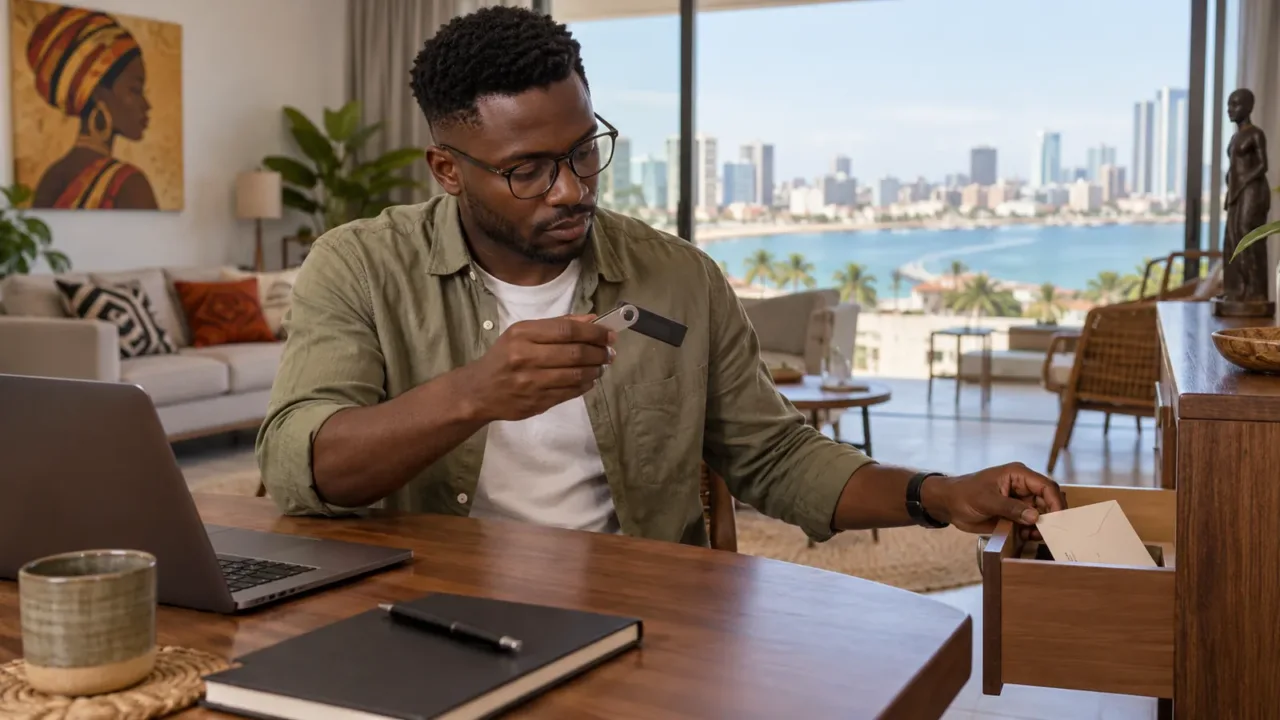
Before choosing a tool, you need to understand where the keys are held, who can use them, what happens if the phone disappears, and how a relative could act in an emergency. A sound approach prioritizes understanding and security over an application presented as foolproof.
In brief
- A custodial wallet entrusts custody to a service provider; a self-custody wallet gives the user control of the keys.
- The recovery phrase must remain secret and offline; legitimate support will never ask for it.
- A poorly designed backup, lost key or network error can make funds irretrievable.
Bitcoin wallets in Angola: understanding the role of keys
The general guide to crypto in Angola outlines the local issues. Wallet security also depends on a technical mechanism shared by all Bitcoin users: control of the keys.
A Bitcoin wallet organizes keys and prepares transactions. Bref Crypto’s guide to how wallets work distinguishes between custody by a service and personal control. The bitcoins remain recorded on the blockchain; the wallet contains the cryptographic tools used to prove control of addresses and authorize spending. The application therefore does not physically “store” the units like a file on a phone.
Bitcoin.org’s technical guide to wallets distinguishes solutions with different trade-offs. Some hold keys with an online service, while others keep them on a personal device or specialized hardware. A custodial wallet can simplify login and account recovery, but the user depends on the provider. A self-custody wallet reduces that operational dependence while increasing personal responsibility.
Avoid choosing solely on the basis of an advertisement, sponsored ranking or familiar interface. Check who develops the software, whether it is maintained, which platforms it supports, how it backs up keys, and whether its documentation explains the security model. Also look for independent security alerts and the ability to restore a wallet without entering the phrase on a website.
An application can be genuine and still be unsuitable for a particular use. A beginner holding a significant amount on an old phone does not face the same risks as an experienced user with a tested backup procedure. The right choice depends on the amount, frequency of use, experience, device availability and ability to follow a procedure without rushing.
The private key authorizes spending
A private key is a cryptographic secret. Whoever possesses it can often sign a transaction spending the funds without obtaining a password confirmation from the person who created it. That is why a recovery phrase, key file or digital backup must be treated as a sensitive asset.
No support service should ask for the phrase to “validate” a wallet, speed up a withdrawal or repair an account. A website that requests the phrase after imitating a wallet’s interface may be trying to take control of the funds. Screenshots, cloud notes, messages sent to yourself and automatically synced photos can expose the phrase if an account or device is compromised.
A phrase should never be entered into a form reached through a link, or shared by phone or messaging app. If restoration is necessary, open the verified official application yourself and follow its documentation. Support may ask for public transaction details to diagnose a problem; that does not justify handing over the keys. Bref Crypto’s guide to wallet operation and security explains the difference between account access and control of the keys.
It is also sensible to separate everyday transactions from long-term storage. A connected mobile wallet makes transactions convenient but remains exposed to the phone, malicious applications and user errors. Offline storage reduces certain online threats without eliminating the risk of physical loss or a faulty backup. No method removes every risk.
Back up without creating a new weak point
A backup restores access if the device is lost or damaged. To be useful, it must remain legible, complete, durable and accessible to the right person. A sheet of paper can withstand a computer failure, but it can burn, get wet or be photographed. Metal storage withstands some forms of damage better, but it does not protect against theft or copying errors.
Two copies reduce the risk of a single point of loss, but they also create two locations to protect. Keep them in separate, secure places without publicly identifying their contents. Not writing “Bitcoin” on an easily recognizable envelope may limit unnecessary exposure, but it is not sufficient protection against people with access to the home. Security depends on the threat being considered.
Testing a restoration with no funds at stake before depositing a significant amount can prevent discovering too late that the phrase contains an error or that the chosen wallet does not support the same derivation path. The test should be performed on a trusted device and according to the documentation, without publishing the phrase or entering it into an online service. A well-understood restoration procedure is more useful than a backup that nobody knows how to use.
An additional phrase, sometimes called a passphrase, can add a layer of separation, but it introduces another secret. Forgetting it can prevent restoration; storing it in the same place as the main phrase can reduce its benefit. It should not be added simply because it is fashionable, nor should a technical procedure be copied without fully understanding it. Advanced security features must be documented and tested before any real-world use.
For significant amounts, a multisignature setup can distribute spending power among several keys or devices. However, it makes configuration, backup and handover more complicated. If one key is lost and the required threshold can no longer be reached, the funds may remain locked. A more complex solution becomes safer only when its operators understand the recovery process.
Prepare a relative’s access without handing over the secret today
Estate planning involves two competing needs: avoiding permanent loss and not giving immediate access to someone who does not need it. Writing a phrase in plain text in a will accessible to several people can expose the funds. Documenting nothing can make the assets impossible to find. The inventory, the existence of a backup and the secret that enables spending must therefore be kept separate.
A plan can record that a wallet exists, identify the devices or tools used, indicate where a sealed instruction is kept and name a professional to contact, without placing the complete key in an ordinary document. It can also explain which funds are held by a custodial provider and which are in a personal wallet. A trusted person should know where to find the instructions without gaining premature access to the secret.
Multisignature procedures and secret-sharing mechanisms require appropriate advice. Some methods distribute restoration capability among several people; they provide resilience only if those responsible can be reached and the instructions remain understandable. A change of country, phone or family circumstances can make an old procedure unusable.
Inheritance issues also involve civil law, succession rules, heir identification and any applicable tax obligations. Owning a key does not automatically settle the administration of an estate. An Angolan notary or lawyer can help organize the documents without placing the secrets directly in an open file. Bref Crypto’s guide to KYC and legal recourse provides additional context on account-related documents, but does not replace local advice.
Identify the main threats and maintain a security routine
Losses often result from a combination of factors rather than a single spectacular hack: a compromised phone, imitation application, cloud backup, phrase sent to fake support, reused password or incorrect recipient. A user may also sign without understanding an authorization request, install remote-access software or approve a transaction under pressure.
Login alerts and strong authentication improve the security of a custodial account. They do not replace a backup for a self-custody wallet. Likewise, antivirus software cannot reverse a signed transfer. The custody model determines which protections make sense: passwords and support for a platform account, backups and physical security for personal keys.
A receiving address should be checked on the wallet’s screen, not only in the clipboard. Some malware replaces a copied address with one controlled by an attacker. For a significant amount, a small test transaction reduces the risk of error, but it creates fees and does not guarantee that the subsequent transfer will be correct. Always check the first and last characters as well as the network, while avoiding publicly revealing addresses linked to your identity.
Promises of recovery should also raise suspicion. A third party claiming it can recover a wallet after the phrase is lost in exchange for an upfront payment is often exploiting the victim’s distress. A confirmed transaction generally cannot be reversed by an application’s support team. Reporting the incident and protecting the remaining accounts are still essential, but nobody can guarantee a refund.
A wallet does not make an activity compliant
Technical security and legal status are separate questions. A user may control their keys correctly and still use a service whose role or authorization requires verification. Conversely, the fact that an operation is technically possible does not show that it has a legal remedy or is compliant in every context.
In Angola, Law No. 3/24 prohibits virtual-asset mining and contains provisions relating to equipment. Law No. 11/24 addresses virtual-asset service providers under the anti-money-laundering framework and provides for their supervision and authorization or registration requirements. The CMC legislative register references Law 3/24, while the text of Law 11/24 is published by the UIF.
These texts are not a personal advice manual. The framework may differ depending on whether a person holds their own keys, provides services to third parties, holds assets for clients or markets a product. A provider’s compliance obligations are not the same as those of an individual. If a professional activity or dispute is involved, advice from a local specialist is preferable to a general conclusion drawn from an article.
A simple security routine to maintain
Start by taking inventory of your wallets and devices, specifying which are custodial and which are self-managed. Check that backups exist, remain legible and are not all stored in the same place. Update your devices, use software obtained from its official source and secure the email address associated with your accounts.
Next, review the people and procedures that could be involved. A backup entrusted to a third party should include clear instructions and a way to verify the identity of the authorized person. Relatives should know that support will never ask for the recovery phrase. If those responsible change, the information must be updated.
Finally, simulate different scenarios: a lost phone, a deleted application, an unavailable responsible person, a move or a death. If the procedure depends on a single device, one password or someone who cannot be reached, it is not resilient. For the broader framework, Bref Crypto’s guide to platform criteria and custody helps distinguish the risk of the tool from that of an intermediary.
A well-managed Bitcoin wallet eliminates neither bitcoin’s volatility nor questions of law and counterparty risk. It mainly reduces avoidable errors and clarifies who can restore access. The best security is not a sophisticated secret phrase, but a simple, tested procedure understood by the people who will actually need it.