Which crypto should you buy before Bitcoin’s next halving? If the investment thesis is specifically based on a reduction in BTC issuance, Bitcoin is the asset directly affected. Choosing an altcoin instead adds another assumption: that the market’s favorable reaction will carry over to a different token whose monetary rules are unchanged by Bitcoin’s halving.
The next event is expected in 2028, not 2027, based on the network’s current parameters. This guide, prepared on November 3, 2026, distinguishes between the mechanism that is certain at a given block height and its uncertain economic consequences. Buying before the deadline guarantees neither a price increase, a better entry price nor the recovery of the amount invested.
In brief
- The next halving targets block 1,050,000; its place on the calendar remains an estimate.
- The reduction applies to newly issued bitcoins allocated per block—not to all miner revenue or bitcoins already held.
- Buying an altcoin before the event requires an independent thesis, rather than the sole belief that “everything will rise after Bitcoin.”
Understand the halving before choosing a crypto
Our guide to the block reward and the difference between the subsidy and fees helps avoid a common misunderstanding. The halving reduces the creation of new BTC included in the subsidy. Transaction fees are another component of miner compensation; they are not automatically cut in half at the same time.
The Bitcoin reference page on the halving places the next change at block 1,050,000, with the subsidy falling from 3.125 BTC to 1.5625 BTC per block. The year 2028 is an estimate based on the chain’s progress. The network does not trigger the event because a date on the civil calendar has been reached.
To illustrate the effect, assume only that 144 blocks are produced during a day. The cumulative subsidy would fall from 450 BTC to 225 BTC for the same number of blocks. This calculation does not represent a promised daily output: block discovery intervals vary. Nor does it say anything about how many bitcoins their holders might decide to sell on the markets.
This distinction changes the economic interpretation. Reducing the flow of new issuance does not halve the circulating supply, nor does it eliminate potential selling by existing holders. Demand, liquidity and holder decisions remain necessary to explain a price. A known monetary rule is therefore not enough to predict the return on a purchase made on a particular date.
Bitcoin: direct exposure to the mechanism under study
An investor looking to study the effects of Bitcoin issuance can start with BTC without immediately adding other assets. That does not make the choice safe; it makes the relationship between the thesis and the asset more direct. The buyer remains exposed to the price, access conditions and custody arrangements, with no claim guaranteeing a resale value.
The reasoning must clarify why the future reduction in issuance would have an effect that is not already sufficiently reflected in the price paid. The event is not arriving as completely unexpected information. Market participants may buy or sell before it occurs based on their expectations. Claiming an obvious advantage for anyone who enters before the target block avoids the very question of what has already been priced in.
The purchase date may matter more than simply being “before” or “after” the event. Two purchases made several months before the halving can correspond to very different prices. A holder who buys before a major decline does not automatically have a better entry point than a buyer who arrives later.
The guide to investing in crypto with a structured approach encourages readers to define the amount, time horizon and exit conditions. For a halving-related thesis, one additional check is needed: what happens if the event proceeds normally but the expected rise does not occur? Without an answer, the deadline risks replacing the reasoning instead of framing it.
Ethereum, Solana and altcoins: another layer of risk
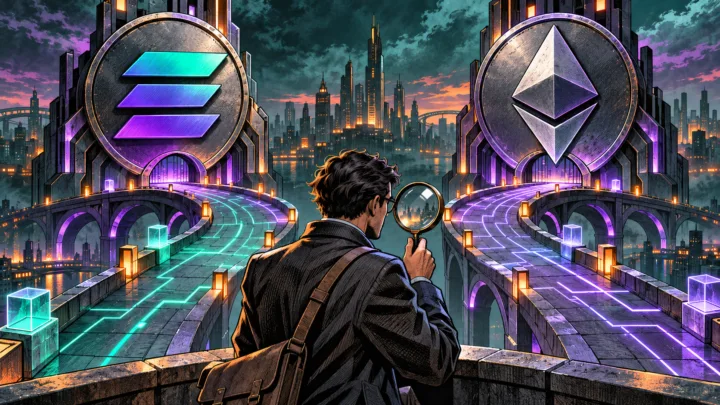
Buying ETH or SOL before Bitcoin’s halving does not provide the same exposure to the reduction in BTC issuance. These networks have their own uses, rules and risks. Their prices may respond to a broader shift in crypto risk appetite, but no Bitcoin protocol rule requires these other tokens to rise.
The documentation on Ethereum fees and Solana fees can be used to study part of their native utility. That research should remain independent of Bitcoin’s schedule. Application activity, supply policy or a governance change may matter more for these assets than their proximity to the halving alone.
For an altcoin, the question is therefore twofold: does its own thesis remain credible, and why would its performance benefit from the scenario being considered? Simply answering “it has more upside” does not make potential losses assessable. Greater sensitivity to enthusiasm can also mean a sharper decline when liquidity recedes.
Smaller tokens can add exit difficulties and complex unlock schedules. Our report on tokenomics and token unlocks helps examine these factors. A scheduled reduction in BTC issuance does not offset significant dilution or insufficient demand for another asset.
Three scenarios to test the thesis before committing funds
First scenario: demand increases while the flow of newly issued BTC declines. This combination may support a favorable hypothesis, but the supply available for sale and the entry price must still be considered. No percentage gain follows automatically from that statement. The outcome also depends on macroeconomic conditions and the behavior of other market participants.
Second scenario: the event occurs as expected, but a contraction in demand dominates the market. Lower new BTC issuance does not oblige buyers to maintain their bids. The price can therefore fall despite a technically successful halving. An analysis that ignores this possibility is not really testing its own hypothesis.
Third scenario: the market rises before the event and then corrects around the deadline. This path can produce very different results depending on the purchase date and the sales that take place. It shows why a sound description of a protocol mechanism is not a market-timing tool. Investors must assess the losses they can tolerate while waiting, not only the target they have imagined.
A purely hypothetical numerical example makes this risk more tangible. A €1,000 position that loses 50% falls to €500. A subsequent 50% gain takes it only to €750, excluding fees. Even a substantial recovery may not be enough to recoup the initial investment. The halving schedule does not change this arithmetic.
Recurring purchases, fees and custody while waiting
Spreading purchases over time can reduce dependence on a single moment without eliminating the possibility of loss. The DCA guide explains this trade-off. A gradual strategy does not turn a risky asset into a guaranteed investment; it organizes entry points whose results will always depend on the prices encountered and the costs incurred.
The fee schedule must be part of the decision. Assume a hypothetical fixed commission of €2 per transaction: five purchases cost €10, compared with €2 for a single purchase subject to the same fee. This difference does not establish that a single purchase is superior in every market. It simply shows that purchase frequency cannot be chosen independently of the actual execution cost.
Waiting several months or years also requires controlled custody. Users must understand the recovery process, withdrawal options and dependencies on an intermediary. The report on crypto wallets distinguishes these responsibilities. A sound understanding of the halving will not protect against an incorrect address or lost access.
Money intended for investment must also be kept separate from near-term expenses. Setting an ambitious future date can encourage someone to commit funds they will need before the deadline. Being forced to sell in an emergency then makes the stated time horizon largely theoretical. A genuinely available budget is a more concrete condition than patience that is merely declared.
The checklist to keep before the next halving
A decision sheet should provide five answers: the asset selected, the mechanism being studied, the maximum amount at risk, the factors that would invalidate the thesis and the review rule. The estimated year of the event can be included, but not as a guarantee of profitability. Technical information should also be dated, because the chain’s progress changes the calendar estimate.
For BTC, the direct link to the halving makes the thesis easier to formulate. For ETH, SOL or another altcoin, an independent case is still necessary. If no satisfactory explanation exists, the appropriate response may be not to buy rather than replace analysis with a list of names popularized by the same cycle narrative.
A useful review is not triggered only when the price rises. It examines assumptions that have proved false, underestimated costs and dependencies uncovered since the purchase. If expected demand does not materialize, investors must be able to acknowledge it without inventing a new deadline after every disappointment. The target block does not justify holding indefinitely without revisiting the reasoning.
Which crypto should you study before the next halving? Bitcoin first if the thesis specifically concerns its issuance—without inferring that buying is mandatory. Other assets require additional reasons. The decisive point is to understand why the price paid might leave room for a favorable outcome, and what losses would be acceptable if the market failed to confirm the scenario.