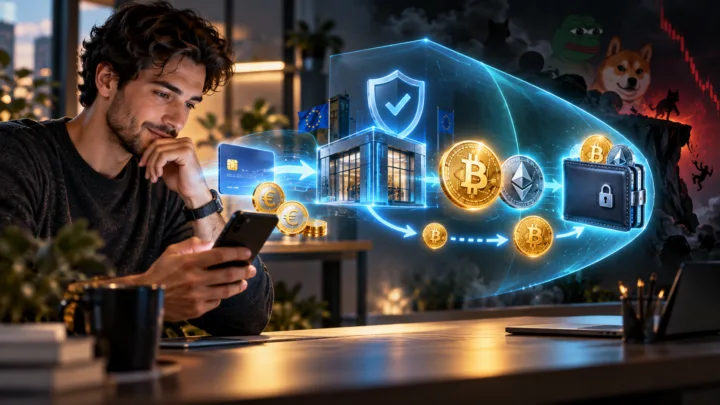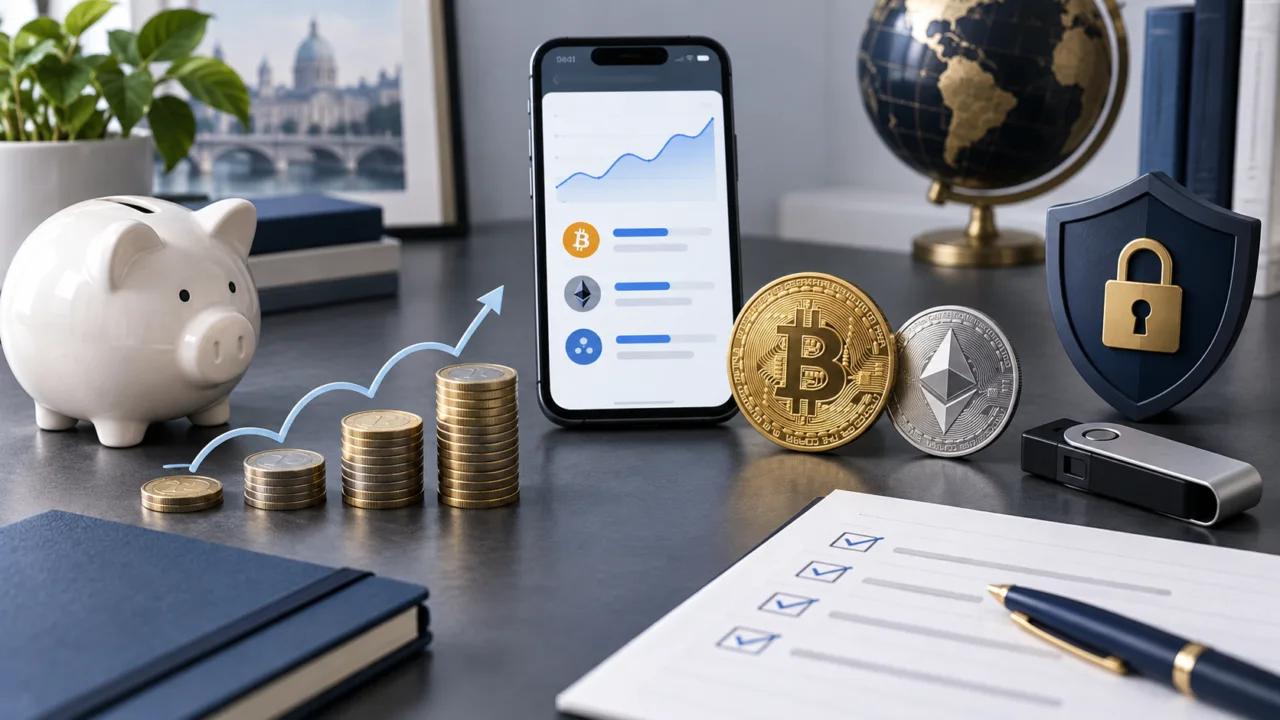
The process can take just a few minutes. The strategy deserves more time.
Bitcoin can lose several dozen percentage points during a correction. Altcoins can fall 80 or 90% and never recover their highs. A mistaken transfer may be irreversible. An exposed seed phrase can wipe out an entire wallet. And a well-known platform is no substitute for checking its regulatory status.
Investing in crypto is therefore not technically complicated. The hardest part is avoiding the transformation of an investment decision into a permanent gamble.
Understand crypto before investing your money
Buying crypto means acquiring a digital asset whose ownership and transfers are recorded on a blockchain. In Bitcoin’s case, the network operates without a central bank or company responsible for issuing new units. Its maximum supply is capped at 21 million BTC, and its workings are explained in greater detail in our complete guide to Bitcoin.
Not all cryptocurrencies follow this model, however.
Ethereum serves, among other things, as infrastructure for applications, stablecoins and smart contracts. Solana follows a programmable-blockchain model with a different technical trade-off. USDT and USDC seek to mirror the value of the dollar. DeFi tokens can provide access to governance mechanisms or financial protocols. Meme coins sometimes rely largely on a community and collective speculation.
Putting all these assets under the same “crypto” label therefore hides considerable differences.
Before investing in crypto, you should be able to explain in a few sentences what you are buying. Who issues the asset? What is it used for? How many units exist? Will new units be created? Who controls the largest wallets? Does the network generate genuine economic activity?
If the only investment thesis is “the price should rise,” part of the work is probably still missing.
An asset’s rise does not prove its quality either. In crypto markets, a few weeks of euphoria can sometimes give a project a valuation of several billion dollars even though its real-world use remains minimal.
Starting by understanding the asset already helps avoid many mistakes.
How much should you invest in crypto?
There is no universal amount.
100 euros may be a substantial sum for one person and almost insignificant for another. The right question is therefore not “how much should I invest?” but rather: what loss can I genuinely absorb without changing my standard of living?
Crypto remains extremely volatile. Even Bitcoin, the sector’s largest and most liquid asset, regularly experiences major corrections. BrefCrypto has already examined the mechanisms behind part of Bitcoin’s volatility.
Rent money, education expenses, emergency funds or money needed to repay a loan have no place in a market capable of losing 20% in a matter of days.
Imagine someone with 10,000 euros in available savings. Investing 500 euros in crypto is not the same as putting all 10,000 euros into several tokens in the hope of multiplying the capital. In the first case, even a total loss would leave most of the savings intact. In the second, the person’s entire wealth would depend on an especially unstable market.
The logic seems obvious. It can quickly disappear when Bitcoin rises 20%, an altcoin doubles or an influencer posts a screenshot of a wallet transformed within a few weeks.
Your exposure should be decided before the euphoria begins.
The amount can then increase gradually with experience, market knowledge and your personal financial situation. It is much easier to add capital to a strategy that is working than to rebuild savings destroyed by an overly aggressive first bet.
Choose a genuinely regulated crypto platform
The platform choice comes before the token choice.
In France, an important change took effect on July 1, 2027. The former PSAN registration is no longer sufficient on its own to provide crypto services. Companies must hold crypto-asset service provider, or CASP, status in accordance with the European MiCA regulation, or have a European authorization allowing them to operate in France.
This matters because some older guides still simply recommend checking whether a platform is “registered as a PSAN with the AMF.” That information is now outdated.
Before opening an account, the right approach is to search for the exact legal entity in the Autorité des marchés financiers’ whitelist. An international brand may operate through several companies depending on the country. A brand’s commercial reputation therefore does not replace regulatory verification.
You should then examine deposit, purchase, withdrawal and conversion fees. An app may advertise “0% commission” while applying a spread—that is, a difference between the actual market price and the price offered to the user.
Security also matters: two-factor authentication, withdrawal history, the ability to restrict destination addresses, a security delay after account changes and transparency about asset custody.
Well-known platforms such as Coinbase and Binance make buying technically straightforward. That never removes the need to check the status applicable in your own country at the time of registration.
Regulation evolves. A screenshot from two years ago is no substitute for an official register checked today.
Buy your first crypto without becoming a trader
Once the account is created, the platform will generally request identity verification. This process, known as KYC, or Know Your Customer, may require an identity document, a selfie and sometimes proof of address.
You can then fund the account by bank transfer, card or other payment methods available in your country. Fees vary considerably. Bank transfers are often cheaper than instant card purchases.
Then comes the order.
For someone who simply wants to invest, the spot market is more than sufficient. Buying on the spot market means actually purchasing the asset, without borrowing capital or using leverage. Binance Academy also notes that spot trading is generally simpler than margin products or futures, which introduce debt and liquidation risk.
Two order types are particularly useful to understand.
A market order buys immediately at the best available price. It is simple, but the final price may vary slightly when liquidity is low.
A limit order, by contrast, sets the maximum price the buyer is willing to pay. The order is executed only if the market reaches that level.
For a first long-term investment, there is no need to know twenty technical indicators, open TradingView across four screens or learn how to short-sell.
Investing and trading are two different activities.
An investor generally seeks to hold an asset for several months or years. A trader tries to profit from much shorter-term movements.
Confusing the two often turns a portfolio built for five years into a series of decisions made every fifteen minutes.
Bitcoin, Ethereum or altcoins: where should you start?
Bitcoin is generally the simplest place to start your research.
It has existed since 2009, has the market’s oldest ecosystem, a known maximum supply and greater liquidity than smaller cryptocurrencies. Its structure is relatively easy to explain: a decentralized digital currency secured by proof of work and limited to 21 million units.
Ethereum follows a different model. ETH supports, among other things, a programmable network on which stablecoins, DeFi applications, tokens and smart contracts are built.
Beyond these two assets lies a much more fragmented universe.
An altcoin can be technically excellent and still be a poor investment. Its network may function while suffering from massive token inflation. An application may have many users even though almost none of the economic value flows back to the token holder.
Small-cap assets add even more risk.
An asset with a market capitalization of 50 million dollars can theoretically multiply in value much more easily than Bitcoin. It can also lose 90% much more easily. Liquidity can disappear quickly, and a few large holders may dominate the market.
Meme coins represent the extreme end of this speculative logic. Even some professional managers now draw a sharp distinction between Bitcoin and these assets: Peregrine Capital recently described meme coins as a particularly speculative form of gambling.
A beginner has no obligation to own fifteen cryptocurrencies.
Diversification does not simply mean adding more names to a portfolio. Ten tokens that fall together do not necessarily create ten different sources of risk.
DCA or a lump-sum purchase: how should you enter the market?
Suppose someone has 1,200 euros to invest.
They can buy 1,200 euros worth of crypto today, or invest 100 euros every month for a year.
The second method is known as Dollar Cost Averaging, or DCA.
It involves investing a fixed amount at regular intervals, regardless of the price. When the market falls, the same amount buys more units. When it rises, it buys fewer.
The main advantage of DCA is not magic. It does not guarantee better performance.
It mainly reduces the importance of the entry point.
Someone who invests all their capital a few hours before a 30% drop immediately suffers that decline across their entire position. Someone who buys gradually still has capital available for the following months.
The strategy also reduces psychological pressure. The crypto market operates 24 hours a day. There is therefore always a reason to wait: a Fed meeting, inflation, war, options expiry, regulation, an ETF, elections or a whale liquidation.
By waiting for the perfect price, some investors never take a position.
Conversely, investing all your money when a cryptocurrency goes viral exposes you to the classic FOMO phenomenon—the fear of missing out on the rise.
DCA provides mechanical discipline.
A lump-sum purchase can nevertheless make sense when an investor accepts volatility and has a very long time horizon. Mathematically, investing earlier can also be advantageous when an asset rises consistently.
There is therefore no universally superior method.
The best method is often the one an investor can follow when the market becomes uncomfortable.
Stablecoins are not savings accounts
USDT, USDC and other stablecoins occupy a special position.
Their objective is generally not to gain 50% in value. A dollar-backed stablecoin instead seeks to remain close to 1 dollar.
They are highly convenient for temporarily holding liquidity within the crypto ecosystem, transferring funds between platforms or waiting for an opportunity without immediately returning to fiat currency.
They are not risk-free, however.
A stablecoin depends on a mechanism that maintains its peg. For the main centralized stablecoins, this involves reserves held by the issuer. There is therefore risk related to the quality of those reserves, the company, its banking partners, regulation and, in some cases, the freezing of addresses.
BrefCrypto has already examined the main benefits and risks associated with stablecoins.
You must also distinguish between holding a stablecoin and placing that stablecoin in a product promising an 8, 12 or 20% yield.
Yield adds another layer of risk.
The token may be lent to a third party. It may be deposited in a DeFi protocol. A platform may reuse deposits. A smart contract may contain a vulnerability. The advertised rate is therefore never free money.
A simple rule is helpful: the higher a yield appears to be for an allegedly stable asset, the more you need to understand who pays that yield and why.
Otherwise, the word “stable” can create an impression of safety that does not exist.
Exchange or wallet: where should you keep your crypto?
Buying crypto and storing it are two different operations.
On a centralized platform, the exchange generally controls the private keys associated with the funds. The user holds a claim against the platform and can request a withdrawal.
That is convenient.
Password, mobile app, account recovery and customer service: the experience is more like that of a digital bank.
Self-custody reverses the responsibility.
With a non-custodial wallet, the user controls their own keys. A recovery phrase, often made up of 12 or 24 words, allows the wallet to be recreated.
This seed phrase is far more important than the application installed on the phone.
If the phone disappears but the recovery phrase remains intact, the wallet can be restored. If someone obtains the phrase, they can generally move the funds without any further authorization.
Never send it by email, photograph it, store it in a WhatsApp conversation or share it with fake technical support.
For significant amounts held over the long term, a hardware wallet keeps private keys offline. For small sums or frequent purchases, leaving part of the funds on a reputable platform may remain more convenient for some users.
Self-custody is not automatically safer.
It becomes safer only when the owner understands what they are doing.
Losing your seed phrase while also losing the device can be just as final as being hacked.
Scams cost more than trading fees
Looking for the best purchase price while neglecting security is a strange way to save money.
Scammers now target investors directly rather than the blockchain. Fake customer support, cloned websites, romance-investment scams, malware, Telegram messages, fake airdrops and guaranteed-yield promises account for much of the threat landscape.
FinCEN recently identified 33,904 reports corresponding to 12.7 billion dollars in suspicious financial activity associated with investment scam networks. BrefCrypto has explained how these crypto scam factories operate.
Cryptography can be excellent and the user can still be robbed.
A few habits prevent many disasters: use a unique password, enable strong authentication, check every URL, test a new address with a small transfer and never share a seed phrase.
You must also be wary of leverage.
Futures allow traders to control a 10,000-dollar position with far less capital. That increases gains when the market moves in the right direction. Losses follow exactly the same logic.
At 10x leverage, a relatively small adverse move may be enough to liquidate a position.
For a beginner who simply wants to invest money in crypto, derivatives are not necessary.
You can spend years in Bitcoin without ever using futures.
Sophistication is not always an advantage.
Sometimes, buying an asset, securing it properly and waiting is already difficult enough.
Think about taxes from the first purchase
Tax rules depend on the country of residence.
A French investor should pay particular attention to keeping records of transactions. Buying, selling, sending funds to a wallet, using several platforms and converting different cryptocurrencies quickly becomes difficult to reconstruct three years later.
In France, the tax authorities notably distinguish private individuals from people whose activity has the characteristics of a professional business.
For an individual managing private assets, taxable gains on digital assets currently fall under a 31.4% flat tax, made up of 12.8% income tax and 18.6% social contributions. The tax authorities also specify that an option for the progressive scale exists. As these rates have changed, it is preferable to consult the tax documentation for the relevant year rather than an old tutorial.
In France, crypto-to-crypto exchanges without additional cash consideration benefit from tax deferral. Converting to euros or using digital assets in certain transactions may, however, trigger a taxable disposal.
Accounts held on certain foreign platforms must also be declared.
The tax authorities notably use appendix 2086 for details of capital gains and losses, and form 3916-3916 bis for certain digital-asset accounts held abroad.
This is not the most dramatic part of investing.
Yet ignoring it for several years can cost more than a bad day in the market.
Keeping a basic transaction history from the outset makes everything that follows much easier.
How should you analyze a cryptocurrency before buying it?
Price should never be the first criterion.
A cryptocurrency priced at 0.02 dollars is not necessarily “cheaper” than Bitcoin at several tens of thousands of dollars. What matters more is market capitalization: the price of one unit multiplied by the number of units in circulation.
A token worth 0.01 dollars with 100 billion units already represents a market capitalization of 1 billion dollars.
To reach 1 dollar, it therefore does not merely need to “gain 99 cents.” Its market capitalization would have to reach 100 billion dollars, assuming the supply remains unchanged.
You should then examine the total supply, circulating supply and token unlock schedule.
A project may show a market capitalization of 500 million dollars with only 10% of its tokens in circulation. As tokens reserved for investors, teams and foundations are gradually unlocked, selling pressure can become considerable.
Real activity matters too.
How many users? How many transactions? What revenue? Which developers? What problem does the protocol actually solve? Is the token essential to the product’s operation, or was it simply added to raise money?
Narratives must also be placed in context. AI, RWA, DePIN, gaming and meme coins: the crypto market loves to move capital quickly from one theme to another. BrefCrypto has analyzed the main crypto narratives of 2027 and the risks accompanying their popularity.
Excellent technology bought at an absurd valuation can still produce a poor investment.
The price paid matters too.
Investing in crypto is mainly about having a method
A first crypto investment therefore does not need to be complicated.
Choose a genuinely authorized provider. Start with an amount you can afford. Understand the asset. Buy on the spot market. Avoid leverage. Secure your account. Then decide whether self-custody is appropriate. Keep the records needed for tax purposes.
Then give the strategy time.
The biggest trap often appears after the first few weeks.
The investor starts with Bitcoin. Then discovers Ethereum. Next comes an AI token, followed by a memecoin. A notification announces a 70% gain on a small cryptocurrency. An influencer predicts a 20x return. The initially simple portfolio ends up containing 17 positions, several of which their owner could not explain.
The number of cryptocurrencies held does not measure portfolio quality.
You must also accept that an investment may fall for a long time. Regulated products have not eliminated this volatility: Bitcoin ETFs can record several hundred million dollars in inflows or outflows in a single session.
This may be the least appealing part of answering the question, “How should I invest my money in crypto?”
The “Buy” button is easy.
Building a coherent position, resisting FOMO, withstanding corrections and protecting your keys for several years requires much more discipline.
For a beginner, the best first step is therefore probably not finding the cryptocurrency capable of returning 100x.
It is building a method strong enough to keep you in the market when the next 30% decline arrives.
Practical steps before your first purchase
- Decide in advance how much you can genuinely afford to lose.
- Check the provider in the applicable PSCA/MiCA register.
- Start by understanding Bitcoin, Ethereum or any other asset under consideration.
- For a first investment, favor spot purchases over leverage.
- Compare actual fees, including the spread.
- Enable two-factor authentication immediately.
- Understand seed phrases before using a personal wallet.
- Never believe in guaranteed returns.
- Keep records of purchases, sales and transfers.
- Regularly reassess the investment thesis rather than focusing only on price.