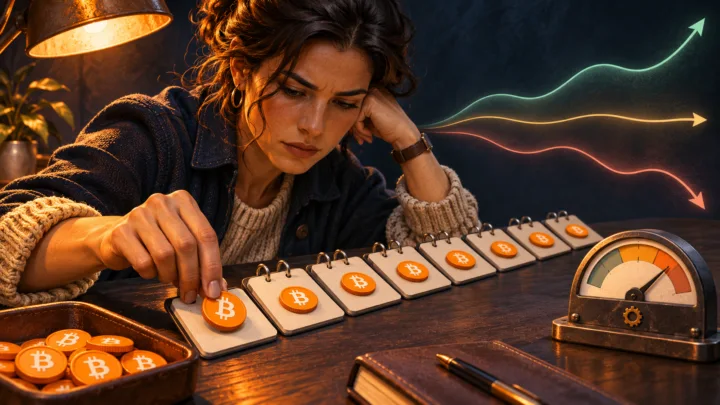
How much could 0.01 Bitcoin be worth in 2027? The calculation is simple: multiply the price of one bitcoin by 0.01. The challenge lies not in the formula, but in the future price, the currency used and the costs required to convert this fraction into spendable money. No model can guarantee the value it will reach.
This guide presents clearly hypothetical price scenarios without forecasting Bitcoin’s 2027 price. It distinguishes between the amount of BTC held, its valuation and the resulting profit, then examines fees and custody. Holding a fraction of an asset does not reduce its percentage risk; it only limits the amount invested if the budget is smaller.
Understand the amount before assigning it a price
Our approach to structuring a crypto investment starts with a budget, not with the need to buy a whole unit. Bitcoin can be divided into smaller units. The Bitcoin Core code defines one BTC as 100 million satoshis, so 0.01 BTC represents one million satoshis.
This distinction helps avoid a common bias: viewing Bitcoin as inaccessible because a whole unit is expensive. Investors can buy a fraction subject to their provider’s minimums. The operational threshold depends on the service selected, not just on Bitcoin’s technical divisibility. A platform may impose a minimum order or withdrawal amount.
It is also important to distinguish the amount purchased from the amount received. If a service deducts fees from the invested amount, a budget intended to buy 0.01 BTC may ultimately provide slightly less. If fees are paid separately, the amount may remain unchanged, but the total cost increases. Both figures should be recorded.
Once held, the number of BTC does not change because the price rises or falls. Someone holding 0.01 BTC retains that amount unless a transaction, a fee deducted in BTC or a custody-related event changes it. Its monetary valuation, however, fluctuates continuously according to the market and the reference currency.
This distinction makes tracking clearer. A goal of accumulating one million satoshis and a goal of funding a €1,000 expense do not describe the same outcome. The first concerns units; the second requires a convertible value available on a specific date, with price risk.
Several possible dollar values, without invented probabilities
With Bitcoin hypothetically priced at $30,000, 0.01 BTC would be worth $300. At $50,000, its value would reach $500; at $75,000, it would reach $750. These examples do not define technical support levels or downside targets. They simply illustrate the relationship between a fraction and the price of a whole unit.
At $100,000 per bitcoin, the fraction would be worth $1,000. A price of $150,000 would produce $1,500, while a price of $200,000 would produce $2,000. If Bitcoin hypothetically reached $300,000, the corresponding gross value would be $3,000, excluding exit fees.
This mental table does not indicate which figure will materialize in 2027. Assigning the same weight to every example would amount to inventing a probability distribution. A selection of educational figures is not a statistical model. Readers should resist treating the highest line as the normal outcome.
The same relationship applies to price changes. If BTC loses 40%, 0.01 BTC loses 40% of its monetary value in the same currency, excluding costs. A small fraction therefore offers no special protection against volatility. Its euro-denominated risk depends on the amount invested, but its percentage return follows the same asset.
The price used must also be specified. An exchange quote, a benchmark index and the price actually obtained on an order may differ. An indicative valuation can help estimate a portfolio, but it does not guarantee that a sale, withdrawal and conversion will be completed instantly at the displayed amount.
In euros, the exchange rate changes the result
For someone whose expenses are paid in euros, a dollar value is not enough. Suppose Bitcoin is hypothetically priced at $100,000 and one euro is worth $1.10. The $1,000 corresponding to 0.01 BTC would then equal approximately €909.09, before fees and conversion spreads.
If Bitcoin remained at $100,000 but the euro were worth $1.20, the fraction would correspond to approximately €833.33. At a hypothetical exchange rate of one euro to one dollar, it would be worth €1,000. The number of satoshis remains the same in these examples; only their equivalent in the reader’s currency changes.
The ECB reference rates are provided for information and do not set a transaction offer. A theoretical conversion should therefore remain separate from the price obtained on the service used. The spread can account for part of the cost, even when the stated commission appears low.
Direct BTC/EUR conversion may simplify the process without eliminating every price difference. Routing through a stablecoin or another currency may add a transaction, fees and counterparty risks. The choice should be based on the actual terms, not on the assumption that an intermediate step makes the result more reliable.
To measure performance, a consistent reference currency is necessary. Switching between dollars, euros and satoshis based on whichever figure looks most favorable can sometimes conceal the loss one is trying to avoid. Tracking may display several units, but the project’s result should be assessed in the currency tied to its objective.
Valuation, profit and recoverable funds are different things
Imagine buying 0.01 BTC for €800, excluding costs. If the position later becomes worth €1,000, the gross profit is €200, not €1,000. With a purchase price of €1,200 and the same final value of €1,000, the investor would instead incur a gross loss of €200.
Successive purchases make the calculation slightly more complex. Some units may have been bought at a high price and others at a lower one. The amounts actually spent and the units received must be added together, rather than using the arithmetic average of prices as the acquisition cost when the quantities are not identical.
Dollar-cost averaging structures this accumulation over time. It does not automatically turn the resulting fraction into a profit. An investor may hold more satoshis than at the beginning while still recording a monetary loss if the final price does not offset all contributions.
Trading fees, spreads and withdrawal costs then affect the net amount. A fixed exit fee would weigh proportionally more heavily on a small position than on a large one. Actual figures should come from the applicable fee schedule; this guide assumes no universal cost for transferring or selling BTC.
Tax treatment also depends on residence, status and transactions. A value displayed before a sale does not necessarily represent the amount available after all obligations. For a specific financial objective, costs should be documented and the relevant rules checked rather than treating an entire capital gain as immediately spendable.
Holding 0.01 BTC requires a custody and usage plan
The choice of wallet matters just as much for a fraction as for a whole unit. Self-custody requires backups to be protected and transfers to be checked. Using an intermediary involves other risks, including withdrawal availability. No method protects the market price itself.
Managing small amounts received can also affect the future cost of transactions. Several purchases followed by numerous withdrawals can create multiple unspent outputs in a wallet. The cost of a Bitcoin transaction depends in particular on its data size and network conditions, not simply on the monetary amount sent.
Bitcoin.org’s documentation on fees explains this distinction. For a fraction intended for a specific expense, the wallet’s fee estimate should therefore be checked at the time of transfer rather than inferred as a simple percentage of the value held.
That does not mean funds should be consolidated or moved without understanding the operation. Consolidation can incur a cost and affect privacy. The practical point is to examine the position’s structure and the wallet’s options before a sale deadline, rather than improvising under pressure from a liquidity need.
A BTC-denominated goal must also remain compatible with overall wealth. Accumulating 0.01 BTC may serve as a personal benchmark, but it does not justify sacrificing an essential reserve. Risk should be measured by the amount of loss one can tolerate, not only by the distance to a symbolic quantity one would like to own.
In 2027, the value of 0.01 Bitcoin will therefore follow a simple multiplication, but the financial outcome remains uncertain. Calculating several prices, converting into the right currency and subtracting costs can clarify the decision. One million satoshis remains an amount; its ability to fund a project will always depend on the market and on when the funds are needed.