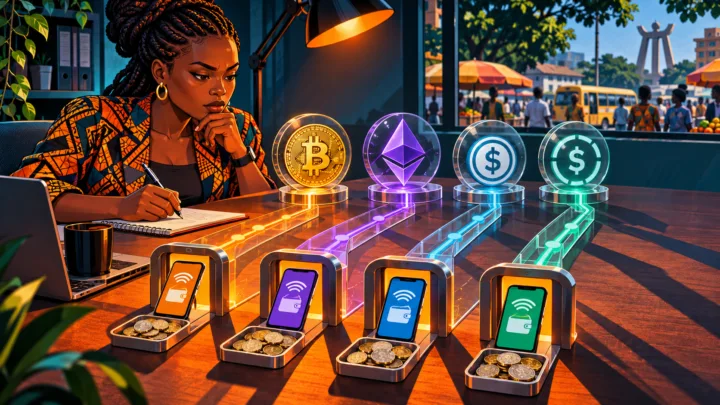
Buying Bitcoin with Orange Money in 2027 will require checking two separate elements: payment in local currency and BTC delivery. The presence of a logo in an advertisement proves neither an official partnership nor an offer available to all residents. The availability of a mobile service alone is not enough to establish compatibility with a crypto transaction.
This guide explains which evidence and costs to review without certifying any seller or unverified Bitcoin integration. Official sources were consulted on November 10, 2026. Availability, rules and fees will need to be checked again in 2027 for the relevant country, account and provider.
In brief
Our article on Bitcoin and mobile money in Africa distinguishes between the different channels. Orange Money may be involved in local payment, but crypto sales and delivery involve separate commitments that must be identified before funds are sent.
- A list of countries where Orange Money operates is not a list of countries compatible with a specific Bitcoin purchase.
- A peer-to-peer transfer and an integrated merchant payment do not provide the same contractual evidence.
- The total cost includes the conversion price, fees, crypto withdrawal charges and any eventual exit costs.
Distinguishing operator presence from an offer that is actually available
The official Orange Money Web Payment overview describes a payment service for merchants, with registration requirements and local rules. This documentation confirms a collection mechanism. On its own, however, it does not announce a universal Bitcoin-buying service provided by Orange.
Three levels must therefore be distinguished: is the requested payment service available in the country, does the seller accept that payment method, and does the seller’s crypto offering meet the applicable requirements? Each question requires different evidence. Answering the first does not automatically validate the other two.
An application or advertisement may mention Orange Money as a payment method without the operator being the BTC seller. Readers should identify the provider’s legal name, sales terms and channels for seeking redress. A logo displayed in an interface does not establish that the mobile operator is responsible for delivery.
The customer’s country of residence also matters. An offer available in one country may depend on a locally verified account, a specific currency or a particular customer category. Users should neither use a third party’s identity nor bypass a restriction to replicate a tutorial from another market.
Building evidence that the service is compatible with your country
The Orange Developer FAQ refers users to local operators for the merchant service’s terms and costs. Country lists published on different pages should not be treated as guarantees of crypto compatibility. Readers should return to the page for the exact product and to the current local documentation.
A research table can bring together the country of residence, payment currency, type of Orange Money account and seller service. The next column should contain the dated source establishing which payment method is accepted. A final column should specify what will be delivered: on-chain BTC, a Lightning payment or simply an internal balance.
Our guide to crypto platforms in Africa helps organize these checks. Commercial information, evidence of access to the product and any applicable authorization must be distinguished. A screenshot does not replace the applicable terms and does not prove that the offer will remain available several months later.
Currency differences must also be documented. The article on XAF and XOF notes that the same commonly used CFA franc label can refer to two currencies and two monetary zones. A price, operator or transfer rule should not be copied from one zone to another without verification.
Comparing the BTC price with the total amount debited
A useful quote shows the amount in local currency, the promised BTC quantity and the costs deducted before delivery. A price that appears close to the market rate may still involve payment or withdrawal charges. Conversely, a fee may already be built into the exchange rate, so it should not be counted twice.
Consider a fictional example unrelated to Orange’s or any seller’s fees. A customer has 50,000 monetary units. After 500 units in payment fees and 1,000 units for conversion, 48,500 units are used to buy BTC. An additional deduction equivalent to 1,500 units before delivery reduces the amount received to a theoretical value of 47,000, assuming the exchange rate remains unchanged.
The cost of the transaction is therefore 3,000 units, or 6% of the initial budget. The calculation assumes no change in the price. It measures only what the different steps remove from the invested amount. To compare a second offer, the customer must request the same final quantity and account for any costs that remain payable by them.
Our guide to crypto fees in Africa distinguishes between exchange-rate margins, commissions and network fees. Orange Money’s fee does not summarize all three. A transaction that is free within the mobile account can still fund an expensive crypto purchase if the seller applies a substantial margin elsewhere.
Check local fees instead of relying on an old tutorial
Senegal provides a concrete example of why dates matter. An Orange support page published for changes taking effect on November 2, 2026 describes new limits and a revised withdrawal-fee cap. Other older operator pages remain accessible with different amounts.
The recent document states a 1% withdrawal rate, capped at 10,000 CFA francs, for the framework it describes. This figure concerns cash withdrawals and is neither a Bitcoin purchase fee nor a condition guaranteed for 2027. It should not be applied automatically to Cameroon, Côte d’Ivoire or another transaction.
This documentary comparison helps avoid a common mistake: using the first result found without checking its date and scope. Readers must distinguish deposits, merchant payments, transfers and withdrawals. The terms may depend on the account, amount and channel, even when they appear under the same brand.
Our article on crypto in Senegal provides local context without generalizing it to the entire continent. For a purchase in 2027, the relevant evidence will be the fee schedule and quote applicable at the time of the transaction, preserved with their date—not a figure copied from an old guide without checking.
Checking responsibilities in direct purchases and P2P transactions
When a sale is offered by a provider, the terms should specify who receives the payment and who delivers the bitcoins. In a P2P transaction, another person may handle delivery under the rules of a matching service. The presence of an intermediary should not be treated as an absolute guarantee of reimbursement.
Before making any payment, users should understand the dispute process, deadlines and required evidence. The payment must match the specified order and recipient. A request to change the number or continue outside the original system calls for a new verification—not automatic approval simply because the conversation appears urgent.
A mobile confirmation proves that funds moved through the payment channel, but not necessarily that BTC was received. The customer must separately check the balance or transaction corresponding to the promised delivery. An order ID, a mobile receipt and crypto transaction evidence serve different purposes in the record.
Orange Senegal’s anti-scam alerts specifically warn users not to disclose their secret code to anyone claiming to be an agent. This protective rule is separate from Bitcoin wallet checks: no seller should receive a recovery phrase to complete a delivery either.
Prepare withdrawals and evidence before making the first payment
An exit checklist should specify where the bitcoins can be sent, which network is accepted, the minimum amount and the fees. A balance visible in an application may remain subject to the custodian’s rules. The ability to buy BTC with a mobile payment does not prove that a withdrawal of the same size will be immediately available.
The guide to KYC checks in Africa helps organize documents without sending them to just anyone. An identity request should come from the official service and correspond to its terms; a private seller should not receive sensitive information merely on the pretext of arranging delivery.
A limited transaction can test whether the process is understood, but it does not prove that a larger amount will have the same liquidity or fee structure. After the test, the local debit, promised quantity and amount received should be reconciled. Any unexplained difference should be addressed before repeating the transaction.
The quote’s validity period should also be recorded. If the price expires before the payment is confirmed, the customer must understand which new calculation applies and who bears the difference. An earlier displayed quantity is not necessarily still a valid promise. This check helps distinguish a change announced in the terms from an unexpected deduction.
Buying Bitcoin with Orange Money in 2027 will therefore be a matter of demonstrated compatibility, not a logo. This guide does not certify any universal crypto partner. The process becomes workable when the country, provider, net price, delivery responsibility and withdrawal route can be established through consistent documents and evidence.