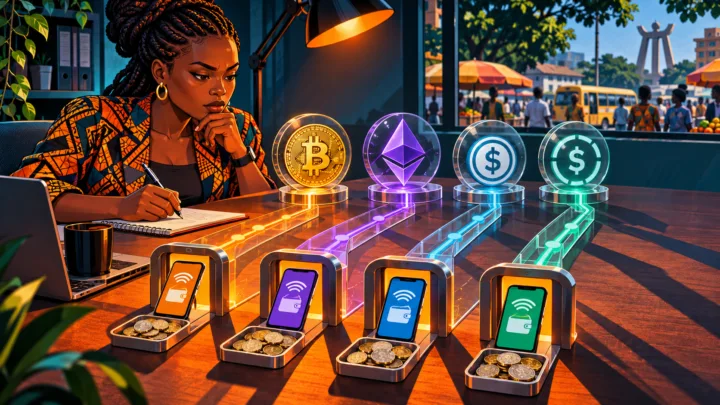
Buying USDT with MTN Mobile Money in 2027 will require checks across the entire chain: payment account, seller, quote, network and receipt. The mention of MoMo in an advertisement does not prove that MTN sells the stablecoin or guarantees the transaction. Local payment and crypto delivery remain two separate commitments.
This guide sets out a verification process without certifying universal integration or recommending any seller. Primary documents were reviewed on November 10, 2026. Countries, restrictions and the terms of each service will need to be checked again in 2027; the calculations below are illustrative and do not represent actual rates.
In brief
Our guide to USDT and mobile money in Africa distinguishes between the different transaction routes. A purchase should be assessed based on the amount actually delivered on a compatible network, not merely the amount debited from the payment account.
- An active MoMo account does not prove that a particular crypto service accepts the customer and their country.
- The USDT symbol alone is not enough: the network and token identity must match the intended destination.
- MoMo PINs, one-time codes and wallet recovery phrases must remain confidential.
Distinguishing MoMo payments from stablecoin sales
The first transaction route transfers value in local currency under the operator’s rules. The second exchanges that value for a quantity of USDT. A delivery failure does not disappear simply because the mobile payment succeeded. Before making any payment, the customer should identify who is responsible for each part of the transaction and what remedies are available.
A provider may offer an integrated purchase, subject to demonstrated compatibility. A P2P marketplace may bring a buyer and seller together under its own rules. A private offer may provide no comparable dispute mechanism. These categories describe transaction models; they do not prove that a specific offer is available or authorized.
Keep the service’s legal name, its terms and proof of the payment method accepted in the relevant country. An advertisement using a brand name is not enough to establish a partnership. MTN’s account-management documents for Cameroon illustrate how to verify the payment account, but do not validate a third-party crypto offering.
Residence and currency also matter. A procedure valid for an account in one country must not be repeated using a third party’s identity or account elsewhere. The report on crypto platforms in Africa helps distinguish commercial presence, service access and regulatory status.
Identifying the exact USDT before choosing an offer
Tether publishes a page covering supported protocols and integration rules. It can be used to verify official networks and references while distinguishing historical information that may still be listed. An old address or outdated tutorial should not be treated as proof of current support.
The destination wallet or service must support the same network the seller uses for delivery. Check the token address and blockchain, not just the name. An asset carrying the same symbol may be an imitation or a representation with additional dependencies.
A platform may also credit an internal balance before any withdrawal takes place. In that case, the user still depends on its rules to send the tokens to an external address. Minimum amounts, withdrawal fees and network availability should be reviewed before payment, especially when dealing with a small budget.
Compatibility must also account for future use. Receiving USDT without having the means to pay for a subsequent transaction can make it harder to move the funds. Fees and how they are paid depend on the network and the service. These conditions should be checked without assuming that every transfer will automatically be funded by the token received.
Reading the local price as a complete quote
The price of one unit of USDT in local currency may include a foreign-exchange margin and commissions. The amount debited from MoMo therefore does not, by itself, describe the purchase cost. The quote should state the promised quantity, deducted fees and final available amount, together with a validity period and delivery method.
Consider a fictional example using a budget of 100 000 units. The seller offers a price of 625 local currency units per USDT, and the payment incurs a separate cost of 1 000 units. The remaining 99 000 units buy 158.4 USDT before any withdrawal. If the withdrawal costs 1.5 USDT, the final wallet balance is 156.9 USDT.
The effective cost is calculated by dividing the 100 000 units actually spent by the 156.9 received, or approximately 637.35 local currency units per USDT. These figures do not describe any current offer. They show why the advertised price of 625 is not enough to compare the result actually obtained.
The report on crypto fees in Africa helps avoid double-counting. If the seller states a final quantity after all deductions, do not subtract the same fees again. Personal expenses that remain outside the quote should, however, be added.
Understanding rights linked to the issuer and the service
Tether’s terms describe the commitments and eligibility criteria for the issuer’s services. An individual selling tokens to a local counterparty is not necessarily using the direct redemption process described in those terms. The actual channel must be identified before referring to a guaranteed conversion.
The dollar reference does not turn USDT into a personal bank deposit. Nor does it guarantee a constant amount in the customer’s local currency. Entry and exit prices, as well as costs, can change even if the token retains its intended reference in the markets concerned.
The issuer’s reserves and terms do not automatically cover the commitments of a seller or custodian. A platform may add its own limits or dependencies. The analysis must therefore separate token risk, counterparty risk and network risk instead of reducing everything to the word stablecoin.
If the objective involves a future payment, verify that the recipient accepts this exact asset and blockchain. Funds received correctly may still need to be converted to pay for an expense. The exit plan is therefore part of the analysis before purchase, not only after a problem appears.
Verifying evidence without disclosing access credentials
A purchase file can retain the order, dated quote, MoMo receipt and proof of crypto receipt. These documents are not interchangeable. A receipt proves a local payment transaction; a transaction or verified balance must still establish that the promised delivery occurred. A screenshot sent by the seller is not enough if the user cannot see anything at the destination.
Official MoMo digital-safety guidance identifies phishing, phone impersonation and fraudulent SIM replacement in particular. Protect your PIN and one-time codes, and verify requests through official channels rather than under pressure from a caller or contact.
A crypto wallet’s recovery phrase is another sensitive piece of information. A seller does not need it to send tokens. A request for remote access to the phone, an account secret or an unexplained signature should not be accepted on the grounds that delivery requires “synchronization.”
Our report on KYC checks in Africa helps distinguish official verification from abusive data collection. A provider may have identity-related obligations, but that does not justify sending documents to a private profile without verifying its role, channel and service policy.
Defining when the purchase is complete
The purchase is not complete when someone confirms that they received the payment. Verify that the net amount, asset and promised network match what is actually available. If the delivery remains in an internal account, the customer should understand that an external withdrawal is still another step.
Dispute procedures should be understood before payment. If there is a discrepancy, retain the evidence and use the relevant service’s official channels. A refund offered to a different number or conditional on a new payment can create additional exposure; it should not be accepted solely to speed up the resolution.
The beneficiary’s name and payment reference must also match the verified instructions for the order. A request to pay a new private account without a clear update to those instructions breaks the evidentiary chain. Stop and request official confirmation rather than assuming the change is merely for the seller’s convenience.
The guide to XAF and XOF also points out that the same monetary vocabulary can conceal distinct regions. Neither MoMo rates nor dispute procedures should be generalized from one country to another. Local documents remain necessary for the transaction actually being considered.
For 2027, the sound approach is therefore to verify the payment account, seller, quote, token, network and exit route separately. This guide does not certify a universal service for buying USDT through MTN. It provides a framework for rejecting an offer whose responsibilities or delivery cannot be demonstrated, before mistaking a successful debit for a completed acquisition.