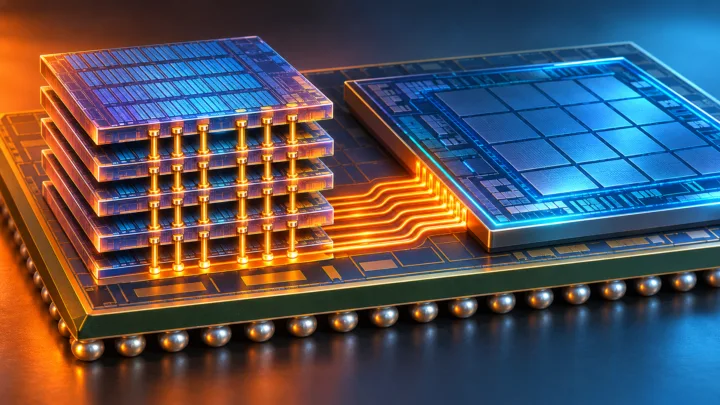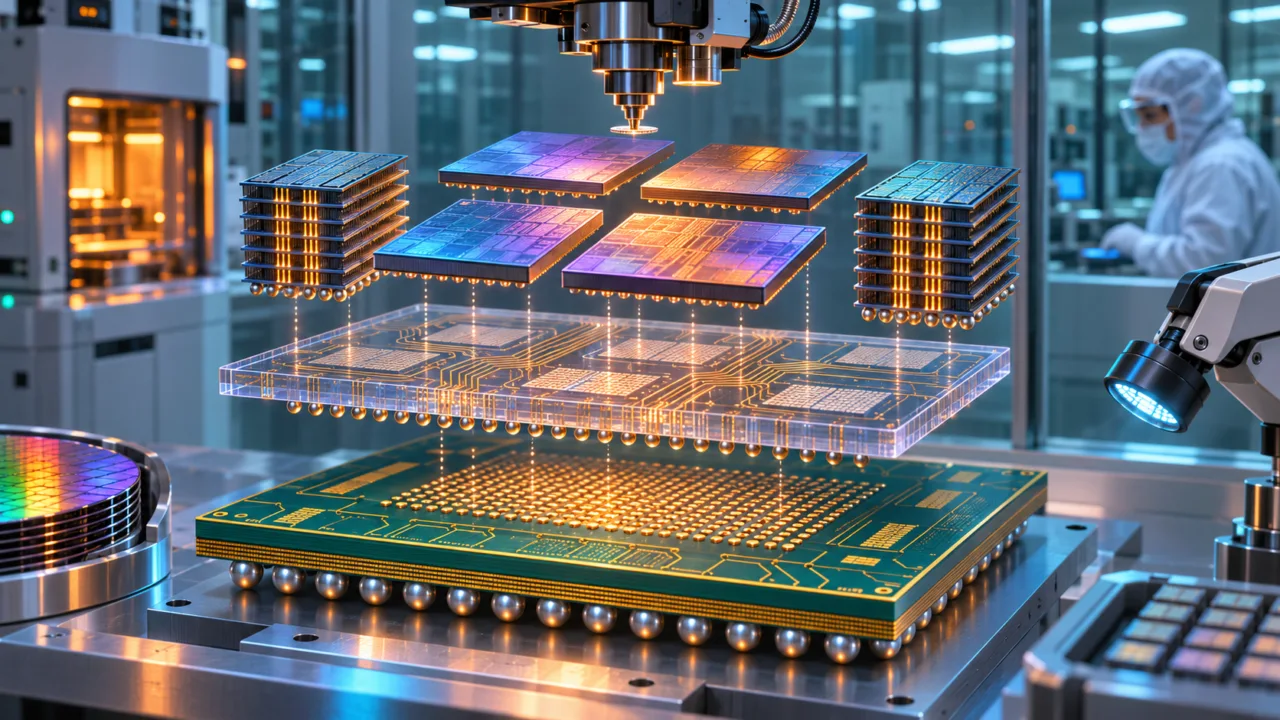
Advanced packaging refers to integration techniques that go beyond simply protecting a chip with an outer casing. Connections, component placement and physical constraints can determine whether a system delivers its expected performance.
This guide follows the chain from circuit manufacturing to the delivery of a usable system, based on sources consulted as of November 24, 2026. It does not forecast a shortage or stock-market performance. Its aim is to identify the links in the chain, their costs and the evidence needed before interpreting a capacity announcement.
In brief
- A manufactured circuit is not necessarily a delivered, operational product.
- Chiplets can add flexibility while creating interconnection constraints.
- Final yield depends on several stages: the capacity of any one stage does not describe the entire chain.
Advanced packaging extends the manufacturing process
Our article on AI in chip design notes that key decisions begin before a chip reaches the factory. The design must anticipate how components will be manufactured and assembled. ASML’s overview of the production stages helps place lithography within a sequence of operations rather than treating manufacturing as an instantaneous process.
A wafer contains multiple circuits that must then be separated and integrated according to the product. Assembly provides the connections and interface with the rest of the system. Its role is therefore not limited to preventing physical damage; it also contributes to electrical operation and the physical conditions of use.
The circuit, its package or integrated assembly, the board and any server must be distinguished. An announcement may concern one of these levels without guaranteeing the availability of the others. Mixing them can lead to an overestimate of deliverable volumes or to assigning a bottleneck to the wrong supplier.
This distinction matters for financial analysis. The same end demand may pass through several companies, each with its own contracts and margins. The price of a finished system does not correspond to the revenue of every participant. Adding their announcements together as if they represented independent markets can count the same investment chain several times.
A useful first map therefore shows who designs, manufactures, assembles and tests the product. Add the stages that are actually available and those that are still planned. This simple representation makes delivery conditions easier to understand than an overall capacity figure with no defined scope.
Chiplets are changing how systems are built
A product can combine several specialized circuits instead of concentrating every function in one large block. This approach creates opportunities for reuse and combination. It does not eliminate constraints: the components must communicate and remain compatible with power, thermal and cost targets.
TSMC’s presentation of SoIC describes an integration offering and how it fits with other packaging techniques. It establishes the existence of an industrial solution, but does not show that every product should adopt it. The right choice depends on the design and the customer’s requirements.
A designer may want to reserve an advanced process for certain functions while using other techniques elsewhere. The potential economics must nevertheless include interconnections and assembly work. A reduction in circuit cost may be partly offset by an additional step or by more difficult testing.
In a hypothetical simulation, an architecture saves 20 on manufacturing but adds 12 in integration and 5 in testing. The simplified gain is 3 before accounting for other differences. If yield or maintenance changes, the conclusion may shift again. Technical partitioning alone therefore does not guarantee a net saving.
For comparison purposes, keep the same performance and quality objective. Two systems with different functions do not become equivalent because they contain the same number of chiplets. The analysis must follow the service delivered by the product, not merely the number of small circuits shown in an illustration.
Interconnections, memory and heat must be considered together
Data moves between components through links whose characteristics affect the outcome. Greater computing power may remain underused if information arrives too slowly. Placement and connections must therefore be assessed alongside memory and software, not treated as a separate issue added at the end.
TSMC’s presentation of the 3DFabric platform distinguishes several integration families, including SoIC, CoWoS and InFO. These names refer to offerings and approaches that must be read in context. They are not directly comparable capacity units or universal synonyms for advanced packaging.
Power delivery and heat removal can impose trade-offs. Bringing components closer together changes their physical environment, while expected operating conditions still have to be maintained. Higher density therefore does not automatically mean lower total power consumption or a simpler installation to cool.
The report on the computing infrastructure used by Anthropic is a reminder that these systems must ultimately operate at a viable site. Even a compliant package does not resolve server, network or data-center constraints. The chain does not end when the assembly line is finished.
For a buyer, the relevant measure is completed work delivered at a given quality level. A link throughput or announced density provides technical information, not the final cost of the service. The complete system must be tested, and the conditions that make the result reproducible must be recorded.
Testing and yield determine usable cost
Yield must be tracked at every relevant stage. Manufacturing compliant components does not guarantee that all completed assemblies will be compliant. Controls must detect defects and establish their scope while taking into account the cost and time required to perform them.
A deliberately simplified simulation shows the cumulative effect: two independent stages each retain 90% of the units. The combined yield is 81%, because 0.90 multiplied by 0.90 equals 0.81. This independence assumption is for illustration; it does not describe the yield of any process or supplier mentioned here.
The cost of a defect can also change depending on when it is detected. A problem discovered after several components have been integrated may tie up more value than a component rejected earlier. Rework and reuse options depend on the product and process; they should not be assumed to apply universally.
SK hynix’s work on memory packaging architectures illustrates the attention paid to reliability and thermal constraints. These research objectives remain distinct from qualified high-volume production. The existence of an improvement program does not prove that all its gains have already been achieved.
For economic analysis, therefore, ask for a cost per usable unit, not merely per unit started. This distinction can change the comparison between solutions. Without quality data and a success rate, a seemingly cheaper technique may simply shift costs to sorting, rework or losses.
Capacity must come together at the right time
A supply chain may have plenty of manufactured wafers but lack suitable assembly capacity. It may also have assembly capacity without all the necessary components. Commercial capacity depends on the limiting link for the product in question, not on the sum of separately announced capacities.
Investments also require time for commissioning and qualification. A building does not prove that its equipment and teams are already producing at the planned level. A percentage increase must retain its baseline, date and unit; otherwise, it provides little verifiable information.
Our analysis of markets concentrated around semiconductors helps put cycle risk into perspective. Several companies may invest in response to the same expected demand. If that demand slows or shifts, additional capacity does not guarantee profitable utilization for each company.
Depending on their terms, contracts can mitigate or distribute this risk. Reservations, purchase intentions and firm commitments should not be conflated. When details are confidential, the analysis should stick to the published wording rather than treating an announced volume as payment already received.
A tracking framework can bring together four stages: projected capacity, installed equipment, qualification and commercial deliveries. This makes it possible to compare actual progress with the initial promise. It does not provide certainty about the future; it helps identify the assumptions on which the analysis still depends.
How to use this information without turning it into a certainty
For a company buying equipment, the question concerns availability, quality and total cost. It must know which solution meets its needs and which alternatives have actually been qualified. A theoretical substitute is no replacement for a continuity plan tested for the product in use.
For an investor, begin by identifying the role of the company under review. A foundry, assembler, memory manufacturer and equipment maker do not capture the same revenue. Margins and capital requirements must be examined before assigning a stock-market value to the term advanced packaging.
Our method for checking an AI-assisted analysis can help verify units and sources. It does not eliminate the need to read the documents. A tool may confuse a factory, process, package and server, then turn partial capacity into a fictitious final volume.
Build several scenarios by varying utilization, yield and integration cost. Also retain a less favorable demand assumption. If a valuation requires every link to operate immediately at its best level, the apparent precision of the calculation probably conceals a significant margin of error.
Advanced packaging matters because it turns components into a functioning system. Its value must be understood alongside design, manufacturing and testing, not in opposition to them. Following these stages makes it possible to read industrial announcements rigorously, without turning a real constraint into a promise of a permanent shortage or guaranteed financial gain.