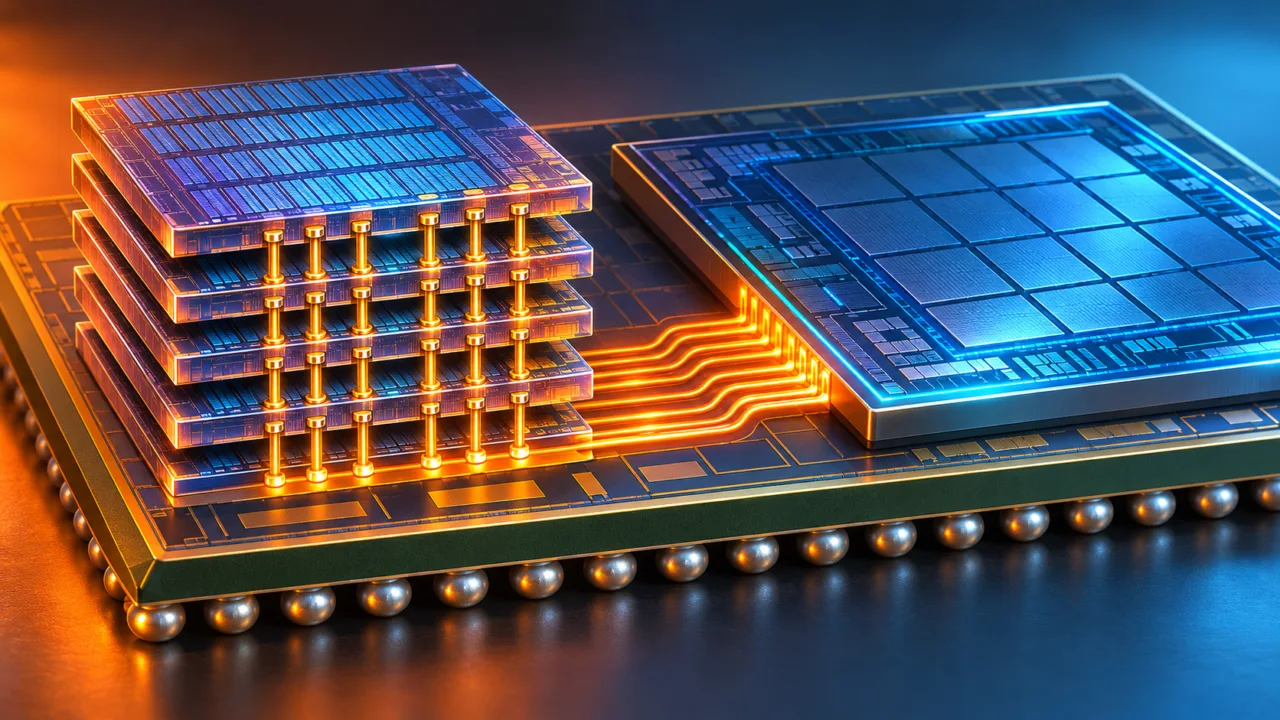
HBM is attracting attention because AI systems rely on more than raw computing power. They also need to store data temporarily and move it quickly enough to keep processors supplied. A machine can have substantial theoretical compute capacity while still waiting for the information required to do its work.
This guide explains the technical and economic mechanisms based on sources available as of November 24, 2026. It does not rank manufacturers or forecast a shortage or stock-market performance. The educational figures are fictional, and commercial specifications remain distinct from the performance of a complete application.
In brief
- Capacity, bandwidth and latency describe different aspects of memory.
- HBM combines stacked memory with close integration alongside compute, depending on the system.
- Its economic value depends on the work actually accelerated and the total cost—not on isolated throughput.
HBM addresses the challenge of moving data
Our report on markets exposed to semiconductors provides the industrial context. To understand memory, start with a program: it handles parameters, inputs and intermediate results. If that information arrives too slowly, some of the available compute sits idle instead of producing output.
Micron’s HBM overview describes a stacked DRAM architecture with numerous connections between the layers. It is distinct from long-term file storage. Confusing working memory with disk capacity would obscure the problem actually being addressed.
The challenge is to keep the processor supplied efficiently within the system’s physical limits. Bringing certain data closer can shorten some paths, but it does not eliminate every exchange with other memory, the network or storage. Architecture must be assessed as a whole rather than presented as a single miracle component.
The customer is therefore not paying solely for a quantity of memory. They are looking for a solution capable of running a workload at the required speed and quality, within the applicable constraints. A higher-performance component may deliver little benefit if the main bottleneck lies elsewhere in the application.
This perspective leads to a useful first question: how much time is being lost waiting for data? Without a diagnosis, a buyer may increase capacity or throughput without solving the underlying problem. The program should be measured before drawing conclusions about the hardware required.
Capacity, bandwidth and latency are not synonyms
Capacity is the amount of data memory can hold. Bandwidth describes a transfer rate over a period of time. Latency is the access or response delay under defined conditions. One of these figures alone cannot be used to reconstruct all the others.
A model or workload can run out of space even with fast memory. Conversely, having plenty of capacity does not guarantee that data can be supplied at the pace of computation. The choice must therefore account for the workload’s size, its access patterns and the resources being used simultaneously.
A simple example makes throughput concrete: transferring 100 units of data at 20 units per second takes at least five seconds under the idealized model used here. Doubling the throughput reduces that minimum to 2.5 seconds. Total execution time will not necessarily be cut in half, because the program may perform other operations and encounter other delays.
Units must remain consistent. Bits and bytes are not interchangeable, nor are a maximum value and a measured sustained throughput. A comparison sheet should specify whether it describes a stack, a component or an entire system. Multiplications are valid only when the scope is consistent.
Our method for checking the figures in an analysis with ChatGPT helps identify these errors. A correct conversion does not, however, demonstrate real-world performance. It makes the calculation consistent; operational results still require measurements on the relevant configuration and workload.
Stacking creates opportunities and constraints
SK hynix’s work on advanced memory architecture addresses connections, stacking and thermal management, among other topics. It shows that adding layers is not enough. Reliability, power delivery and heat dissipation must remain compatible with the desired integration.
Vertical connections help enable communication between layers, depending on the technology used. Their density and manufacturing require industrial precision. Better integration can improve a system while increasing certain assembly or quality-control challenges. Technical sophistication does not mean that every unit automatically becomes cheaper.
Placing memory close to compute also requires packaging work. Components must be connected according to the required specifications and operate together after assembly. System yield therefore depends on multiple stages, not just on the quality of the memory considered in isolation.
Our article on AI in chip design highlights the importance of considering components together. A design must account for data exchanges and product constraints. A memory improvement cannot be mechanically transferred to every architecture already deployed.
For industrial analysis, distinguish between announced capacity, qualified production and customer integration. Each provides different evidence. A demonstration of taller stacking does not immediately reveal commercial volume or the margin generated across the full product range.
Requirements depend on the model and the service delivered
AI workloads do not all use memory in the same way. Data size, the number of simultaneous requests and the organization of computation can change requirements. A configuration suited to a test may behave differently under a more varied request distribution or a stricter latency constraint.
In a contribution published by SK hynix on data and compute, the emphasis is on coordinating them at the system level. This perspective comes from a company with an interest in the memory market. It helps identify the technical questions without constituting an independent ranking of the available solutions.
The report on the computing capacity sought by Anthropic helps put infrastructure demand into context. But a GPU count alone does not reveal how those GPUs are used or configured in terms of memory. Deployment conditions must be known before drawing precise conclusions about component consumption.
Software can also change requirements. A different organization of workloads or data may reduce certain transfers, with effects that still need to be checked against quality and total execution time. It would therefore be incorrect to present every hardware improvement as the only path to better service economics.
A serious test keeps the same quality objective, documents the versions and measures several representative cases. The comparison should not artificially improve results by reducing the difficulty of the workload. Without these conditions, an apparent gain may come from a change in the task rather than from the component under study.
Assessing supply pressure without declaring an endless shortage
HBM demand may require several complementary capabilities: memory manufacturing, assembly, testing and integration. A constraint at one link in the chain can limit deliveries even if other stages have resources available. Broadly referring to a chip shortage is not enough to identify either the cause or its duration.
Manufacturers can invest to increase supply, but additional capacity does not immediately become a qualified product. Conversely, higher output may encounter demand that differs from forecasts. Analysis must allow for both the risk of tight supply and the risk of overcapacity, without treating either as permanently impossible.
Statements about production that has been sold or reserved require their conditions to be examined. A commitment, a forecast and collected revenue do not mean the same thing. Do not extrapolate a future price from a comment about demand when contracts and their duration are not public.
In a simulation, a company funds capacity for 100 units against expected demand of 100. If actual demand reaches 70, fixed costs are spread across fewer units; if it reaches 130, volume may not be able to increase immediately. Both situations can affect prices and margins depending on the contracts.
To monitor the sector, track qualified volumes, lead times, investment and financial results when they are disclosed. Purchase intentions and factory announcements provide context, not certainty of profit. Missing details should remain clearly identified rather than replaced with a linear trajectory.
From a useful component to a possible investment
A genuine technical need does not make every company in the sector attractive at the same price. First determine which company manufactures, assembles or integrates the product, then examine its revenue and costs. The name of a component may cover several activities with very different margins and risks.
Memory that improves compute efficiency can create value for the customer without all of that value accruing to the manufacturer. Pricing, competition and contracts determine how the benefit is shared. Analysis must connect the technical function to documented monetization rather than automatically converting higher throughput into higher profit.
For a system-purchasing budget, compare the cost per successfully completed task, including energy, software and utilization. More expensive hardware may be profitable if its useful gain covers the difference. But an improvement on a single sub-test does not demonstrate the final economics and does not justify excluding integration costs from the calculation.
For a portfolio, examine shared dependencies with other AI players already held. Several manufacturers may be exposed to the same order cycle. Adding memory exposure does not guarantee independent protection against a slowdown in infrastructure spending.
HBM matters because it helps move the data required for computation. Its value must be measured within a system and an application, then connected to contracts and costs. This progression makes it possible to understand an important technology without assigning it a universal technical gain or a guaranteed financial return.