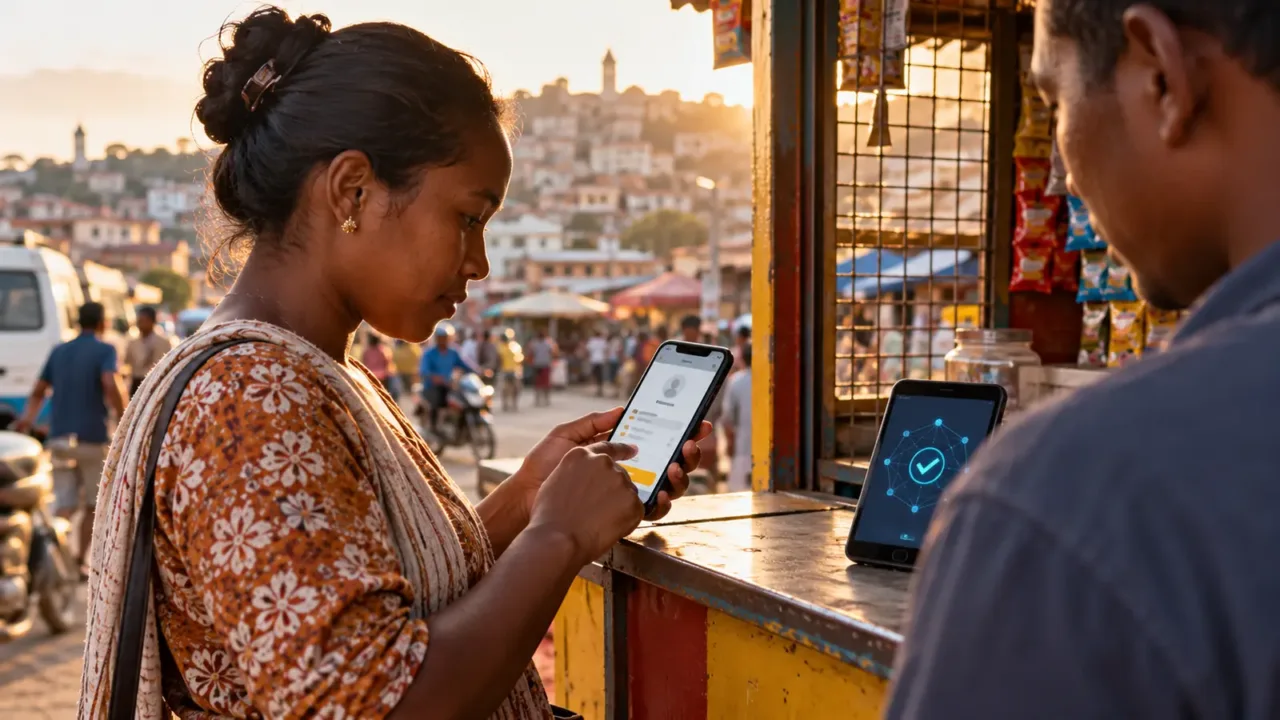
Searches for buying Bitcoin or USDT with Airtel Money in Madagascar often conflate two separate operations: transferring ariary from a mobile wallet and receiving a digital asset from a third party. Airtel’s official pages describe transfers, payments and mobile financial services. They do not, on their own, establish that Airtel sells Bitcoin or that every exchange advertised by a seller is authorized.
Before following a payment link, distinguish the mobile operator from the crypto platform. The presence of a payment method in an offer does not prove that the two services have entered into an official integration.
In brief
- Airtel Money is an electronic-money service with its own terms, fees and procedures.
- A seller’s acceptance of Airtel Money does not prove that Airtel operates or guarantees the crypto exchange.
- Confirm the beneficiary and terms in the official order, then separately verify that the tokens are delivered.
What Airtel’s documents describe
The official Airtel Madagascar page explaining how Airtel Money works lists features such as deposits, sending money to Airtel Money, certain inter-operator transfers, bill payments and links to bank accounts. It describes local-currency and mobile-money services, not a direct bitcoin-conversion process.
The general guide to buying cryptocurrency with mobile money explains how responsibilities are divided between the operator moving the ariary and the counterparty delivering the assets.
Airtel Money Madagascar’s general terms and conditions define the account as a record of electronic money equivalent to an amount held on the user’s behalf. They govern the contract between the customer and Airtel Mobile Commerce Madagascar, as well as authentication and transactions initiated from the account.
The document does not state that Airtel Money offers a crypto exchange. It sets out the framework for the wallet and the customer’s obligations. Someone selling USDT in exchange for an Airtel transfer is therefore adding a separate service to the mobile-money transaction. The user must identify the crypto counterparty and its commitment to deliver.
Fees and limits may change. The version of the terms reviewed explains that they are communicated through the rates published or displayed during a transaction. Read the confirmation screen before approving the payment and check the total amount. An old fee table does not guarantee today’s charge.
The process resembles purchases made through other mobile wallets in several respects, but the terms and fees are not interchangeable. Our guide to crypto platforms in Africa helps identify the counterparty, while the report on wallets and key security helps verify delivery and custody.
How to distinguish an official integration from simple payment acceptance
A genuine integration should appear in official documents, the service’s terms or the provider’s interface. The customer should be able to identify the operator receiving the funds, the crypto seller, the fees, how data is handled and which service is responsible if the tokens do not arrive.
A Facebook post or conversation in a group is not enough to demonstrate a partnership. A merchant may offer customers the option to pay through Airtel Money without Airtel approving the product being sold. Check the merchant’s name through the official channel, the purchase description and the receipt generated. If the order only describes a transfer to a mobile number, do not assume it includes a contract to purchase a digital asset.
In a P2P exchange, the Airtel account may only be used to move the ariary. The seller then remains responsible for transferring the crypto to the designated platform or wallet. The mobile account and crypto account do not automatically form a single legal relationship. To establish who is responsible, keep the terms of both services.
Ask the seller for the promised net amount, network, destination address or account, withdrawal fees and execution time. If the answer changes depending on who contacts you, do not send the money. A professional offer should clearly explain who receives the payment and which document proves delivery.
Calculate the net amount before sending ariary
The cost of a transaction is not limited to Airtel Money’s fees. Add the seller’s quoted price, the spread, any platform commission and blockchain fees. Calculate the unit price based on the ariary actually debited and the amount of crypto actually received. A “zero-fee” offer may conceal a margin in the conversion rate.
Compare offers for the same amount, asset, network and time. The BFM foreign-exchange rate provides a reference for converting USD and ariary, but it does not set the price of a crypto purchase. Keep the exchange rate, market price and fees charged separate.
Check your Airtel account limits, transaction cap, transfer times and any eligibility requirements. These parameters may depend on the account level or the terms in force. Do not split a transaction to bypass a limit, identity check or platform rule.
If the service offers a stablecoin such as USDT, a price close to the dollar does not guarantee the same ariary rate when buying and selling. The seller may quote a different price depending on liquidity. You must also know the delivery network and whether the destination wallet accepts the token on that chain.
Protect your number, code and identity data
Never give a seller your Airtel Money PIN, a confirmation code received by SMS or access to your phone. No crypto provider should need these details to confirm the amount delivered. A code often authorizes a transaction or changes the account; sharing it could enable an unauthorized debit.
If the counterparty sends you a login link, check the website address and avoid entering Airtel or crypto credentials on an unofficial page. Fake forms can easily copy operators’ logos and colors. Open the menu or application from your device rather than through a link shared in a group.
A company may request an identity document to comply with a verification procedure. Check the company’s legal identity, the purpose of the data collection and its privacy policy. The guide to KYC, personal data and remedies provides a framework for understanding which information is necessary and how to protect it.
Protect your account with a unique secret code and secure your SIM card as well. If you lose your phone, contact Airtel using the details published on its website to suspend or protect the account. Someone claiming to “help” after a public comment may be a fake agent seeking your code or a copy of your identity document.
In a P2P purchase, check both confirmations
The buyer should verify the amount debited and the beneficiary in the Airtel Money app. The seller should check the credit in their own transaction history rather than relying on a screenshot. The buyer must then confirm the crypto delivery in their account or wallet. The complete transaction therefore requires at least two independent validations.
If the transaction takes place on a platform with escrow, stay within the official order and use the prescribed dispute procedure. Do not agree to switch to a direct payment in exchange for a discount. Escrow may hold the crypto during verification, but it does not necessarily change Airtel’s refund rules.
Check that the payment-account holder complies with the platform’s rules. A transfer from a third party may trigger a dispute or verification. Never pay a different number from the one shown in the order without a traceable explanation.
A blockchain transaction is not simply an Airtel Money credit notification. For an on-chain transfer, request the transaction hash, check the network and recipient on the appropriate explorer, then wait for the number of confirmations required by the platform. A wallet screenshot does not prove that the assets reached the correct account.
Act quickly if a transaction fails
If Airtel Money confirms the debit but the seller does not deliver, contact Airtel regarding the electronic-money transfer, then open a dispute with the crypto platform if the order was created there. The first service can review its own transfer; it cannot directly change the status of a blockchain transaction or force a seller to deliver an asset.
Record the time, amount, transaction number, beneficiary, P2P reference and channel used. Keep the original receipts and relevant exchanges. Only send identity documents through the necessary official channels, and conceal data that is not relevant to the claim.
Airtel’s terms specify the procedures and limits applicable to the account. Read the current version, particularly the claims procedure and deadlines. If the transfer was authorized from your account, the situation may differ from an unrecognized debit. Describe exactly what happened instead of sending partial screenshots without a timeline.
Beware of a second person promising to “recover” the funds in exchange for an upfront payment. They may pose as Airtel support, a platform team or a blockchain specialist. Do not share any code or pay a private wallet to unlock a refund.
When Airtel Money may be suitable—and when to stop
Airtel Money may be used to transfer ariary when the beneficiary and payment service are covered by the terms in force. A crypto purchase through a third party nevertheless adds counterparty risk. Confirm that the crypto service is explicitly identified, that delivery is defined and that the process does not rely solely on a private message.
If you cannot confirm the seller’s identity, the amount to be delivered, the network or the remedy procedure, stop the transaction. A platform that requires a borrowed identity, a secret code or an undocumented transfer should not be trusted. The absence of an official integration does not prevent private exchanges, but it means users should not attribute the seller’s responsibility to Airtel.
The simplest rule is this: verify Airtel Money through its own channel, verify the crypto in the account that is supposed to receive it, and never treat proof of debit as proof of delivery. This separation helps establish what happened and which service should receive a complaint.