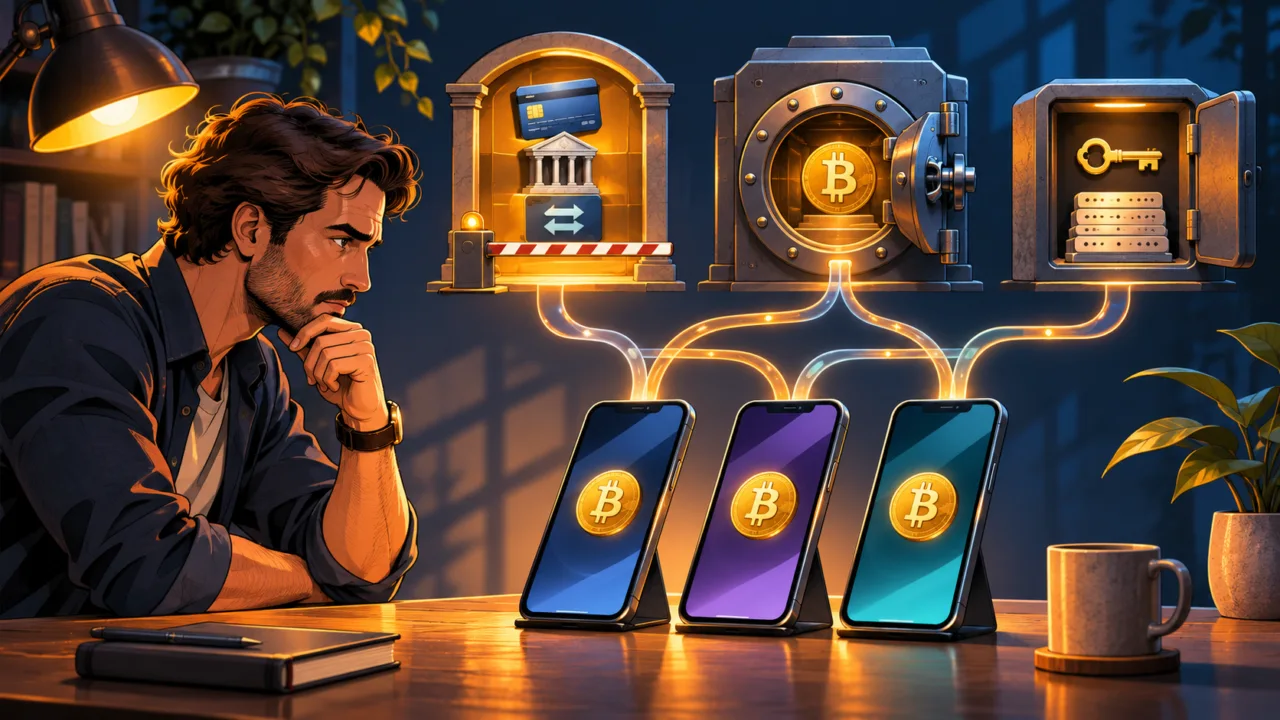
Apps for buying Bitcoin may offer a centralized account, purchases linked to a personal wallet, or access to multiple financial products. Their mobile interface does not reveal who holds the keys or what the user can actually withdraw. Comparing app-store ratings does not answer those questions.
Looking ahead to 2027, this guide examines Coinbase, Kraken and Relai as three examples of documented user journeys. The offerings were reviewed on November 5, 2026, and will need to be checked again. The article does not identify one universally best app and does not assume that these services are available in every country.
In brief
Our guide to buying cryptocurrencies outlines the steps involved in making a first purchase. On mobile, users must also consider the app, account access and recovery after losing their phone.
- An exchange account and a non-custodial wallet do not represent the same custody model.
- The full price and minimum amounts must be checked within the exact purchase flow.
- The official app should be installed from a verified source before any funds are deposited.
Distinguishing the app, the account and the Bitcoin purchased
An app is an interface. It may display a balance held by a service provider or manage keys whose security is the user’s responsibility. That distinction affects recovery procedures, withdrawals and risks. Seeing Bitcoin on a screen does not prove direct control of the keys.
The same brand may also offer several apps. A centralized account, trading interface and self-custody wallet should not be treated as purely visual versions of a single product. Their terms and responsibilities may differ even when the logo looks familiar.
The official presentation of the Coinbase app and supported devices can help verify its distribution identity. Users must distinguish this account app from other mobile products offered by the same provider and review the service they are actually opening.
The asset itself must also be identified. Buying Bitcoin on the spot market is not the same as trading a contract on its price or automatically receiving a representative token on another blockchain. Before confirming a transaction, users should know what they will hold, what can be transferred and what will be settled at withdrawal.
The choice ultimately depends on the intended use: an occasional purchase, recurring purchases, sending funds to a wallet or using a payment network. An app packed with features is not necessarily better suited to a simple need. Unused features should not obscure difficult withdrawals or high costs.
Comparing Coinbase, Kraken and Relai based on their user journeys
Coinbase offers a purchase experience linked to an account, as well as Advanced features with different pricing. Its fee page states that costs depend on several factors and may vary by region. The quote shown for the account should take precedence over a general rate found on a comparison site.
Kraken distinguishes between several official apps. Its mobile app overview includes an app focused on buying and tracking, as well as a Pro offering with more trading tools. The presence of a feature in this overview does not prove that every user can access it.
Relai follows a different model: an app focused on Bitcoin and self-custody. Its official website describes recovery-phrase backups and the purchase process. At the time of review, it displayed an entry amount of fifty euros or Swiss francs for the journey presented, which should be checked again before use.
These examples are therefore not three versions of the same service. One reader may prefer the structure of a centralized account for certain uses, while another may want a route to their own keys. Making that choice requires understanding the responsibilities involved; it cannot be reduced to the number of clicks.
Our guide to the cryptocurrencies available on Coinbase provides additional context for a multi-asset service. For an exclusively Bitcoin-focused need, the number of available tokens is not enough to make a decision. Conversely, a specialized app is not automatically better suited if its minimums or payment methods do not fit the user’s needs.
Checking local access and the source of the installation
Availability in an app store may depend on settings that do not correspond to eligibility for the service. A successful download does not mean that every feature can be used. The accepted country, contracting entity and product must be checked against the terms applicable to the account.
For European readers, the European authorities’ MiCA factsheet recommends consulting the relevant regulatory sources. A provider’s commercial claim should be checked against the entity and service concerned, without treating regulatory status as a guarantee of capital.
Installation should begin from the official website or a verified distribution link. An app’s name and icon can be copied. An advertisement, private message or file supplied by someone claiming to be support does not become trustworthy simply because it uses a familiar brand.
The permissions requested should match the app’s functions. An unexpected request for remote access or a recovery secret should be a reason to stop. Users should never treat a personal wallet’s recovery phrase as a support code to be shared with another person.
Updates and device compatibility also matter. An unmaintained or shared phone can create risks unrelated to the quality of the service. The comparison should reflect the environment actually being used, not just a demonstration on a recent device.
Comparing the quote, minimums and final destination
The same budget may produce different amounts depending on the payment method, spread and fees. For a meaningful comparison, record the amount charged and the quantity actually received at roughly the same time. Maker, taker, spread and gas fees should be distinguished rather than collapsed into a single line.
An instant purchase flow and an order book do not impose exactly the same constraints. The former may provide a simple quote; the latter allows certain order choices but does not guarantee immediate execution at the desired price. A simple interface should not be confused with a lower cost.
The payment method can have a significant effect on the result. A bank transfer, card and mobile payment wallet may not carry the same fee. Comparing funds already credited to one service with a card payment to another requires that difference to be made clear.
Minimums should be checked at every stage: deposit, purchase, sale and withdrawal. An app may accept an amount that does not subsequently allow the intended journey to be completed. For a small sum, a fixed cost or withdrawal threshold may matter more than the trading fee.
If the goal is to receive Bitcoin in a personal wallet, the final amount delivered is a useful indicator. The network must be compatible with the receiving wallet. An address that appears correct is not enough to prove compatibility with every transfer method offered.
Preparing for phone loss before funding the account
A centralized account and a self-custody wallet are not recovered in the same way. The former depends in particular on the service’s identity and access procedures. The latter may depend on key backups or a specific recovery mechanism. Users must understand the system actually in use rather than assume there is one universal method.
A self-custody wallet reduces certain dependencies on a custodian while adding personal responsibility. A poorly stored backup can be lost or copied. Self-custody is therefore not a guarantee against mistakes, theft or signing a deceptive instruction.
For an account, authentication and recovery methods should be prepared together. Securing the login without considering the loss of a device can prevent legitimate access. Conversely, an overly easy backup route can weaken the security setup. The exact options should be checked in the service’s documentation.
Procedural notes can indicate where to find information and whom to contact without keeping every secret in the same place. A screenshot of a recovery phrase stored with account credentials exposes several safeguards to the same compromise. Documenting the process does not mean centralizing keys in a shared folder.
A small test receipt and transfer may help verify the setup if the costs remain proportionate. It does not prove the service’s future security or that the entire backup has been stored correctly. Its purpose is to identify a concrete problem before increasing exposure.
Choosing an app suited to the actual use case
A final checklist can compare the asset purchased, custody, payment method, net price and recovery. It should leave unknown information marked as unknown. An app-store rating or promise of rapid support does not replace checking rights and withdrawal conditions.
Users can then rule out features that add unnecessary risk: leverage, yield or complex transactions are not needed to learn how to buy and transfer a small amount of Bitcoin. Their presence should not become a reason to use them without first understanding them.
In 2027, the best apps for buying Bitcoin will therefore be those whose accessible user journey matches the reader’s needs and skills. Offers and fees will need to be reviewed again. As long as price, custody and recovery remain unclear, waiting is preferable to installing the most heavily promoted app.