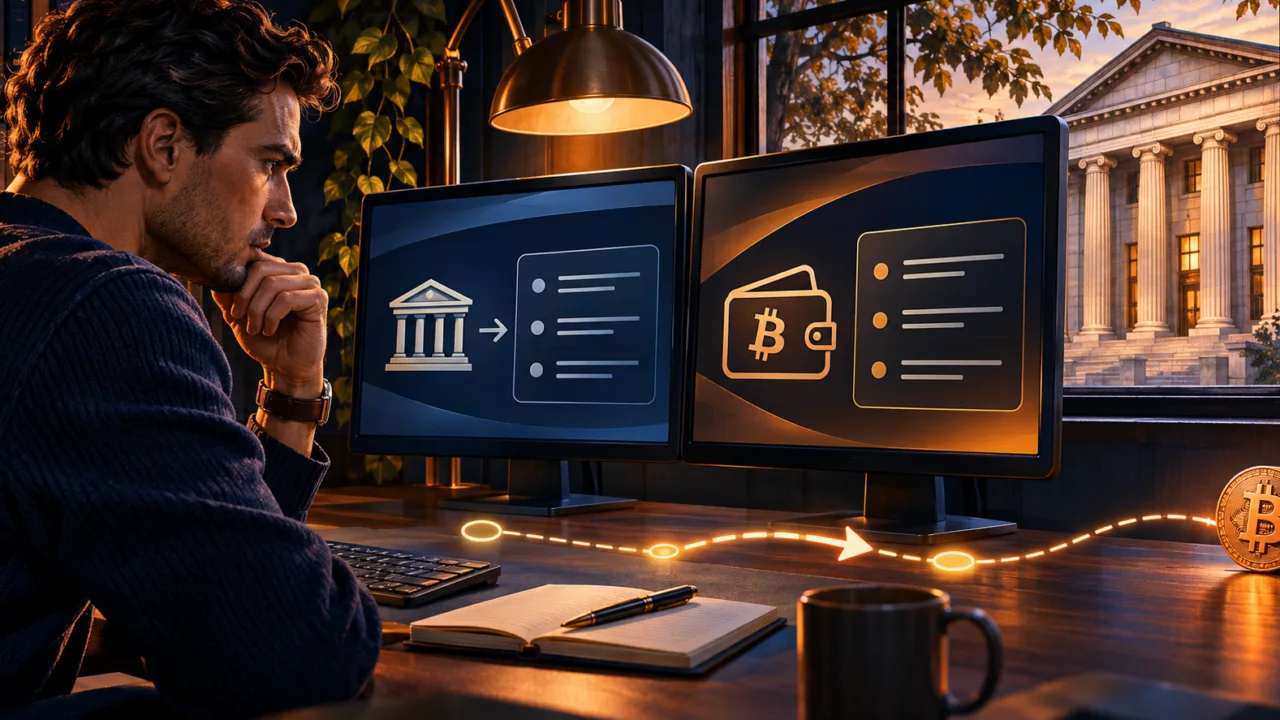
Buying Bitcoin from a bank account in 2027 may be offered by different providers, depending on the country, the account and the services available. But sending a transfer to a platform does not mean that the bank sells Bitcoin or guarantees the investment. The transfer of money, the purchase of the cryptoasset and its custody after the transaction must be treated as separate steps.
This guide outlines the practical checks to carry out based on documents reviewed on November 11, 2026. The service examples illustrate specific conditions; they are not a recommendation or a promise of universal access in 2027. Local law, the bank’s terms and the provider’s conditions must be considered together.
In brief
- Funding a platform by bank transfer does not turn its crypto offering into a product guaranteed by the issuing bank.
- The account holder’s name, beneficiary, currency and required references must match the current instructions.
- The cost and documentation required for a return to the bank account should be reviewed before the first deposit.
Bank transfer, purchase and custody: three steps to keep separate
The crypto ecosystem glossary helps distinguish between money, platforms and wallets. This distinction clarifies the process: funds may first be transferred to an account linked to the provider and then used for a purchase. The balance after the deposit does not necessarily represent a quantity of bitcoin already held.
The provider may offer a simplified purchase process or a different trading interface. Prices and fees should be reviewed for the specific process being used. A low-cost transfer does not guarantee the best price at the purchase stage, and a transaction promotion does not make every other movement free.
After the purchase, it is important to establish who holds the assets. A balance on a platform does not automatically mean that the customer controls the keys. Withdrawing to a personal wallet is an additional step, involving its own network, fees and checks. These features should not be assumed to exist simply because the purchase succeeded.
A bank may also distribute a financial product exposed to Bitcoin or offer a service through a partner. The contract must then be read to determine what is actually held: the asset, a claim on an intermediary or a listed security. Presenting these options within a banking app does not make them interchangeable.
The first useful document is therefore a simple summary listing the contracting company, funding method, purchased product and custody arrangement. This makes it easier to ask support a precise question and compare offers. Above all, it prevents the security of a bank transfer from being confused with the economic risk of the product it funds.
Which details and account holder should be checked?
Kraken’s official bank deposit checklist notably requires the bank account name to match the customer account name. It distinguishes business and personal accounts and reiterates the references that must be included when requested. These instructions should be read for the selected method rather than copied from an earlier deposit.
Crypto.com’s documentation on EUR deposits also sets out requirements concerning the name, currency and SEPA channel, along with restrictions on third-party payments. Differences between providers matter, particularly for joint accounts or payment intermediaries. A procedure accepted by one provider is not automatically valid with another.
Before making a transfer, retrieve the details from the official account area and check the beneficiary, currency and any required reference. A private message claiming to provide a new IBAN should be independently confirmed. Anyone asking you to speed up the payment should not become the sole source of instructions for moving funds.
The beneficiary may be a payment partner rather than the familiar brand name. The official instructions should explain this difference. If the information conflicts, request clarification before making the transfer. Do not select the most reassuring information or send several payments to see which one is credited.
A small test transfer can verify certain practical details, but it does not demonstrate the service’s financial strength or overall compliance. Keep proof of the transfer and check the amount credited. A successful test does not justify ignoring any later change to the conditions, beneficiary or countries served.
How should the full cost of the process be calculated?
The calculation starts with the amount debited from the bank account and ends with the quantity actually received, followed by the cost of any withdrawal. In between, there may be bank fees, currency conversion, deposit fees, a purchase commission and a price spread. A “free deposit” offer describes only one part of the process.
Consider a fictional illustration: a 200-euro budget incurs 2 euros in transfer fees, followed by a 0.5% purchase commission on the remaining 198 euros. The commission comes to 0.99 euro, leaving 197.01 euros of exposure before any other cost. This example does not reflect the pricing of any institution; it shows how successive fees combine.
The purchase price should then be compared at the same moment and for the same amount. An interface may advertise a low commission while offering a price that differs from the reference market price used by the reader. The final transaction summary should be examined rather than comparing advertising percentages alone.
The bank account’s currency can also affect the cost. A transfer in a currency different from the one accepted by the provider may result in a conversion or rejection, depending on the terms. Checking the required currency and the bank’s pricing helps avoid attributing a funding cost to the platform.
For repeated purchases, recording fixed and variable fees in a table makes it possible to compare different schedules. The same flat fee weighs more heavily on frequent small transactions than on a larger amount. This arithmetic observation is not a recommendation to increase the exposed budget: market risk and the ability to absorb losses remain separate questions.
Why might a bank request supporting documents?
The Bank of France explains how account transactions are monitored. It describes vigilance relating to anti-money-laundering measures and possible requests concerning the origin, destination and purpose of funds, as well as the beneficiary. Not every documentation request should therefore be interpreted as a general ban on Bitcoin.
The relevant file should explain the economic process: proof of the initial transfer, the provider’s statement and transaction references. For a return of funds, the purchase and sale history helps link the amount received to its origin. A screenshot showing only the current balance does not necessarily reconstruct that history.
Our guide to KYC checks and personal data provides a method for distinguishing a legitimate request from abusive data collection. Specific requirements vary by country and institution. The procedure should remain verifiable through the official channel, especially when a message urgently requests sensitive documents.
Supporting documentation must never include the secrets that allow assets to be moved. A recovery phrase and private key are not proof of income intended for a support agent. Statements, contracts and public references should make it possible to understand a transaction without transferring control of the wallet to a third party.
A question about the origin of funds should not be evaded through a false statement, a borrowed account or an artificial sequence of small transfers. The useful response is to clarify the facts and ask what documents are expected. Adding an inconsistency to the file may complicate verification rather than speed it up.
What should be checked before withdrawing to a bank account?
The withdrawal should be assessed before making the deposit. Checking available currencies, fees, limits and the accepted beneficiary account helps avoid a process that is easy to fund but difficult to unwind. The conditions for selling Bitcoin and those governing a withdrawal in fiat currency should be distinguished in the calculation.
The processing time for a bank transfer should not be confused with the provider’s internal validation time. An executed sale may still involve documentation or operational steps before payment. Reading the transaction statuses and keeping confirmations helps identify where a delay is occurring.
If the user chooses direct custody in a wallet, returning funds to the bank may require another step through an intermediary. Control of the keys alone does not provide a payment account or guarantee conversion. The transfer network and the recipient’s rules should be checked before sending.
The limitations of hardware wallets also show that protecting signatures does not replace economic records. Keeping transaction histories separately from the hardware makes it possible to prepare a future sale or explain a return of funds, even if an older application is no longer used.
Buying Bitcoin from a bank account in 2027 may therefore refer to several different processes, not a universal feature offered by every bank. The decision should connect local law, account identities, the acquired product, total cost and the possibility of withdrawal. The relevant check concerns the entire chain, not merely the presence of a “bank transfer” button.