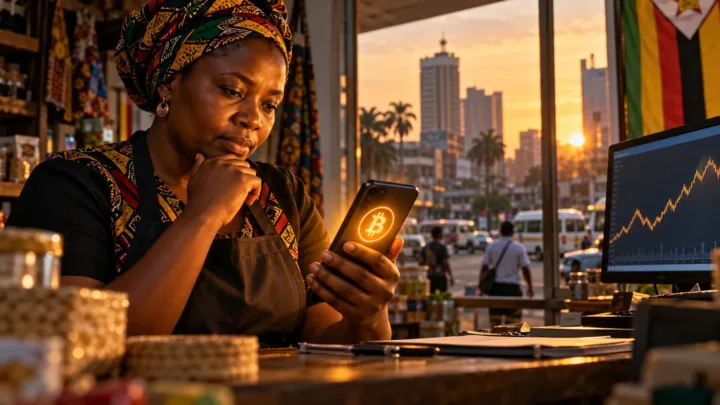
Buying USDT in Zimbabwe may seem straightforward because the token aims to maintain a value close to one dollar. Yet that target does not guarantee the local price, access to a payment method, or conversion into USD or ZiG. The outcome depends on the seller, the network selected, fees, liquidity and whether you can ultimately exit the token.
A stablecoin reduces some of the price swings associated with Bitcoin, but replaces part of that market risk with other dependencies: the issuer, intermediaries, blockchains and the channels used to enter and exit the asset. These layers should be understood before sending money, particularly when the funds are earmarked for a future expense.
In brief
- USDT aims to track the dollar, but it is neither a banknote nor a bank deposit.
- A token on Tron, Ethereum or another chain cannot be sent indiscriminately between networks.
- Verification must cover the purchase, custody, fees and final withdrawal into genuinely usable currency.
What the USDT price actually means
The BrefCrypto guide to crypto in Zimbabwe places USDT in an environment where USD and ZiG coexist. A price close to 1 USD means the market generally values a token around that reference point. It does not mean every holder can exchange USDT directly for a cash dollar at the same rate.
Tether’s official terms distinguish USDT from fiat currencies: the tokens are administered by the issuer, can exist across multiple protocols, and their direct issuance or redemption is subject to eligibility, verification and fee requirements. Buying on a secondary platform does not automatically make the buyer a direct Tether customer. In many cases, the buyer relies on the seller or exchange to resell the balance.
The price seen by a resident may diverge from the advertised peg. Local supply and demand, payment costs, settlement risks, liquidity and the seller’s margin all influence the P2P rate. A price of 1.03 USD in local equivalent does not prove that USDT officially “is worth” more: it may reflect difficulty accessing a payment channel or a temporary spike in demand.
The full cost calculation includes the deposit, conversion rate, spread, purchase commission, network fee and exit. The guide to crypto trading fees and hidden costs explains the differences between visible fees, slippage and blockchain fees. Compare the total amount debited with the number of tokens actually received.
Choose the exact network before transferring
USDT is available on multiple networks, but the same ticker does not represent a universal address compatible with every chain. A platform may accept deposits only on certain networks. If the sender chooses a network unsupported by the recipient, the transfer may be lost or require a paid recovery procedure that is not guaranteed.
Before sending, check the destination service’s official interface for the network name, address format, minimum deposit, required number of confirmations and any memo or tag. The token name alone is not enough. After pasting the address, compare its first and last characters, as malware can replace clipboard contents.
Choosing a network involves a trade-off. Lower fees may be attractive, but compatibility, liquidity and withdrawal options matter more than saving a few cents. A platform may temporarily suspend deposits or withdrawals on a chain for maintenance. Check the network’s status when making the transaction, not several days beforehand.
An on-chain transfer is confirmed according to the blockchain’s operating rules. Once recorded, it generally cannot be cancelled through a simple support request. Users should therefore avoid testing an address by sending their entire balance. A test transfer can reduce the risk of sending funds to the wrong destination, but it creates additional fees; whether it is worthwhile depends on the amount and the tool being used.
Buying through a platform or P2P seller
A centralized platform may offer a purchase interface, custodial storage and withdrawals. Before using it, check the legal entity named in the terms, supported countries, payment methods and available assets. Zimbabwe’s FIU provides a dedicated VASP portal with forms and AML documents. This oversight should not, by itself, be interpreted as a recommendation of a provider or proof that all of its services hold the required authorizations.
P2P trading can connect a buyer and seller without a conventional bank conversion within the same interface. It does not eliminate counterparty risk. Review ratings cautiously, along with the seller’s history, limits and payment channel. Positive comments prove neither that the activity is conducted regularly nor that the seller will be able to honor a contract in the future.
If the service provides an escrow mechanism, remain within the official process until the tokens are released. The Binance P2P instructions illustrate the role of escrow in transactions conducted through its platform, but this documentation does not confirm that a specific account, payment method or product is available to every Zimbabwean resident.
A seller who asks you to pay a third-party account or leave the platform’s chat creates an additional risk area. Once payment is sent, the platform may no longer be able to arbitrate the dispute. Keep payment references and wait until the funds appear in your own service. A buyer’s screenshot is not proof that the money was received.
Do not confuse EcoCash with an USDT seller
EcoCash provides electronic money services. Its official terms describe a payment wallet with transactions linked to USD and ZiG values, as well as rules on fees, limits and processing. They do not establish an official integration with USDT or a general authorization to sell crypto-assets.
An individual may sometimes claim to accept a mobile payment in exchange for a token. That does not mean the mobile-money operator endorses the sale, guarantees delivery or handles crypto disputes. Before transferring funds, identify the recipient, the purpose of the payment, proof of receipt, the recourse mechanism and the entity delivering the tokens. Do not give a seller your PIN or OTP.
The BrefCrypto guide to buying cryptocurrencies with mobile money reiterates a general rule: distinguish the payment provider from the asset seller. A mobile wallet can move fiat currency without verifying the identity of an independent seller. For Zimbabwe, the sources used for this guide do not establish any official EcoCash-USDT integration; commercial claims should be verified separately.
Assess custody and counterparty risks
If USDT remains on a platform, the user depends on the operator for account access and withdrawals. The service’s terms may allow additional verification or a freeze when a transaction appears suspicious. Know where the official support channel is and how to retrieve records before a problem arises.
With self-custody, the user controls a private key and is responsible for protecting it. The key should never be given to a payment service, and the recovery phrase must never be shared by message. Fake support agents sometimes promise to restore a transaction in exchange for the phrase. Any site claiming it can “synchronize” a wallet by asking for the words may take the funds.
The issuer also plays a role distinct from that of the network. Tether’s terms state that certain direct redemption functions require verification and remain subject to thresholds and rules. Holding USDT in a wallet therefore does not automatically create a straightforward right to immediate conversion into a bank account in Zimbabwe.
Stablecoins carry risks including depegging, address freezes, protocol incidents, intermediary outages and changes to the applicable terms. Circle’s USDC legal page illustrates, for another issuer, how rights depend on the contractual relationship, eligibility and applicable conditions. This framework is not identical to Tether’s; it shows why each issuer must be assessed separately.
Plan the exit before making the deposit
The objective should be expressed as a final amount: how much USD or ZWG can arrive, through which channel, within what timeframe and at what price? A profitable purchase shown in a screenshot can become expensive if the seller applies a margin on the sale, withdrawals are suspended or the fiat channel does not accept the amount.
Before a significant transaction, check the minimum sale threshold, withdrawal options, fees, exit network and required documentation. Run a simulation without confirming payment if the interface allows it. If necessary, a small test transaction can confirm receipt, but it does not demonstrate future liquidity or the service’s long-term reliability.
The ZiG rate changes, and a value displayed in USD does not necessarily correspond to the amount you will be able to recover in local currency. The RBZ publishes exchange-rate references, not a contractual price for tokens. Any calculation should specify the time, currency, rate and exit cost. Without those details, an estimate does not show the final financial result.
USDT simplifies the unit of account, not the guarantee
In Zimbabwe, USDT can provide a dollar-denominated unit of account for certain digital transactions. Its use nevertheless depends on intermediaries, issuer rules, a network and an exit channel. Near-parity does not replace available liquidity or a repayment contract applicable to every holder.
Verify the token, network and seller independently, keep a record of the payment, then check the amount recoverable in USD or ZiG before deciding. BrefCrypto’s coverage of stablecoins in Africa examines other regional uses and risks. No stablecoin turns essential funds into a risk-free investment.