

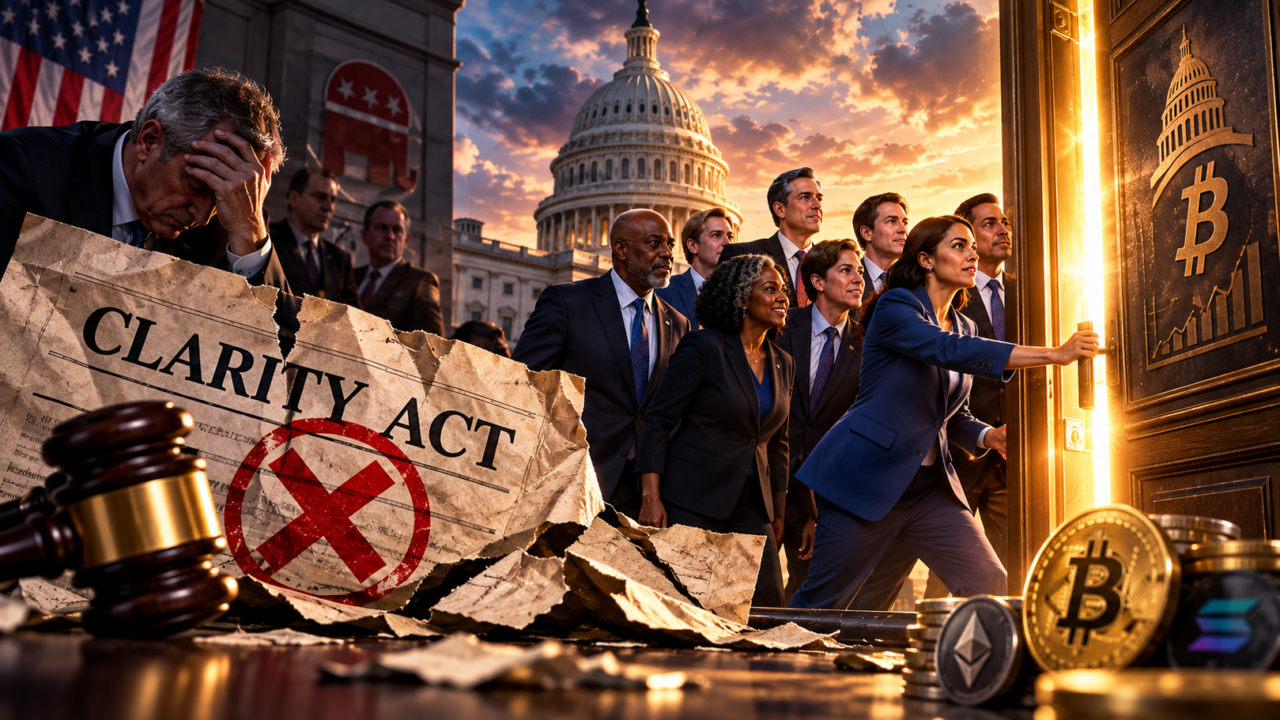
49 votes in favor, 50 against, and eleven missing votes to reach the decisive 60-vote threshold. The CLARITY Act has just suffered its most serious setback in the US Senate. Two days after the September 15 vote, however, the bill is not completely dead. Seven Democratic senators who voted against it maintain they want to continue negotiations, while a procedural maneuver leaves the possibility of a new vote open. Meanwhile, the SEC and CFTC are no longer waiting on Congress to move forward with some of their crypto rules. Washington is now moving along two tracks at once.
CLARITY Act Fails with 49 Votes
The September 15 vote was not yet a final vote on the CLARITY Act. The Senate had to decide whether to end procedural debate to move to consideration of the bill. This cloture motion required a three-fifths majority of the Senate, or 60 votes. It only garnered 49, compared to 50 votes against and one absence.
Bref Crypto had already noted a few days earlier that the CLARITY Act was arriving in the Senate without securing its 60 votes. The official vote confirms that the issue ultimately extended beyond Democrats alone. Susan Collins, Josh Hawley, Jerry Moran, and Thom Tillis, all Republicans, were also among the « no » votes. Chris Coons, a Democrat from Delaware, did not participate.
The contrast with the House is striking. In July 2025, H.R. 3633 was passed by 294 votes to 134, with 78 Democrats joining Republicans. The bill had therefore already demonstrated that a bipartisan compromise was possible in one chamber of Congress. The Senate simply imposes a much higher procedural hurdle.
The setback is real. However, it does not mean that senators have definitively rejected every provision of the bill. They merely refused, at this stage, to clear the procedural hurdle required to continue its consideration. This is an important nuance, and in Washington, it can make all the difference.
Seven Democrats Refuse to Bury the Bill
The first sign that prevents calling the bill dead came the very next day.
Kirsten Gillibrand, Angela Alsobrooks, Cory Booker, Catherine Cortez Masto, Ruben Gallego, Mark Warner, and Raphael Warnock issued a joint statement on September 16. All had voted against cloture the previous day. All now say they remain committed to passing legislation on crypto market structure.
Their statement describes the vote as a « setback, » « but not the end » of the work. The seven senators assert they want to continue working in a bipartisan manner on the issue.
This group is particularly significant because several of its members have already supported different stages of the crypto negotiations. Notably, Gallego and Alsobrooks had joined Republicans when the bill progressed through the Banking Committee earlier in the year. The issue is therefore not simply a principled opposition to any regulation of the sector.
Disagreements center on the content. Bref Crypto was already monitoring this development when the ethics compromise surrounding the CLARITY Act seemed to unblock at the White House.
However, the September 16 statement does not guarantee a new vote. Nor does it state that the seven senators will vote « yes » on the currently available bill.
It only indicates that they wish to resume negotiations. Mathematically, this is not yet enough. Even if all seven were to join the 49 « yes » votes from the last roll call tomorrow, the Senate would only reach 56 votes. It would therefore be necessary to secure other support or win back some of the Republicans who voted « no. »
The issue remains open. The coalition, however, has yet to be rebuilt.
Ethics Remains at the Heart of the Disagreement
Negotiations in recent months have largely revolved around rules applicable to politicians holding interests in crypto.
Democrats have notably requested restrictions on the financial activities of elected officials and high-ranking administrators to limit conflicts of interest. The debate gained particular prominence due to crypto activities linked to Donald Trump and his family. These concerns were expressed publicly by several Democratic senators, while Republicans, for their part, asserted that they had integrated a large portion of their demands into the final bill.
On September 14, Cynthia Lummis, John Boozman, and Tim Scott released a new version of the CLARITY Act. According to their presentation, it incorporated 126 amendments requested by Democrats, as well as the core of an ethics proposal negotiated by Thom Tillis and Ruben Gallego. The bill also provides a role for state attorneys general in enforcing certain provisions.
Donald Trump had accepted a significant portion of these new restrictions prior to the vote, according to Reuters and other media outlets tracking the negotiations. This was clearly not enough to muster the 60 votes required.
Why? Because the conflict is not limited to a single provision. Discussions also cover stablecoin rewards, the risk of bank deposit runs, rules applicable to certain DeFi activities, developer protection, and the division of authority between the SEC and CFTC.
For instance, Josh Hawley had previously threatened to oppose the bill due to the consequences he feared for banks and deposits. Bref Crypto detailed this conflict between stablecoins and regional banks. Thus, a compromise on Trump was not enough to resolve the entire equation.
Thom Tillis Leaves a Procedural Door Open
Thom Tillis’s vote deserves its own section. The Republican Senator from North Carolina supported the CLARITY Act negotiations and had initially voted in favor of cloture. When failure became obvious, he ultimately switched to a « no » vote. Reuters reports that this shift preserves the possibility of reconsidering the vote.
This mechanism aligns with standard Senate rules. A motion to reconsider must be entered by a senator who voted on the prevailing side of the initial vote. In this case, the prevailing side was the « no » vote. The Senate’s procedural glossary explains precisely that a member can change their vote on a cloture motion to preserve the option to request a new vote later.
This detail prevents treating the 49–50 vote as a legislative death sentence.
A revote is possible.
However, several procedural steps would have to be cleared, and above all, there would need to be a political reason to do so: no one benefits from repeating the exact same vote with the exact same senators and the exact same outcome.
First, votes must be found.
The precedent of the GENIUS Act shows that an initial procedural failure does not automatically doom crypto legislation. Bills can return after further negotiations.
Then there is the calendar.
The Senate is entering an already busy period ahead of the midterms and must also address budgetary issues. Prior to the vote, Cynthia Lummis warned that the available window was becoming extremely narrow, estimating that a failure could delay comprehensive market structure reform for several years. The procedure exists, but time is running out.
SEC and CFTC Move to Regulatory Action
While Congress searches for its 60 votes, the SEC and CFTC already possess their own authorities.
Well before the failure of the CLARITY Act, the two agencies had begun harmonizing their approaches. In March, they issued a joint interpretation classifying various crypto-assets into categories such as digital commodities, collectibles, digital tools, stablecoins, and digital securities. They also clarified the treatment of certain mining, staking, and wrapping activities.
Following the September 15 vote, SEC Chairman Paul Atkins stated that his agency would continue to act with or without new legislation, within the limits of powers already granted by law. CFTC Chairman Michael Selig also indicated that his agency was ready to move forward with its rulemaking.
This is the famous « Plan B » now being discussed by the industry. The SEC can clarify how securities laws apply to tokens, adapt certain custody or issuance rules, and work on tokenized securities. Its 2026 regulatory agenda explicitly mentions crypto-asset custody, capital raising, and tokenization.
The CFTC, for its part, can act within the scope already granted to it by the Commodity Exchange Act. This allows for progress, but it does not give the agencies the same powers as a law passed by Congress. And Paul Atkins himself had acknowledged this prior to the vote.
Regulators Cannot Fully Replace Congress
This is perhaps the most important point to understand what comes next. The CLARITY Act seeks to codify a durable framework between the SEC and the CFTC: which assets fall under which agency, which platforms must register, how to handle certain secondary market transactions, what frameworks to apply to crypto market participants, and what legal protections to grant to certain activities. The bill passed by the House in 2025 already contained a long list of provisions on these matters.
An agency cannot simply invent a new jurisdiction that Congress has never granted it.
It can interpret existing law.
Write rules within its scope.
Grant certain exemptions.
Clarify its practices.
It cannot single-handedly reshape the entire US legislative framework.
Paul Atkins formulated this very clearly on August 18: in his view, a law remains « essential » to create sufficiently durable rules. He also explained that a purely regulatory framework could be undone by a future administration or a future regulator adopting a different interpretation.
Therein lies the limit of the SEC-CFTC plan.
It can reduce uncertainty today.
It cannot offer the exact same legal stability as a bill passed by the House, the Senate, and signed by the President.
This is also why the CLARITY Act remains important despite its procedural failure.
The issue is therefore not a choice between two mutually exclusive options—Congress or regulators.
The United States could now operate with both in parallel: agencies build what they can immediately, while Congress attempts to resume the legislative work.
Crypto Continues to Move Forward Elsewhere in Congress
Furthermore, the setback for the CLARITY Act has not halted all bills related to digital assets.
On September 16, just one day after the Senate vote, the House Ways and Means Committee approved the Digital Asset Tax Certainty Act by a vote of 38 to 5. The bill aims, among other things, to clarify the tax treatment of mining, staking, and other digital asset operations.
The vote was broadly bipartisan.
This does not mean the bill has become law; it must still clear other hurdles in Congress.
However, it demonstrates that the gridlock over the CLARITY Act does not represent a complete halt to US crypto legislative efforts.
Issues are fragmenting.
Market structure in the Senate.
Taxation in the House.
SEC rules.
CFTC rules.
Stablecoins already being addressed separately.
This development is not necessarily what proponents of the CLARITY Act had hoped for, as they aimed to establish a more cohesive framework. Nonetheless, it is becoming the regulatory reality of the moment.
Bref Crypto had already highlighted that the primary adversary of the CLARITY Act was also the legislative calendar.
This observation is even truer today.
Congress can continue to pass piecemeal regulations without immediately succeeding in passing the overarching legislation meant to organize the entire market.
Dead or Delayed? For Now, Delayed
Calling the CLARITY Act « dead » today would be too definitive.
The Senate vote is unambiguous: the cloture motion failed on September 15 by 49 votes to 50, and the bill therefore did not advance.
Cynthia Lummis reacted strongly after the vote, presenting the failure as the end of the effort for this session of Congress. This reading represents the position of one of the bill’s main Republican architects, not an absolute procedural impossibility.
On the other side, seven Democrats officially state that the work continues.
Thom Tillis has preserved a path to reconsideration.
And Senate rules do indeed allow for returning to a failed motion.
This is where the CLARITY Act actually stands on September 17, 2026.
Not passed.
Not permanently erased.
Stuck between a still-recoverable procedure and a closing political calendar.
Meanwhile, the SEC and CFTC will likely not wait for the Senate to resolve its coalition problem. Both agencies already have a joint crypto program and have announced their intention to continue utilizing the authorities granted to them by existing laws.
The paradox is almost perfect.
The CLARITY Act was supposed to clarify who does what between the SEC and the CFTC.
Its blockage now forces the SEC and CFTC to move forward without it.
This could yield more rules in the coming months.
But not necessarily the durable legal certainty that Congress sought to establish.