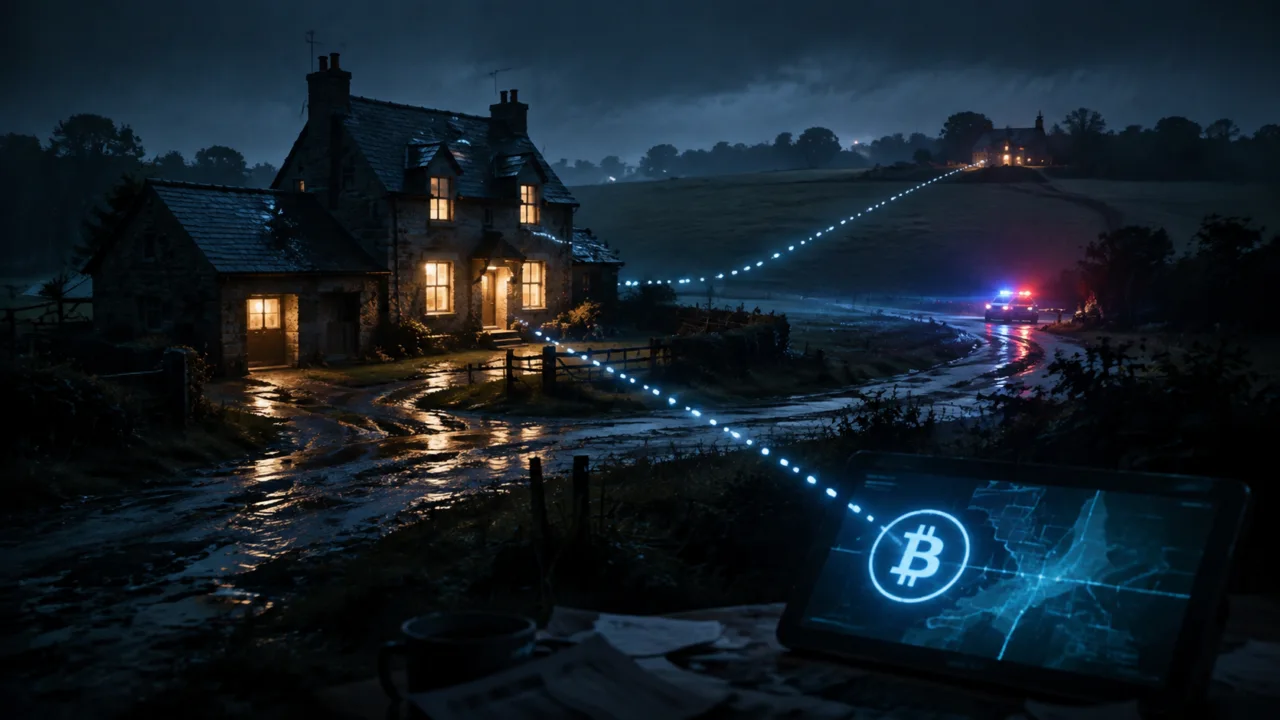
An isolated house targeted on August 22
Vern-sur-Seiche has around 8,000 inhabitants and lies south of Rennes, in Ille-et-Vilaine. The property in question is located outside the town center, in the countryside.
The case comes against an already serious backdrop. In July, Bref Crypto counted 77 crypto-related kidnappings, hostage-taking incidents, extortion cases or attempts in France during the first half of 2026. The Breton case occurred after that assessment and is therefore not included in those 77 incidents.
On August 22, several people entered the property and confronted the occupants. The tenants were assaulted, subjected to violence and then held hostage. The attackers eventually realized, however, that the person they were looking for did not live there.
The owner was reportedly the real target because of cryptocurrency he was believed to hold. The attackers eventually left after discovering that he was absent.
The victims received care after the incident and, according to published reports, remain deeply affected by the assault. The Rennes prosecutor confirmed the mistaken identity while declining to provide further details in order to protect the investigation.
Many details remain unknown
It is important to focus precisely on what the investigation has established.
At this stage, prosecutors have not made public the exact number of attackers, the duration of the hostage-taking, the type of weapons possibly used or how the suspects linked the address to the owner they were seeking.
It is also unknown how much cryptocurrency they thought they could obtain. No public information makes it possible to say that they actually had reliable information about the owner’s assets.
This matters. In cases of this kind, a few details quickly circulated on social media can soon become a story far more precise than the judicial case actually is.
No arrests had been publicly announced in the initial information available either.
The investigation must therefore determine how this property was selected, whether the attackers had outdated or incorrect information, and whether they obtained information from a data leak, social media, an intermediary or another source.
This last point could become central. The error did not simply prevent the perpetrators from finding their target; it exposed people who, according to the available information, had no direct connection with the cryptocurrencies being sought.
France accounts for an unusual share of crypto-related attacks
CertiK’s data provides an indication of the scale reached by these physical attacks.
The security firm recorded 52 verified wrench attacks worldwide in the first half of 2026, compared with 39 a year earlier. Documented financial exposure reached approximately $124.1 million.
France alone accounted for 33 of those 52 incidents, or nearly two-thirds of the total recorded by CertiK. Europe accounted for 39 cases.
The nature of the phenomenon has also changed. Home invasions rose from one publicly verified case in the first half of 2025 to 20 in the first half of 2026. Kidnappings increased from 12 to 16.
These figures differ from the 77 cases announced in France by the authorities, but the two datasets are not incompatible. CertiK applies a more restrictive methodology and includes only publicly documented and verifiable physical incidents. The French count covers a broader scope that notably includes attempts and extortion.
The trend itself is difficult to dispute: physical violence linked to crypto assets is no longer an isolated phenomenon in France. CertiK now describes a particularly strong concentration in Western Europe.
A home address is becoming sensitive financial data
The Vern-sur-Seiche case adds one key element above all: an incorrect address can be enough to put innocent people in danger.
Crypto security has long been built around private keys. Do not reveal your seed phrase, use a hardware wallet, avoid phishing and verify signatures. All these precautions remain essential.
They do not, however, protect against someone who knows—or believes they know—your physical address.
CertiK specifically points out that several sources of information can be combined to identify holders: personal data exposed in leaks, public profiles, social media, professional information and sometimes analysis of public transactions.
A leak does not even need to indicate how many bitcoins a person holds. Purchasing a hardware wallet, registering with a crypto service or appearing in a customer database may already provide a signal.
The recent Coldcard case illustrates the issue from another angle. Bref Crypto showed that self-custody security also depends on the tools used to create and protect keys. In Vern-sur-Seiche, the problem lies one step further: even a perfectly secured key cannot protect the people located at the address being sought.
Asset privacy is therefore also becoming a matter of physical security.
Coercing the owner bypasses cryptography
A blockchain such as Bitcoin can be extremely difficult to attack technically. The human who controls the keys is far more vulnerable.
That is the principle behind a wrench attack. Instead of trying billions of cryptographic combinations, the criminal attempts to obtain the key, signature or transfer through coercion.
A hardware wallet can prevent a hacker on the other side of the world from accessing the funds. It cannot prevent an armed person from asking the owner to sign a transaction.
Multisignature arrangements can limit this problem when properly designed. If several independent keys in geographically separate locations are required, one person may not be able to immediately transfer all the funds.
This type of architecture does not eliminate the risk. It mainly prevents one individual from becoming the sole point of failure.
The same logic applies to public communications. Regularly displaying the exact value of one’s holdings, linking wallets to one’s identity or publishing detailed information about one’s home creates a risk that does not exist in the same way with a conventional bank account.
The paradox is clear: the blockchain can be transparent without requiring the holder to be.
Law enforcement has changed its approach
The French response has adapted as well.
On May 16, 2025, following several particularly violent kidnappings, the Interior Ministry brought together crypto-sector professionals, the National Police, the Gendarmerie, GIGN, RAID, BRI and representatives of Adan.
The plan notably provided for priority access to 17 for certain identified professionals, home security assessments, specialized briefings for the most exposed individuals and their families, and increased cooperation to trace crypto assets.
The ministry had already said it wanted to combine physical protection, digital vigilance and tracing capabilities. The measures announced by the Interior Ministry detail this protection framework
The Gendarmerie has since strengthened the involvement of its National Cyber Unit. On August 31, 2026, a few days before the Vern-sur-Seiche case was revealed, the UNPJ described these kidnappings and hostage-taking incidents as an emerging organized-crime phenomenon.
Its specialists can support investigators across the country, notably by examining phones, blockchain transactions and digital traces.
In other words, these cases are no longer treated as simple thefts involving Bitcoin as a means of payment.
Relatives can also become targets
The person who owns the cryptocurrency is not always the one directly subjected to the attack.
Spouses, parents or other relatives may be targeted because they provide leverage. In the United States, Bref Crypto previously reported on a plan in which suspects allegedly monitored a bitcoin holder and his family before attempting to steal from them.
France has also seen several cases in which relatives found themselves at the center of an extortion scheme.
The Vern-sur-Seiche case goes even further: according to public information, the victims were not even relatives of the holder being sought. They simply occupied his property as tenants.
This configuration considerably broadens the risk.
An old address can remain in a database for years. An owner can rent out a property. A crypto entrepreneur can move. Information that was accurate when recorded can become dangerously wrong a few months later.
For a criminal group planning a physical operation based on imperfect data, this obsolescence can have serious consequences.
Vern-sur-Seiche thus shows that protecting personal data in the crypto sector is no longer merely a matter of spam or phishing.
It can become a matter of personal safety.
Crypto traceability also makes kidnappers’ task more difficult
Attackers sometimes choose cryptocurrency because they believe they can quickly move a ransom outside the banking system.
That reasoning is incomplete.
Bitcoin and many blockchains publicly retain transaction histories. An address may be pseudonymous, but movements remain observable. Investigators can then match these transactions with data from exchanges, seized devices or services that have carried out identity checks.
During the January 2025 kidnapping of David Balland, co-founder of Ledger, and his partner, the Gendarmerie said that part of the crypto ransom paid had been traced, frozen and seized.
Crypto therefore does not make extortion invisible.
It mainly changes how quickly the money can move and how the investigation is conducted.
The Interior Ministry has also stressed this point since 2025: crypto assets do not constitute a lawless zone, and blockchain-analysis tools can become an advantage for investigators once a transaction has been carried out.
The difficulty remains intervening before an attack takes place.
Crypto security no longer stops at the wallet
For a long time, the phrase “not your keys, not your coins” almost entirely summed up Bitcoin security.
It remains valid. It is simply no longer sufficient.
Holding assets yourself protects against an exchange failure, arbitrary account freezes and certain counterparty risks. This autonomy also transfers more responsibility to the holder: key management, backups, asset privacy and now physical exposure.
The answer is not to hide the very existence of crypto or to view every holder as a future target. Rather, it is to incorporate human risk into the security model.
The Vern-sur-Seiche case gives this shift a dimension that is rarely so clear.
The people who were assaulted reportedly did not lose their seed phrase. They did not sign an incorrect transaction. They did not even hold the cryptocurrencies being sought.
They were simply in the wrong place because an address had been associated with someone else.
That is what this case adds to the French debate. With 77 incidents recorded in the first half of the year and an exceptional concentration of physical attacks in CertiK’s data, crypto protection is no longer played out solely between a screen and a hardware wallet.
It sometimes begins much earlier, with the information that makes it possible to link digital assets to a person and an entry door.
Key takeaways
- On August 22, tenants in Vern-sur-Seiche were assaulted and held hostage by individuals looking for the property’s owner, who was believed to hold cryptocurrency.
- France had already recorded 77 crypto-related kidnappings, hostage-taking incidents, extortion cases or attempts in the first half of 2026.
- CertiK counted 33 verified physical crypto attacks in France during the first half of the year, out of 52 worldwide.