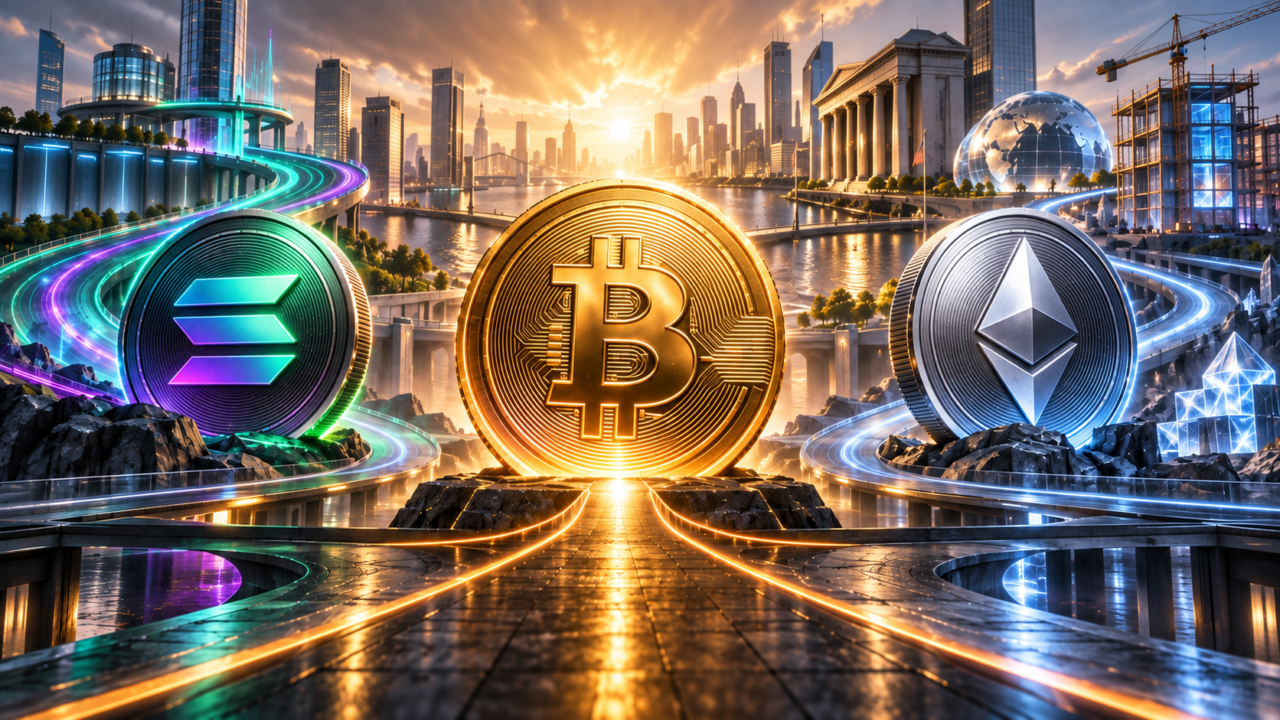
There is therefore no single answer, depending on the level of risk accepted. However, the data available in September 2026 point to a fairly clear ranking: Bitcoin for resilience, Solana for growth and Ethereum for a potential turnaround.
Bitcoin remains the strongest crypto for 2027
Bitcoin has something that practically no other cryptocurrency can replicate today: an already massive institutional market. BlackRock’s IBIT Bitcoin ETF manages around $60 billion, less than three years after its launch. According to Farside Investors, all US spot Bitcoin ETFs had recorded approximately $55.1 billion in cumulative net inflows as of September 18, 2026.
That figure matters more than a new narrative on X.
It means Bitcoin now has an infrastructure that allows wealth managers, funds and traditional investors to gain exposure to BTC without directly using a crypto exchange. Flows can obviously reverse: $649 million flowed out of Bitcoin ETFs in a single session in May. Institutionalization therefore does not eliminate volatility.
Fidelity Digital Assets nevertheless observes that Bitcoin is currently the market’s main source of resilience. Its third-quarter 2026 report finds that unrealized profits remain more concentrated in BTC, while ETH and SOL are in a more fragile position.
For 2027, Bitcoin therefore has a simple advantage: it does not need a new ecosystem to emerge to justify its existence. Demand already exists.
Its drawback is exactly the opposite. With an enormous market capitalization, achieving a 5x or 10x return becomes much more difficult than for a smaller asset.
Solana probably has the greatest growth potential
If the question becomes, “Which major cryptocurrency could surprise the most in 2027?”, Solana probably deserves the top spot.
Not because of meme coins.
The interesting story is now unfolding in payments, stablecoins and tokenization.
Solana has around $10 billion in stablecoins on its network and approximately $200 billion in monthly stablecoin transfers, with advertised median fees of around $0.0013. Visa, Western Union, Worldpay, PayPal and Fiserv are among the companies using or building infrastructure linked to the network.
At the end of July, Solana also hosted approximately $3.7 billion in tokenized real-world assets excluding stablecoins. BlackRock, JPMorgan and several institutional asset managers are now part of this ecosystem.
The network also claims approximately 50 million monthly active addresses and 3.5 billion monthly transactions.
This institutional development is also beginning to directly affect SOL. Solana ETFs have already attracted capital despite the recent price weakness.
That is why Solana appears particularly interesting for 2027. Its market capitalization remains much smaller than Bitcoin’s, while its infrastructure is beginning to support use cases that go well beyond speculation.
The potential is therefore greater.
So is the risk.
Ethereum could be 2027’s surprise
Ethereum is in an unusual position.
The network remains major infrastructure for stablecoins, DeFi and tokenized assets, but ETH has significantly underperformed Bitcoin over the past two years. For some investors, that is precisely what creates the opportunity.
2027 is notably expected to bring Hegotá, the next major stage outlined in Ethereum’s roadmap after Glamsterdam. The work includes censorship resistance, account improvements and certain guarantees for Layer 2 networks. However, the timeline remains subject to change.
The Ethereum Foundation is working in parallel on three main areas: increasing network capacity, improving the user experience and strengthening the base layer.
ETH’s problem is therefore not a lack of development.
It is the network’s ability to turn that activity into sufficiently strong demand for the token itself.
That is also why crypto narratives around stablecoins and tokenized assets will be particularly important in 2027. Ethereum and Solana are precisely at the center of this competition.
If I had to summarize the selection for 2027, it would therefore be simple:
Bitcoin remains the most robust choice in terms of the potential-to-risk ratio.
Solana probably offers greater upside potential among large-cap cryptocurrencies, with higher risk.
Ethereum is the catch-up bet: less obvious today, but potentially powerful if its technical improvements and institutional activity eventually translate into stronger demand for ETH.
I would be much more cautious with small-cap cryptocurrencies presented as “the most promising cryptos of 2027.” They can indeed rise 10x. They can also lose 90%.
The most promising cryptocurrency is not necessarily the one whose price can rise the fastest.
For 2027, Bitcoin remains the one whose investment thesis requires the fewest conditions to work.