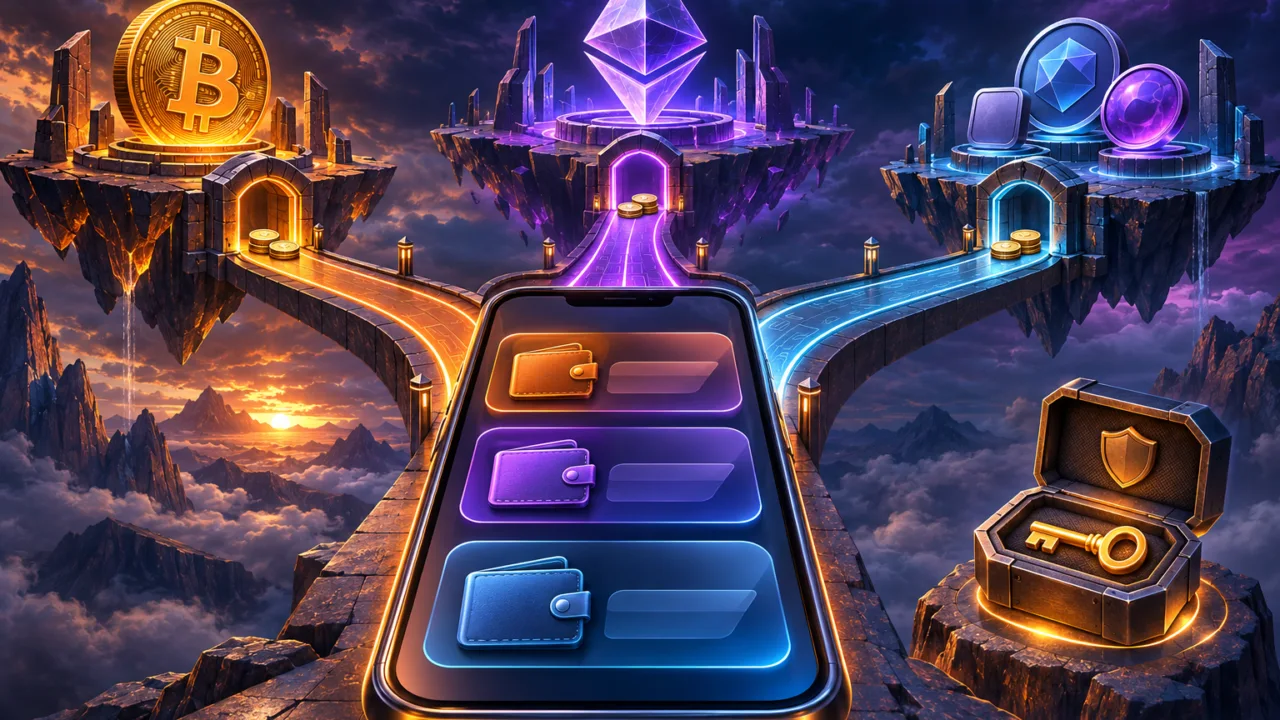
Multichain wallets for 2027 promise a single interface across multiple networks. That convenience does not mean all accounts share the same address, assets move freely between chains, or one recovery procedure restores every configuration. A unified display can conceal distinct mechanisms.
Trust Wallet, Phantom and Kraken Wallet offer three examples to compare based on individual needs. Documents reviewed on November 6, 2026, also show that network lists change. This guide therefore focuses on verification and recovery methods, rather than presenting current coverage as a promise for the whole of 2027.
In brief
Our guide to how crypto wallets work distinguishes keys from the interface. That distinction becomes even more important when several networks appear in the same application.
- An address and a symbol are not enough: identify the network, asset and contract where applicable.
- A multichain wallet does not automatically transfer funds between networks.
- A shared backup can simplify access while concentrating certain risks.
Start with essential networks, not the advertised total
A reader who uses Bitcoin and Ethereum does not necessarily need the same features as someone using several applications on EVM-compatible networks. The number of chains shown in an advertisement does not measure that fit. First, list the operations that are actually required.
The Trust Wallet overview describes a mobile application and an extension supporting multiple networks. Users must verify the features of the version they use. Broad coverage does not guarantee the same interactions with every application or the same signing tools on each network.
The official Phantom list distinguishes supported from unsupported networks. At the time of review, it notably mentioned Solana, Ethereum and Bitcoin, while classifying Arbitrum and Optimism as unsupported networks. This shows why a wallet’s former multichain reputation cannot replace a precise list.
The Kraken Wallet documentation presents different coverage, including several EVM networks. It specifies that availability may vary depending on the wallet type. The Kraken name does not automatically extend the wallet’s features to those of the platform account, or vice versa.
A selection grid should therefore include one row for each essential network. It should record receiving, sending, signing and recovery, not merely mark a “compatible” box. This approach helps identify an important limitation before installation, rather than after receiving an asset on a chain the interface does not display.
Distinguish accounts, addresses, networks and tokens
An application can group several accounts without giving them the same rules. Some addresses may share the same format across multiple networks, while balances remain recorded separately. Before any transfer, users should verify the network selected at the source and the one expected at the destination.
A token symbol does not provide sufficient identification. Two assets can use the same name on different contracts. For a token, record the relevant network and contract from an official source, without treating its appearance in a wallet’s search results as economic validation.
Asset representations can also retain specific dependencies. A token that tracks the value of another asset does not necessarily provide the same rights or exit options. The interface may add their values in fiat currency without explaining all these differences on the first screen.
Finally, distinguish between an observed balance and the ability to spend it. A tracked account may appear without its corresponding keys being available in the application. This may be intentional, but it must remain clear. A portfolio chart is not proof that every position can be transferred immediately.
The guide to self-custodial wallets helps identify that control. In a multichain environment, the question must be asked for each account. Grouping balances together does not prove uniform control over all displayed funds.
Verify backups and recovery paths
A seed phrase can derive multiple accounts, depending on the standards and parameters used. That does not guarantee that another application will automatically find every expected address. Users should retain the non-secret information needed to identify the network, account type and configuration.
Accounts added separately require a separate inventory. A hardware account or imported key may not depend on the application’s primary seed phrase. Assuming that one backup covers everything displayed can create a false sense of security and lead to incomplete recovery during an incident.
The chosen connection method must also be understood. Several products offer different creation and restoration models. Users should consult the procedure for their actual account rather than automatically applying instructions for a seed-phrase setup to every other available method.
Access recovery should be tested according to official instructions, without unnecessarily exposing reserves. Do not import hardware-device secrets into a connected application simply to obtain a multichain display. Interface compatibility should be pursued without compromising the separation of keys.
Our guide to hardware wallet limitations provides additional context for this check. Adding networks can multiply the software and signatures involved. The fallback setup must remain understandable even if the main application disappears, changes its features or stops supporting a chain.
Understand cross-chain transfers and fee requirements
A wallet can display two networks without moving funds between them. Ethereum’s overview of bridges explains the role of mechanisms connecting separate ecosystems. A cross-chain transfer must therefore be assessed as an additional operation, with its own contracts and dependencies.
Users must know which asset will actually arrive, the destination network and the conditions for returning. An integrated button does not guarantee that the received representation will be usable in the desired application. Examine the route before signing, not after the funds arrive.
Fees may be paid in different assets depending on the network and route. Holding significant value in tokens does not guarantee that an account has the required asset to pay for the next operation. Plan the funds needed to exit without assuming the application will automatically convert assets at the right time.
The guide to trading and network fees distinguishes the costs that need to be compared. An integrated swap may add a service fee, price impact or transfer steps. The comparison should measure the net amount available after the entire route.
Fictional example: a reader saves one euro on a withdrawal to a different chain, then has to pay three euros to reach the network they need. The cheapest line item at the start did not produce the least expensive route. This calculation does not even include the additional risk associated with moving between chains.
Limit the concentration of risks and permissions
A single interface can make monitoring more convenient, but it can also bring together uses that may be better kept separate. A long-term reserve does not necessarily need to sign the same requests as an account used to test applications. Visual simplicity should not erase that organization.
Creating multiple accounts from one backup is not always enough to separate the risk of that backup being exposed. If the shared secrets are compromised, several accounts may be affected. Distinguish between accounting separation, separation of use cases and effective separation of signing mechanisms.
Permissions should be reviewed according to the relevant contracts and networks. MetaMask explains the difference between disconnecting and revoking. Removing a connection in an interface does not mean that all permissions across all chains have disappeared.
Privacy also requires review. Grouping a user’s addresses can reveal relationships that each address alone did not directly show. Data providers, synchronized histories and sharing features should be examined without confusing read-only access with an absence of sensitive information.
A practical rule is to reduce unnecessary features. Users do not need to activate every network or connection to benefit from a multichain application. Each expansion of the scope should serve an identifiable use case and have a procedure for withdrawing permissions or exiting.
Compare configurations and plan for change
The result of the selection process can fit into a personal table: application, version, required networks, accounts, recovery, fees and usual signatures. Each line should include the relevant limitations. Features that will never be used do not make up for a missing essential network or an unclear recovery process.
Changes in coverage should be monitored. Phantom’s documentation, for example, notes that support for Sui ended in September 2026. This does not mean the assets disappeared from the blockchain, but it changes the tool needed to access them. An independent account inventory helps manage this type of change.
In 2027, Trust Wallet, Phantom and Kraken Wallet should therefore be compared based on the features available at that time. The best multichain wallet is not the one that accumulates the most network names. It is a setup in which the owner knows where their assets are, what they are signing and how to recover access without improvising or sharing their secrets.