The market offers several sources of income: Bitcoin appreciation, staking, stablecoin lending, liquidity provision, trading, mining and even crypto-paid work. They do not involve the same level of risk, starting capital or consistency.
Someone with €500,000 obviously does not approach the goal of €100 a day in the same way as someone with €5,000. With substantial capital, a relatively modest annual return may be enough. With very little capital, reaching the same amount requires such high returns that investing quickly starts to look more like speculation.
That is where promises become dangerous.
Here is what it would really take to try to earn €100 a day in crypto in 2027, what seems reasonable, what depends on market conditions and what is mostly fantasy.
€100 a day completely changes the calculation
Before looking for the best token, it is worth examining the maths.
Earning €100 every day means generating €36,500 over a full year. The question is no longer how to buy €200 worth of Bitcoin and wait for it to rise. It means producing the equivalent of a genuine annual income. Our guide to investing in Bitcoin already explains why wealth accumulation must be distinguished from the pursuit of regular income.
The difference is essential.
Buying Bitcoin at €50,000 and then watching it reach €75,000 produces a 50% capital gain. It does not, however, arrive as €100 paid every morning. To turn that gain into daily income, part of the position would have to be sold gradually.
Staking works differently. Rewards are paid for participating in the security of a Proof of Stake network. Lending involves providing assets that others borrow. Liquidity providers earn fees. Traders, meanwhile, try to capture market movements.
Each model has its own economics.
That is why a video promising “€100 a day in crypto with €1,000” should immediately raise one question: where does the €100 come from?
With €1,000 in capital, earning €100 would require a 10% return every day. Even without compounding the gains, that represents 3,650% of the initial capital over a year.
This is not a normal investment objective.
It is an extreme risk.
The required capital is much higher than most people imagine
Now suppose the aim is to generate €36,500 a year solely from the return on capital, without spending the capital itself.
The result is instructive.
| Theoretical annual return | Capital required for €36,500/year |
|---|---|
| 3% | approximately €1,216,667 |
| 5% | €730,000 |
| 8% | €456,250 |
| 10% | €365,000 |
| 12% | approximately €304,167 |
| 20% | €182,500 |
These amounts are calculated before taxes, fees, potential losses and changes in asset prices.
Even with a 10% annual return, around €365,000 is therefore needed to generate the equivalent of €100 a day without touching the capital.
At 5%, the amount rises to €730,000.
At 20%, €182,500 would still be required.
And a sustainable 20% annual return is nothing like a low-risk investment. In crypto, such a rate may come from substantial token issuance, temporary rewards, high credit risk, more vulnerable smart contracts or simply a protocol seeking to attract capital quickly.
The advertised yield alone is never enough.
You also have to consider the currency in which it is paid. Receiving 20% in a token that loses 60% of its value is obviously not a good deal.
These calculations explain why talk of “crypto passive income” can sometimes become misleading. A few clicks may indeed be enough to deposit funds into a protocol.
The capital capable of turning a reasonable return into a genuine salary, however, may be considerable.
Staking can pay, but it cannot create a miracle
Staking is probably one of the first strategies a crypto holder considers when seeking yield.
On a Proof of Stake network such as Ethereum or Solana, assets are locked or delegated to help secure the network. In return, validators and delegators receive rewards.
On Ethereum, launching your own validator directly requires 32 ETH. Users with smaller amounts can use pooled or liquid staking solutions. Ethereum explains this process directly in its documentation on staking pools.
That return should not, however, be confused with guaranteed income in euros.
Imagine a holder with €100,000 in ETH earning 4% in rewards over a year. This theoretically represents around €4,000 in ETH before fees and taxes, or an average of approximately €11 a day.
Generating €36,500 at the same return would require more than €900,000 in capital.
And the value of ETH can still fluctuate during the year.
A 4% return in ETH accompanied by a 40% drop in the price of Ether is a very different experience from a bank account paying 4% in euros.
The same reasoning applies to Solana. The protocol states that rewards depend in particular on inflation, the total amount of SOL staked and the validator’s commission. The return is therefore not a constant written permanently into the code.
Staking can improve the return on an asset you already intended to hold.
It becomes much less compelling if you buy a token solely because its APY looks high.
Stablecoins offer another path to yield
Stablecoins slightly change the equation.
USDC, USDT and other assets seek to maintain a relatively stable value, often around 1 dollar. This removes some of the volatility associated with Bitcoin, Ether or Solana.
They can then be lent out.
On Aave, for example, a user can supply tokens to a liquidity pool and earn interest paid by borrowers. Aave states that the rate depends in particular on pool utilisation: the greater the proportion of liquidity borrowed, the more rates can change. This is therefore a dynamic return, not a guaranteed fixed rate. Aave explains the process directly.
This is precisely where the earlier calculations become useful.
With €50,000 invested at 5%, the theoretical annual income would be €2,500, or less than €7 a day.
€100,000 would produce €5,000.
€200,000 would produce €10,000.
To reach €36,500, still at 5%, €730,000 would be required.
Increasing the return obviously reduces the required capital. That is tempting. It is also where the risk starts to rise.
A protocol can suffer a vulnerability. A stablecoin can lose its peg. A blockchain can encounter a problem. A bridge can be hacked. A yield can collapse after an incentive campaign ends.
Our article on the benefits and risks of stablecoins examines this relative stability, which never means the complete absence of risk.
In crypto, “stable” mainly describes the targeted price.
Not the safety of the investment.
20% or 50% APYs require an explanation
One rule can help avoid many bad decisions: when a protocol displays a spectacular return, you need to find out who is funding it.
A 30% rate can have several origins.
The protocol may distribute large amounts of its own token to attract liquidity. The advertised return then appears very high, but the creation of new tokens increases supply and can put pressure on the price.
It may also come from strong borrowing demand. In that case, someone is genuinely willing to pay a high price for access to capital. You need to understand why.
A third possibility is a combination of several DeFi mechanisms: borrow an asset, deposit it elsewhere, receive a liquid token, reuse it as collateral and repeat the process.
The apparent return increases.
So does the number of things that can go wrong.
This type of strategy regularly experiences periods when borrowing costs exceed the final return. In September 2026, some strategies using USDe on Aave entered negative-yield territory after borrowing rates rose.
That sums up DeFi rather well.
What was profitable yesterday may no longer be profitable tomorrow.
The major crypto narratives of 2026 also show that capital moves quickly between stablecoins, RWAs, AI, DeFi and other sectors. High yield attracts capital. The arrival of that capital sometimes reduces the yield itself.
Competition works.
Even on the blockchain.
Trying to earn €100 a day solely by constantly switching to the protocol displaying the highest APY can therefore have the opposite effect: multiplying fees, technical risks and potential losses.
Trading can produce €100 a day, but it cannot guarantee it
This is probably the most appealing method on social media.
Buy in the morning. Sell higher. Take €100. Repeat tomorrow.
It sounds simple.
The problem is that the market has no contract with the trader.
With a €10,000 account, earning €100 represents 1% of the capital per day. With €5,000, it requires 2%. With €25,000, 0.4%. With €50,000, 0.2%. With €100,000, 0.1%.
Viewed in isolation, some of these percentages appear modest.
Repetition changes everything.
A fixed daily target often pushes traders to seek a transaction even when no attractive setup exists. It is 4 p.m. and €60 is still missing from the target? The temptation to increase the position appears.
A loss follows.
The trader wants to recover it before midnight.
Then comes leverage.
This is exactly how an income target can damage risk management.
A good trader should not ask the market to pay the same salary every day. Some days offer many opportunities. Others offer almost none.
One month can be excellent.
The next can be negative.
This irregularity explains why comparing trading to a salary is particularly dangerous.
Leverage makes the problem worse. A 10x position multiplies exposure, not skill. A move of a few percent in the wrong direction can trigger a substantial loss or liquidation.
Earning €100 on a trade is entirely possible.
Building a financial strategy around the certainty of doing it 365 times is another proposition.
Bitcoin can generate more than €100 a day without paying anything out
Consider another scenario.
An investor holds €100,000 worth of Bitcoin. During the year, BTC rises by 50%.
The portfolio gains €50,000.
Spread over 365 days, that represents approximately €137 a day.
Can we say that the investor “earned €137 a day with Bitcoin”?
Mathematically, yes.
Economically, the wording is misleading.
The gain did not arrive regularly. Bitcoin may have gained 15% in January, lost 20% in March, moved sideways for two months and then surged at the end of the year.
The investor only truly has a gain in euros after selling part of the position.
This detail is particularly important for 2027.
No one currently knows how Bitcoin will perform next year. A bullish scenario could generate returns well above €36,500 on a sufficiently large portfolio.
A correction could produce exactly the opposite.
Bitcoin’s best use is therefore probably not to assign it an obligation to make a daily payment.
Bitcoin can be an accumulation asset.
A long-term reserve.
A speculative investment for some people.
It is not a machine designed to send €100 to an account every evening.
Those seeking regular income must therefore distinguish between two sources of gains: capital appreciation and the return generated by capital.
Confusing the two produces overly optimistic projections.
Providing liquidity can generate more
DeFi offers another possibility: providing assets to a decentralised exchange.
Imagine an ETH/USDC pool.
A user deposits both assets. Traders then use this liquidity to make swaps and pay fees. Part of those fees goes to liquidity providers.
The economics look attractive: instead of simply waiting for crypto prices to rise, the capital is put to work.
The reality is more technical.
The return depends on trading volume, the share of the pool held, protocol fees, asset prices and competition between providers.
There is also the risk of impermanent loss.
When the prices of the two assets move sharply relative to one another, the composition of the position changes automatically. It may then be worth less than if the two tokens had simply been held separately.
Modern versions of some AMMs also allow liquidity to be concentrated within a price range.
Capital becomes much more efficient.
Management becomes much more active.
If the price leaves the chosen range, the position may stop generating the expected fees.
To reach €100 a day, you would therefore need either substantial capital or exposure to pools offering higher returns.
Yet the highest returns often appear on riskier pairs or less established protocols.
Once again, there is no shortcut.
Additional profitability compensates for something: volatility, complexity, smart-contract risk, liquidity or token risk.
Arbitrage is no longer the free money it once seemed
Buying Bitcoin 1% cheaper on one platform and immediately selling it elsewhere seems like the definition of easy money.
That is the principle of arbitrage.
Price differences still exist, particularly between exchanges, currencies, blockchains or less liquid markets. They are nevertheless quickly exploited by firms with bots, professional infrastructure and substantial capital.
Individuals must account for trading fees, withdrawal fees, transfer times and sometimes banking constraints.
Suppose there is an apparent difference of 0.6%.
After 0.2% in buying fees, 0.2% on the sale and transfer costs, the opportunity may have disappeared before the capital even reaches the second platform.
Professional arbitrage often works differently: funds are already held across several markets and trades are executed simultaneously.
This requires distributed capital, automation and sound management of platform risks.
Arbitrage operators can make €100 a day.
The important word is “operators”.
This is more a financial activity than a passive investment accessible by depositing €500.
The same applies to market making. A company can earn tiny spreads thousands of times a day.
Copying this model from a phone obviously does not offer the same economics.
Bitcoin mining is no longer a small home-based income stream
Mining is another way to earn crypto without buying it directly.
ASICs perform the calculations required for Bitcoin’s Proof of Work. In return, miners receive a share of newly created BTC as well as the fees from transactions included in blocks.
In theory, that is crypto income.
In practice, the competition is industrial.
Electricity prices are decisive. Hardware must be purchased, cooled and maintained, while changes in network difficulty must be anticipated. A machine that is profitable with almost free electricity can become loss-making in a region where every kilowatt-hour is expensive.
This pressure has intensified with artificial intelligence. BrefCrypto recently showed that Bitcoin miners are being pushed towards increasingly cheap energy sources as AI competes for their best power sites.
Core Scientific, TeraWulf, IREN and other players have even begun redirecting part of their infrastructure towards AI computing, which can sometimes be more profitable.
Earning €100 a day through mining is therefore still possible.
Nevertheless, it looks more like operating a small energy business than launching an application on a laptop.
The initial capital can be substantial.
Electricity can absorb the margin.
The noise and heat produced by ASICs are not minor details either.
For an individual in 2027, buying Bitcoin directly will often be much simpler than building infrastructure solely in the hope of earning €100 in daily mining profits.
With little capital, working can beat investing
Here is the part rarely mentioned in videos titled “crypto passive income”.
Someone with €1,000 will find it very difficult to turn that capital into €3,000 in monthly income without taking enormous risks.
The same person could, however, earn €3,000 through a skill sold within the crypto ecosystem.
Blockchain development, cybersecurity, community management, writing, design, translation, data analysis, video creation, research, bug bounties, hackathons and ambassador programmes are all ways to receive money from the crypto industry without having to achieve a 300% return on a portfolio.
The economic reasoning becomes entirely different.
The primary capital is no longer money.
It is the skill.
A developer earning €500 from a bounty did not need to place €10,000 in a risky token. Someone completing four €750 assignments during the month already reaches €3,000.
They can be paid in stablecoins or later convert part of their income into Bitcoin.
For someone starting with limited wealth, this route may be much more realistic.
It also has an advantage: a skill can continue generating income even when Bitcoin falls by 30%.
The portfolio does not ask permission before falling.
This difference is particularly relevant in markets where access to international jobs and digital payments matters as much as investment itself. BrefCrypto has already shown in its article on crypto use cases in the DRC that Bitcoin and stablecoins also serve as payment and transfer rails, not merely as bets on prices.
Making money in crypto and making money from crypto capital are therefore two different things.
With limited capital, the former may be much more effective.
The more precise the promised return, the more cautious you should be
“€100 a day guaranteed.”
“2% every day.”
“15% a month with no risk.”
These are exactly the formulations that should trigger suspicion.
A genuine market does not work this way.
Prices change. DeFi rates change. Volumes change. Staking rewards change. Even a professional strategy experiences less profitable periods.
Someone capable of generating 2% a day without risk would not need to sell their method for €49 on Telegram.
Compounding would do the rest.
This is also why scams so often combine “high return + regularity + guarantee”.
In September 2026, BrefCrypto covered a FinCEN report linking 33,904 reports to $12.7 billion in suspicious financial activity surrounding investment scam networks. Fake crypto investments are now organised on an industrial scale.
In another case, an American promoter promised annual returns of between 15% and 30% through an alleged technology using artificial intelligence. A jury ultimately found him guilty in a case involving $24 million.
The presence of AI, bots, mining, DeFi or a sophisticated dashboard proves nothing.
You must always know where the money is.
And how it is generated.
How much capital would really be needed in 2027?
Let us now consider different profiles.
With €1,000, reaching €100 a day would require a daily return of 10%. This is not a realistic investment objective.
With €5,000, the required return falls to 2% a day. Still extremely aggressive.
With €10,000, 1% per day is required.
With €25,000, 0.4%.
For €50,000, approximately 0.2% per day.
With €100,000, approximately 0.1%.
These figures do not mean it becomes “easy” to generate €100 a day from €100,000. Daily returns remain irregular.
They simply show why capital matters so much.
At the other extreme, someone with €500,000 does not need to target protocols offering a 40% return. A gross return of 7.3% is mathematically enough to reach €36,500 over the year.
This is where a fairly classic principle of finance emerges.
The greater the capital, the less necessary it is to seek an extraordinary return to generate substantial income.
Small investors often do the opposite.
Because they have little capital, they seek the highest possible return. They then end up in the most volatile assets, riskiest platforms and most leveraged strategies.
Lack of capital drives people towards risk.
Risk then destroys the little capital available.
A rather bad cycle.
2027 will not eliminate taxes or regulation
Gross return is not the return you keep.
In Europe, MiCA has already changed how crypto services can be offered. In France, since 1 July 2026, providers wishing to offer crypto-asset services must hold a PSCA authorisation under MiCA or an appropriate European authorisation. The former PSAN status is no longer sufficient.
In 2027, you will also need to check the tax rules applicable in your country.
Rules can change quickly.
Germany, long known for its favourable treatment of crypto held for more than one year, is for example considering a flat 25% tax on certain crypto gains for assets acquired from 2027 onwards.
This illustrates the problem well.
A strategy that generates €36,500 before tax does not necessarily leave €36,500 available to live on.
You have to deduct protocol fees, trading costs, possible blockchain fees, losses and then the applicable taxes.
Staking income may also be treated differently from capital gains depending on the country.
The same applies to mining or professional activity paid in stablecoins.
A target of €100 net per day therefore requires more than €36,500 in gross annual returns.
In 2027, the right calculation will start with the amount you actually want to keep after all these frictions.
The most realistic plan for targeting €100 a day
Looking for a single strategy capable of producing exactly €100 every day is probably the wrong way to approach the problem.
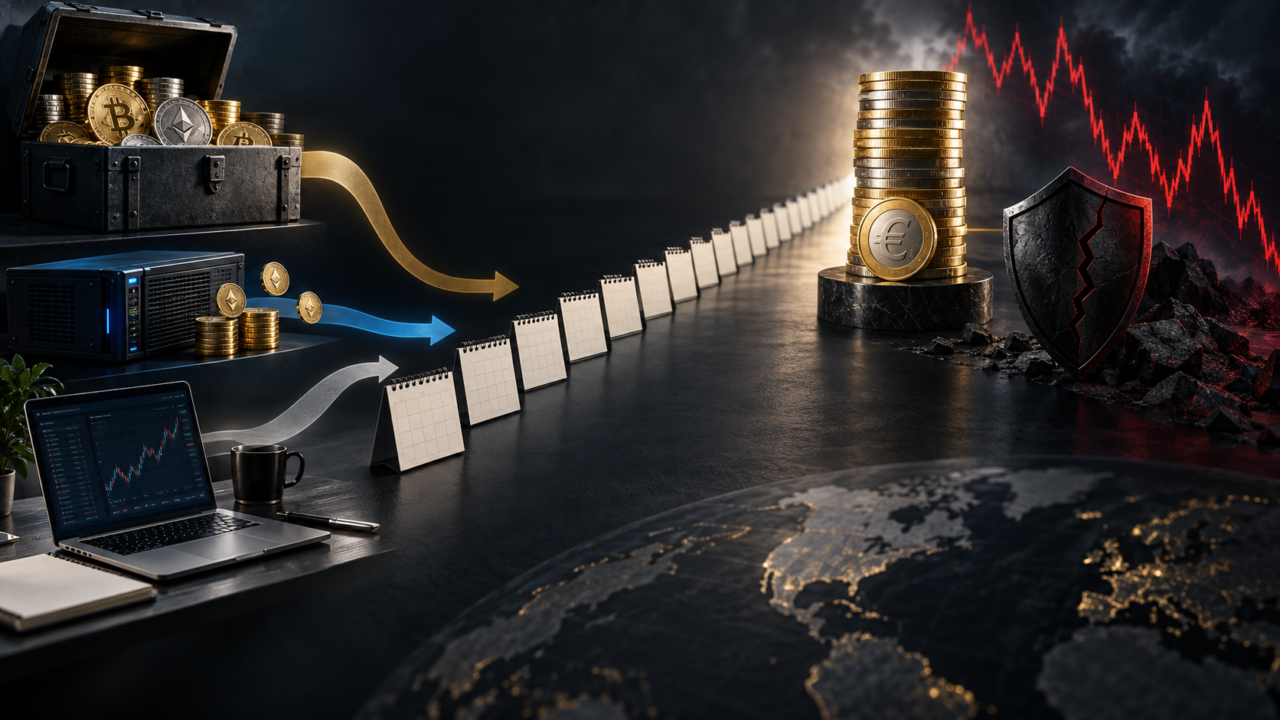
A more robust structure consists of separating three engines.
The first is long-term capital. Bitcoin, possibly Ethereum or other carefully selected assets, can be used to build wealth gradually. The objective is not to withdraw €100 every day, but to increase the capital that may later generate more income.
The second engine is yield. Staking or lending can allow part of the portfolio to generate a few additional percentage points when the risk is understood and accepted.
The third is active income. Web3 assignments, content creation, development, bounties, cybersecurity, consulting or other skills can generate sums that do not depend solely on portfolio size.
This combination looks much less spectacular than a miracle bot.
Yet it solves the main problem.
With €5,000 in capital, trying to extract €36,500 a year from the portfolio requires extraordinary performance. With €5,000 invested gradually and €3,000 in monthly professional income from the ecosystem, the equation becomes entirely different.
Some of the income can be spent.
Some can strengthen savings.
A third portion can be used to buy Bitcoin during corrections.
The capital then grows.
Over time, the return on capital itself begins to become significant.
That is a much more credible path to €100 a day than trying to achieve a 10x return every year.
For some investors who already have several hundred thousand euros, relatively modest returns may be enough.
For everyone else, crypto can remain an excellent sector in which to invest, work or build a business.
It does not turn €1,000 into an annual salary of €36,500 without asking for something in return.
And that something usually has a very simple name: risk.