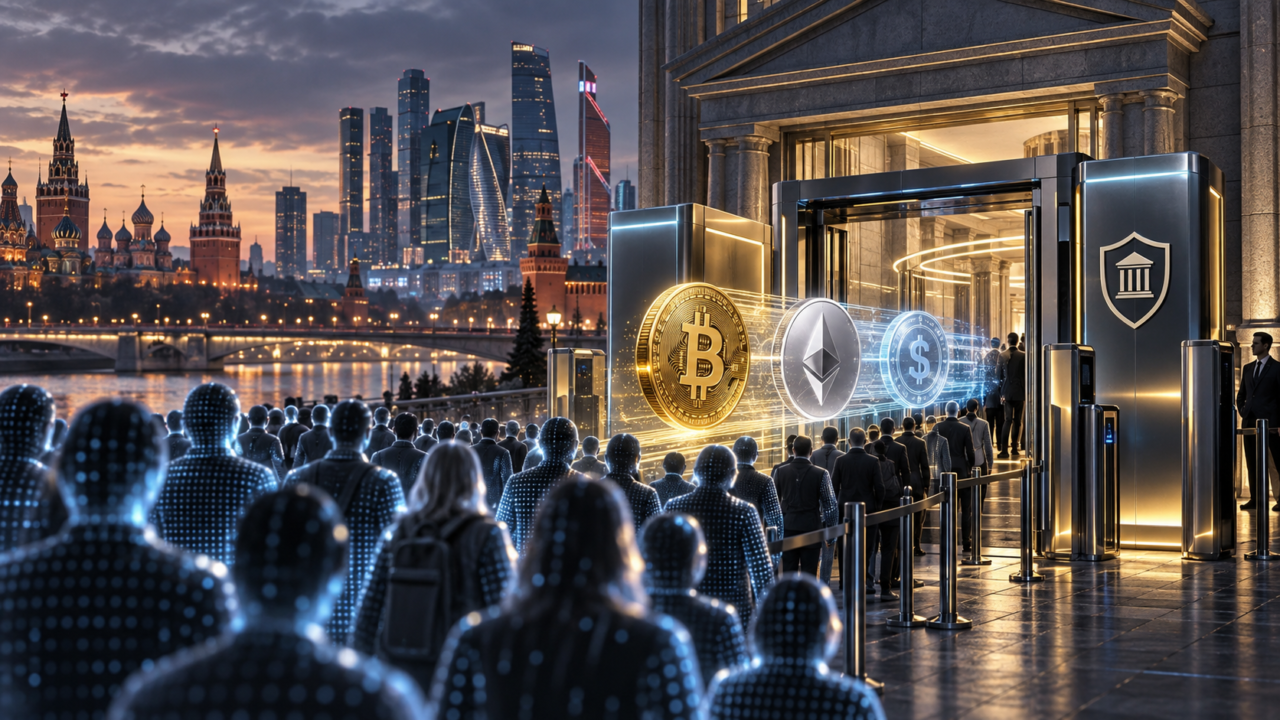
Russia expects 10 million new users
The figure was cited on September 21 at the Moscow Financial Forum. According to Ivan Chebeskov, around 10 million additional citizens could use cryptocurrencies in Russia in 2027, to varying degrees. The ministry acknowledges, however, that it is impossible to determine the current user base precisely, since transactions long took place outside a regulated national framework. BrefCrypto had already detailed the official opening of Russia’s crypto market on September 1. Rambler Finance directly reported the deputy minister’s comments.
Chebeskov believes that some current users still rely on foreign platforms or the former informal infrastructure. Moscow now hopes that most new users will use Russian intermediaries.
The potential is far from negligible. The same deputy minister estimated in 2025 that around 20 million Russians were using crypto for various purposes. At the time, the Bank of Russia valued the assets held by citizens in exchange wallets at 827 billion rubles, or around $10 billion, at the end of March 2025. Bitcoin accounted for 62.1% of those holdings, Ethereum for 22% and the USDT and USDC stablecoins for 15.9%.
Adding 10 million users therefore does not mean creating a market from scratch. Rather, it means bringing a significant part of an existing market onto regulated rails.
Bitcoin, Ethereum and USDT move through banks
The main break with Russia’s previous model lies in the infrastructure.
Since September 1, non-qualified retail investors have been able to buy certain highly liquid cryptocurrencies through authorized entities. The limit is set at 300,000 rubles per year per intermediary, or around $3,600 at recent exchange rates. Qualified investors can access a broader range without this quantitative limit after meeting the conditions imposed by the regulator.
Bitcoin, Ethereum and USDT were selected by the Bank of Russia for public access. The regulator uses market capitalization, daily trading volume and price history, among other factors, to select eligible assets.
BrefCrypto had already explained why BTC, ETH and USDT passed Russia’s first regulatory filter.
Banks can play an important role in this architecture. Brokers, asset managers, crypto platforms and digital custodians can act as intermediaries. Some Russian banks are no longer merely observing the sector from a distance.
Sberbank, the country’s largest bank, is preparing a crypto wallet integrated into its applications, custody services and loans backed by Bitcoin, Ethereum or USDT. The institution had already tested a Bitcoin-backed loan in late 2025.
Using a traditional bank primarily changes the user experience. Buying Bitcoin could gradually come to resemble buying a stock or bond more than using an offshore platform.
Sberbank already sees $46 billion in trading
Banking projections provide an indication of the scale being contemplated.
Sberbank estimates that regulated crypto trading volumes could reach 3.5 trillion to 4 trillion rubles during the first year, or around $46 billion. By 2029, the bank forecasts up to 7.5 trillion rubles, or approximately $87 billion.
And even this estimate is presented as conservative.
In February, Russia’s Finance Ministry estimated current crypto transaction volumes at around 50 billion rubles per day. Over a full year, that represents approximately 18 trillion rubles. In other words, a large share of transactions could continue to bypass regulated platforms for several years.
Russia’s strategy is therefore less about creating demand than capturing activity that already exists.
Sberbank also launched crypto settlements for certain companies involved in foreign trade in early September. The bank says transactions can be completed within minutes, with an average fee of around 0.3%.
This aspect is particularly important in the Russian context. Since the financial sanctions imposed after the invasion of Ukraine in 2022, Moscow has been seeking alternative infrastructure for certain international transactions.
Crypto is therefore entering the system on two levels: investment for retail users and international settlement for certain companies.
Russia still does not authorize everything
Describing Russia as “adopting crypto” without qualification would give a misleading picture of the framework being established.
Cryptocurrencies remain banned as a regular means of payment for goods and services within Russia. Consumers therefore cannot legally replace rubles with Bitcoin at the supermarket simply because the investment market is now regulated.
Exceptions include foreign trade, certain transactions involving digital assets and mining-related activities.
The Bank of Russia also continues to treat cryptocurrencies as highly risky assets. On September 18, it proposed limiting banks’ proprietary exposure to cryptocurrencies and foreign digital instruments to 1% through new prudential ratios. Institutions will also have to report their volumes from January 2027.
This is an important detail.
Moscow is not replacing its banking system with Bitcoin. Rather, it is seeking to absorb crypto into infrastructure it can monitor, regulate and tax.
Even retail investors must take a test before gaining access to authorized assets. Unregulated intermediaries will gradually be pushed out of the domestic market, while digital custodians will have to meet capital and compliance requirements close to those used in traditional finance.
Russia is opening the door. It is still keeping its hand on the lock.
2027 is expected to complete the regulatory shift
The timeline explains why the ministry is referring specifically to 2027.
The first part of the new regime came into force on September 1, 2026, but several obligations have yet to be rolled out. Professional participants in particular benefit from transitional periods to obtain the necessary authorizations.
From July 1, 2027, certain transactions will have to go through licensed structures. Several additional provisions concerning custodians, transfers and infrastructure will also enter into force during the year.
The Bank of Russia is still working on several dozen implementing regulations. Its first deputy governor, Vladimir Chistyukhin, said on September 21 that Russia’s crypto industry could nevertheless operate within a largely functional legal framework before the end of 2026. He referred to 27 regulatory texts still needed to fully implement the framework.
This timeline creates a rather unusual period.
Retail users already have access to the regulated market. Major banks are preparing their products. Platforms must obtain their licenses. Prudential rules are coming. Then 2027 is expected to consolidate the whole system.
The 10 million new users mentioned by the ministry are therefore not a forecast based solely on a rise in the price of Bitcoin. The assumption also rests on reduced friction: banking access, regulated custody, the ability to buy BTC, ETH or USDT through a known intermediary and a now identifiable legal framework.
For many users, this development could matter more than another crypto application.
In the United States, the CLARITY Act remains stalled
The US timeline is moving in a different direction, at least legislatively.
On September 15, 2026, the Senate failed to invoke cloture to proceed to consideration of the CLARITY Act. The vote ended 49 to 50, while 60 votes were needed to clear this procedural hurdle. It was not a final vote on passage of the bill, but its failure halted the legislation’s progress.
BrefCrypto had already followed the CLARITY Act’s difficulties in securing the 60 votes needed in the Senate.
The disagreements notably concerned ethics rules applying to political leaders, stablecoin rewards, community banks and various aspects of digital-asset oversight. Four Republican senators joined Democrats in the negative vote, while Thom Tillis voted against it to preserve a procedural possibility of requesting reconsideration.
The bill is therefore not legally dead. A motion to reconsider remains on the Senate’s calendar. Its political window has nevertheless narrowed considerably ahead of the midterm elections.
This does not mean that the United States has stopped moving forward on crypto. The SEC and CFTC continue to use their existing powers, while the GENIUS Act has already created a federal framework for stablecoins.
The contrast with Russia therefore concerns the pace and regulatory method above all, not a simple opposition between a “pro-crypto” country and one that is not.
Moscow now wants to bring crypto home
The figure of 10 million new users ultimately sums up Russia’s new priority rather well.
For years, millions of Russians were already holding Bitcoin, Ether or stablecoins, often through foreign services. Moscow could neither completely prevent this activity nor truly integrate it into its financial system.
The new framework changes that calculation.
Bitcoin, Ethereum and USDT now have a legal route to retail users. Sberbank is preparing wallets, custody services and crypto-backed loans. Crypto-based international payments have begun for certain companies. Exchanges, brokers and custodians are gradually entering the licensing system.
All of this remains tightly controlled. The 300,000-ruble cap for non-qualified retail investors, the ban on domestic payments and the proposed 1% prudential limit for banks all show that the Bank of Russia is not abandoning its caution.
Even so, the change in doctrine is difficult to miss.
Just a few years ago, Russia’s debate focused largely on the possibility of heavily restricting cryptocurrencies. In September 2026, the discussion is now about how many millions of citizens will join the regulated market, which assets banks will be able to custody or accept as collateral and how many trillions of rubles will flow through the new platforms.
Washington, for its part, already has a far more developed crypto sector and broad institutional access to Bitcoin. Its current problem is different: turning several years of regulatory initiatives into durable legislation governing market structure.
Two trajectories. Two systems.
And in Russia, 2027 could become the year when long-dispersed crypto activity shifts massively toward local banks and infrastructure.