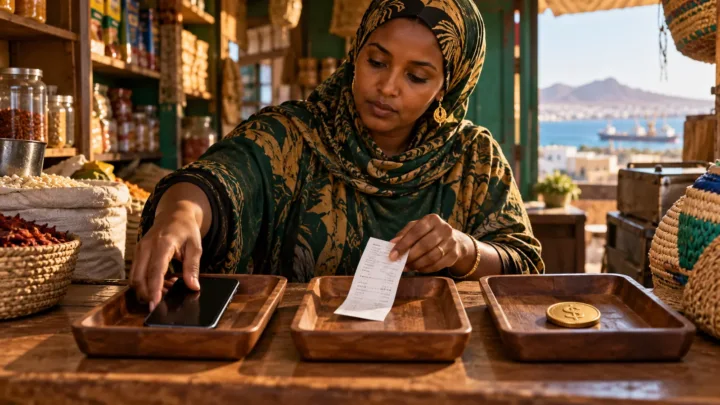
Connecting Bitcoin with mobile money in Djibouti does not mean turning a phone number into a Bitcoin address. A mobile payment moves value through an operator’s system. Delivering BTC relies on a different mechanism. If an intermediary connects the two, that party’s role, status and commitments must be verified separately.
D-Money and WAAFI are among the electronic-money issuers listed by the central bank. Their presence does not demonstrate an official crypto gateway. This guide explains how to assess an offer without importing an M-Pesa tutorial from a neighboring country or inventing an integration we have not confirmed.
In brief
- Electronic-money payments and Bitcoin receipts are two separate operations supported by two different forms of evidence.
- An operator’s name in a private advertisement is not enough to prove a partnership or guarantee delivery.
- Verify the provider, contracts, beneficiary and fees before committing; no local offer was tested for this guide.
Bitcoin and mobile money in Djibouti: map the two flows
An offer may sound simple: send francs by phone and receive BTC. Behind that sentence are several separate relationships. Our general guide to buying crypto with mobile money helps distinguish payment, exchange and custody before following instructions.
Draw three boxes: your payment account, the exchange provider and your Bitcoin destination. Add the names of the responsible parties and the expected amounts. If one box is missing, the process still does not make clear who will be accountable if something goes wrong. A seller who refuses to identify themselves leaves a fundamental risk unresolved.
The phone is only an access tool. A mobile app may serve a bank, an electronic-money operator or a crypto wallet. Their presence on the same device does not create shared infrastructure or mutual guarantees. The appearance of the screen does not reveal the nature of the right you hold.
This distinction also matters for the words “received” and “confirmed.” The first service may confirm a payment while the second has not delivered the asset. A unique identifier in an app does not become a Bitcoin transaction ID. Each piece of evidence must be traceable to its own system.
To make a decision, describe the final outcome outside the phone: which asset, what quantity and who controls the keys? Someone who receives only an internal balance is not in the same situation as someone whose personal wallet confirms receipt. The initial requirement must make that distinction clear.
What local sources can confirm
The Central Bank of Djibouti’s list of licensed institutions includes D-Money and WAAFI under electronic money. It identifies a service category. It should not be cited as proof that either operator sells Bitcoin or guarantees private exchanges.
Circular 2025-01 on VASPs itself distinguishes electronic money from crypto-assets. A professional arranging a conversion must therefore be assessed according to its actual activity. Authorization for one link in the chain does not automatically cover all the others.
D-Money’s terms and conditions, dated October 1, 2026, when we consulted them, describe an account denominated in electronic-value units. This characteristic must not be confused with a Bitcoin receiving address. A crypto transaction requires another service or another wallet.
For WAAFI, do not use documentation intended for another country or another company without checking it. A brand operating across several markets may offer different contracts. Verify the local entity and the precise function before treating any document as payment instructions.
Our research on October 19, 2026, did not confirm a BTC purchase offer from these operators, nor did we test a local transaction. This guide therefore promises no available button or seller. It sets out the checks required if a lawful offer is presented, without recommending that users bypass an unavailable feature.
Identify the intermediary and beneficiary before paying
An advertisement naming a payment method does not prove that the operator authorizes it, that the provider is regulated or that it can deliver. Ask for the name of the responsible company or individual, the service reference and the exchange terms. Our guide to crypto platforms and proof of status helps structure this check.
The payment beneficiary must match the advertised process. Redirecting payment to a cousin’s account or to a “technical agent” is not a minor formality. It changes the evidence of receipt and may make it difficult to identify the counterparty that received your funds.
Also verify names and the documents being requested. A personal payment account should not become an account lent to a stranger. The risks go beyond losing money: a transaction may later be attributed to you even though you controlled neither its purpose nor the actual beneficiary.
Our guide to crypto KYC and data protection distinguishes identity checks from suspicious data collection. Anyone asking for your payment PIN or recovery phrase is not carrying out a routine administrative verification. Stop the exchange and use official channels.
For regular or professional activity, have the authorizations and terms of both services confirmed before collecting money from third parties. The technical ability to send a payment does not authorize you to become a financial intermediary. A usage tutorial does not answer that question of legal status.
Calculate the cost of a chain with multiple fees
The cost of a mobile payment does not represent the full cost of buying Bitcoin. Include any initial payment, transfer, conversion price, deductions and final withdrawal. Our method for assessing crypto fees and net cost helps compare routes that produce the same outcome.
Take a completely fictional example. A person pays 15,000 DJF for the transaction and an additional 100 DJF in charges. They receive 0.0016 BTC in a balance, followed by a deduction of 0.00002 BTC at withdrawal. The final amount is 0.00158 BTC for total spending of 15,100 DJF.
The effective price is then approximately 9,556,962.03 DJF per BTC. This figure does not reproduce any operator’s or seller’s pricing. It simply shows that the amount actually withdrawn is the appropriate denominator when the goal is to hold the BTC personally.
Ask for a breakdown of the costs rather than labeling every difference a “mobile-money fee.” A currency-conversion margin belongs to the seller or conversion service; a withdrawal deduction may follow a different policy. Transparency requires linking each amount to a responsible party and a rule.
When comparing another channel, use the same date, budget and final destination. An offer that excludes withdrawal should not be presented as cheaper than one that already includes it. Minimums can also make a solution unsuitable for small amounts, even when the advertised rate appears competitive.
Collect proof of payment and proof of Bitcoin delivery
After making a payment, check the history in your own account. A screenshot sent by the other party is not enough to confirm what your operator recorded. Keep the reference, amount, time and beneficiary details, without publishing personal data in a discussion group.
For BTC delivery, check the agreed address and network. A transaction visible on a block explorer must correspond to your destination, not merely to a screenshot showing a similar amount. The confirmation status must be understood according to the receiving service’s requirements.
The guide to crypto wallets and key management explains this check. A personal wallet can receive funds without revealing its secrets. The seller does not need your recovery phrase to send funds to a public address.
A small test can verify technical receipt if the fees and minimums allow it. However, a successful first transfer does not prove that the seller will have the liquidity for a larger amount. Increasing the amount sharply after a test therefore changes your exposure to counterparty risk.
If something goes wrong, put the events in order: payment requested, payment executed, delivery announced and receipt confirmed. This chronology prevents a local settlement issue from being confused with a network error or a withdrawal that is still pending. It also makes it easier to direct a specific complaint to the right party.
Plan the exit and incidents without improvising
Converting back requires a fresh check. Holding BTC does not guarantee that a local buyer will accept it in exchange for francs when needed. An offer available on entry is not a promise of permanent liquidity on exit.
Before selling, obtain the payment terms, beneficiary details and procedure to follow if local receipt fails. Do not deliver the asset based on an unverified notification. The service rules should specify the order of commitments; an improvised private exchange increases the risk of losing both forms of evidence.
Keep a way to cover urgent expenses without depending on this chain. An unavailable phone, an account review or maintenance can slow the process. The time required for a technical transaction is only part of the time needed to obtain francs that can actually be spent.
If a contact requests another payment to release the delivery, ask for verifiable justification. Do not provide a confidential code or remote access. A genuine procedure should be traceable through the relevant service and should not depend solely on the person collecting the additional money.
Bitcoin and mobile money in Djibouti can therefore meet in a service offering without becoming a single system. Professional due diligence means identifying the link between them, its authorizations, costs and evidence. Until that link is more than an oral promise, the process does not provide a sufficient basis for committing funds.