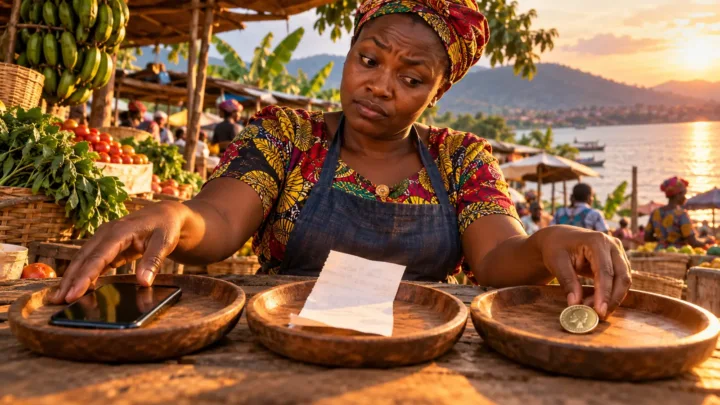
Bitcoin and mobile money in Burundi operate through different rails, even when their interfaces sit on the same phone. A franc balance held with a payment operator does not become BTC simply because the user switches screens. Sending money, making a potential purchase and delivering assets on a blockchain involve separate evidence and responsibilities.
This separation matters especially as instant payments expand. BurundiPay brings bank and mobile accounts closer together, but its announcement does not demonstrate any Bitcoin gateway. To understand what is actually possible without inventing a local service, users must trace the money, identify each participant and maintain the distinction between payment infrastructure and crypto authorization.
In brief
- The official list of payment institutions is not a list of approved Bitcoin sellers.
- BurundiPay covers payments between accounts; its launch does not turn francs into cryptoassets.
- A mobile receipt and a Bitcoin transaction answer two different questions and cannot substitute for one another.
Bitcoin and mobile money in Burundi: tracing two separate records
Our guide to crypto purchases and mobile money in Africa illustrates the initial divide. On one side, an operator records an amount in its own system. On the other, the Bitcoin network records transactions according to its own rules. A screenshot combining the two does not prove that the operations match.
In a mobile wallet, the customer holds a right defined by the service contract and the applicable framework. In a personal Bitcoin wallet, technical control depends in particular on the means used to sign transactions. On a custodial platform, the user remains dependent on an intermediary to make a withdrawal. Using the word “wallet” for every case conceals these differences.
Any operation claiming to connect the two rails must therefore set out each step: payment origin, beneficiary, delivery obligation and asset destination. If one step is missing, the user cannot know who is responsible for the final outcome. A promise of instant conversion does not fill that gap.
The legal question comes before any commercial test. This research did not confirm any approved Bitcoin channel for the use described. This guide explains the mechanisms and their risks; it does not validate a seller or provide a way to bypass restrictions imposed by an operator, bank or authority.
The phone is merely a shared interface. The same device can display a banking app, a game and a crypto wallet without making those services equivalent. Ease of navigation should not obscure differences in contracts, fund recovery and the identity of the responsible party.
Identifying the payment providers actually documented
The list of payment institutions published by the BRB, dated February 9, 2026 for active participants, notably distinguishes the electronic money institutions Lumicash, Sasai Fintech Burundi for EcoCash and Ellis Business Company for Cashtel. This list is a dated starting point, not a guaranteed snapshot of all subsequent developments.
The category must be read alongside the name. An electronic money operator does not necessarily carry out the same activities as an international money transfer service or an aggregator. Appearing in an official table does not extend an institution’s authorization to every new function announced by a reseller on social media.
The commercial name also warrants local verification. A similar brand may exist in another country with a different currency, company and terms. A tutorial intended for another market does not show that a Burundi resident has access to the same service or that the same fees and identity documents will be accepted.
References to M-Pesa or Airtel Money on general-interest pages should be assessed with the same discipline. The sources reviewed here do not confirm an official Burundi integration with Bitcoin for these brands. Adding their names to a headline creates neither actual availability nor a right to transact.
An agent’s advertisement is not a substitute for the operator’s terms. Users must verify the role the agent can actually perform: deposit, withdrawal, assistance or another service expressly covered. A business displaying a payment sign does not automatically gain the right to offer every conceivable financial product.
What BurundiPay changes—and what it does not prove
The BRB presented the launch of BurundiPay on April 23, 2026 as an instant-payment infrastructure connecting bank and mobile accounts. Its significance lies particularly in interoperability. Better connections between institutions may reduce technical barriers to ordinary transfers, depending on the integrations actually put into service.
Launching an infrastructure does not mean that every bank, operator and function is already operating without limits. Official communications also call on institutions to continue their integration work. Availability should therefore be checked with the relevant participants rather than treating a coverage ambition as immediate universal access.
Nothing in the announcement supports presenting BurundiPay as a central bank digital currency, a stablecoin or a Bitcoin blockchain. The infrastructure organizes a payment rail; the legal and technical nature of the values exchanged does not change by analogy with a crypto app.
This distinction provides a simple test for advertising claims. If an intermediary says BurundiPay guarantees its BTC sale, it must provide specific evidence of that function and of the contractual link being invoked. Showing only the launch announcement does not answer the question. That document concerns something else.
For a household, improved conventional payments may even address the original need without a cryptoasset. Sending francs to a relative and speculating on Bitcoin are not the same objective. Comparing regulated services suited to the expense first avoids adding a conversion and market exposure without a demonstrated purpose.
Comparing costs without confusing speed with the net price
An honest presentation adds up the amounts that actually leave the account and measures the final quantity received. Our method for assessing crypto fees and total cost does not stop at the commission displayed by a single app. It accounts for the payment, the quoted price and any withdrawal deductions.
Here is a purely fictional example that describes no available offer. A user would spend 150,000 BIF, plus a 1,000 BIF payment fee, for an advertised quantity of 0.001 BTC. With a deduction of 0.00002 BTC, only 0.00098 BTC would remain. The expenditure would reach 151,000 BIF for that net quantity.
The effective cost would be approximately 154,081,632.65 BIF per BTC. This educational figure is neither a Bitcoin price nor a Burundian franc exchange rate. It shows why comparisons must use the quantities received, not only those displayed before fees. Omitting a deduction produces a different conclusion.
Processing time adds another dimension. A fast payment on one network does not guarantee availability on the other side. The intermediary may wait for a confirmation, request a document or experience an outage. No universal delivery timeframe can be inferred from the speed of the initial transfer alone.
A value expressed in francs can also change between steps. The seller must specify when the price becomes final and what happens if a transaction fails. Without written terms, the buyer may discover after payment that the quoted amount was only a temporary indication.
Distinguishing payment evidence from delivery evidence
The mobile service receipt should identify the date, amount, beneficiary and transaction reference. An image sent by the other party is not a substitute for checking the account from the user’s own device. A message can be falsified or show a payment unrelated to the sale under discussion.
For Bitcoin, a transaction ID makes it possible to examine a movement on the network. The destination and expected amount must still be checked. A transfer visible to another address does not prove delivery to the correct user. Our guide to crypto wallets and their keys helps explain what the holder actually controls.
On a custodial account, an internal entry may appear without a corresponding individual public transaction. The contract must explain this situation; a blockchain ID should not be invented. The key question is whether the user holds an internal balance or an asset actually transferred to their personal address.
Evidence should be retained without publishing all account details. Documentation useful to a complaints service may contain private information. Sharing it in a public group creates exposure to further fake support channels. Access codes, signatures and recovery phrases have no place in an ordinary payment demonstration.
The identity-verification and redress process must remain consistent with the accounts used. Having a third party pay to avoid a limit creates a mismatch between the buyer and the sender. That difference can make the case harder to explain, even when the parties say they know each other.
Set a stop rule before moving funds
The first rule is to stop any proposal whose legal or contractual framework has not been confirmed. Do not wait for a loss before looking for the responsible entity. A legitimate service should be describable through more than a seller’s personal number or a promise of returns.
The second concerns the beneficiary’s identity. A sudden account change, a forced split payment or a request for a false payment reference calls for a stop and independent verification. These instructions make the transaction less traceable; they are not tricks that make it safer.
The third concerns economic usefulness. If the sole objective is to pay for a local expense in francs, adding Bitcoin may introduce unnecessary volatility and fees. The choice should serve the concrete need, its timeframe and the permitted services—not the appeal of a technology.
In Burundi, understanding the two records therefore helps both to recognize payment innovation and to reject a fake gateway. BurundiPay, mobile accounts and Bitcoin must be described according to what they actually do. Their presence on the same phone creates neither a shared guarantee nor authorization for automatic conversion.