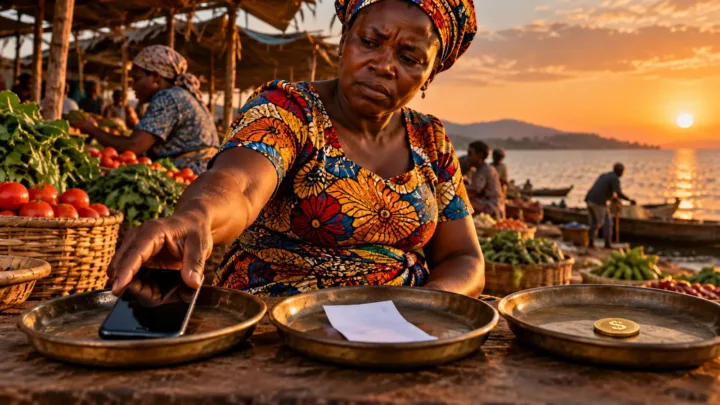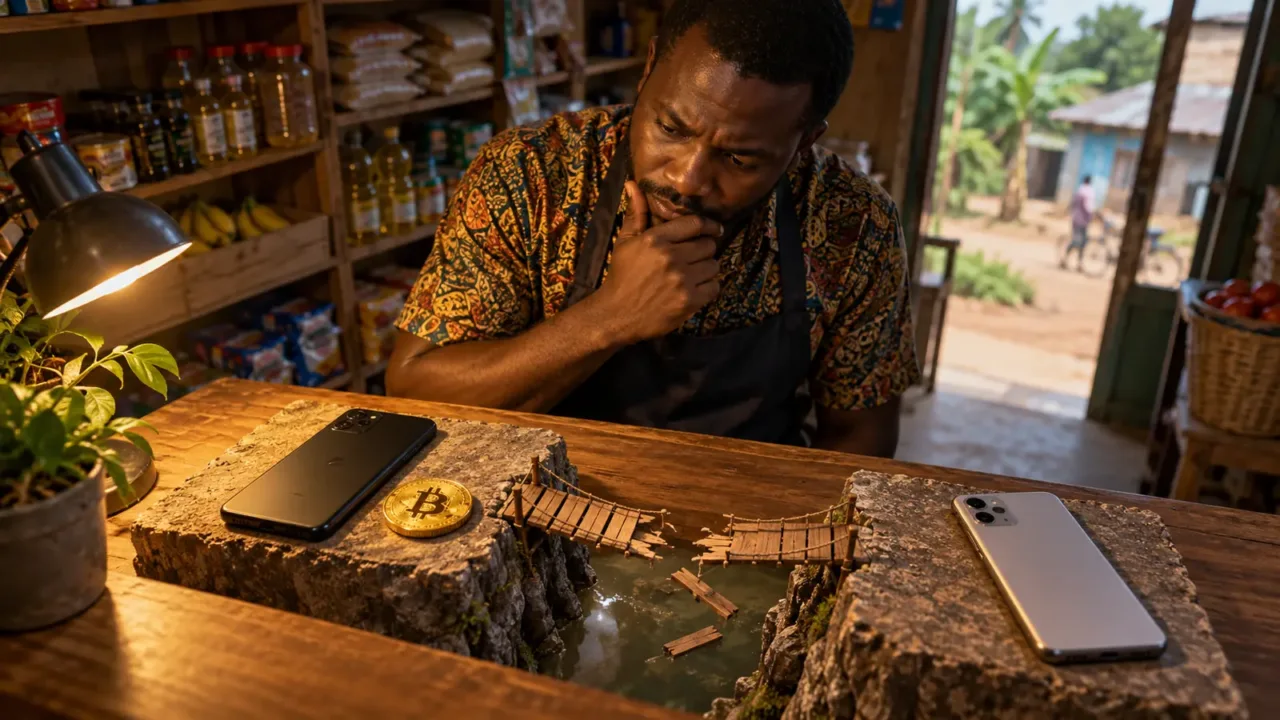
Bitcoin and mobile money in Malawi may appear on the same phone, but their transactions do not automatically share the same ledger or the same responsible parties. A kwacha balance held with a mobile operator does not become BTC simply because a seller adds the word “conversion” to an offer.
To understand the proposed flow, payment, any exchange and final custody must be kept separate. This approach also makes it possible to recognize progress in local payments without attributing an unproven crypto integration to it. Here is how to assess the roles of Airtel Money and TNM Mpamba, the available evidence and the limits of any bridge claim.
In brief
- Improved interoperability between payment systems does not amount to an official connection to Bitcoin.
- A mobile receipt and a blockchain transaction ID prove different events.
- Fees, the beneficiary’s identity and the time until final availability must be examined across the entire flow.
Bitcoin and mobile money in Malawi: two contracts to map
Our guide to buying crypto with mobile money distinguishes the monetary payment from the promise to deliver the asset. This creates a practical test: can the user explain who receives their kwachas and who owes them the expected asset? A single interface is not enough to unify those responsibilities.
Within the mobile-money flow, the provider records value according to its terms of service. On Bitcoin, transactions follow the network’s rules. A custodial platform may add its own internal accounting between these two steps. Each produces useful information, but none automatically replaces the evidence provided by the others.
The actual path must therefore be mapped before an offer is assessed. Paying a seller directly is not the same as using a purchase feature integrated into the operator’s app. The former may simply involve an ordinary transfer service, without the payment provider knowing about or guaranteeing the sale being discussed.
A request to use a third-party account or change the beneficiary creates a break in this map. The user should not resolve it with a simple promise made in a conversation. The terms and identities must remain consistent so the transaction can later be explained to a complaints service.
This analysis does not validate any commercial route. The research did not confirm a licensed local Bitcoin–mobile money flow to recommend. The guide sets out the questions to resolve before a permitted transaction, without providing instructions for concealing a payment or bypassing a restriction.
Recognizing operators without inventing their functions
A CFTC decision published on July 17, 2025 identifies Airtel Mobile Commerce and TNM Mpamba among the main mobile-money players in Malawi. This source helps establish the local participants. It does not certify a crypto seller using their names.
TNM’s official FAQ describes, among other things, access to the Mpamba service within its own environment. A documented payment or mobile-account function should not be supplemented with an assumption that Bitcoin can be purchased. The specific product must appear in a relevant offer or set of terms.
Known brands in other countries require the same caution. An M-Pesa tutorial produced elsewhere does not demonstrate an equivalent offering in Malawi. The existence of an international brand does not automatically mean the same company, currency, limits or customer rights apply in every market.
Agents must also be distinguished from operators. A mobile sign outside a shop may indicate a possible role in certain services, but not a general authorization to offer crypto investments or conversions. An agent adding a commercial activity should be able to explain the basis on which they operate.
To verify a function, the official channel must be located independently of the seller. A screenshot from another country may be authentic while still being inapplicable. The country, company, currency and date must match the service the reader is actually considering using.
Understanding interoperability without attributing a blockchain to it
The ticketing case examined by the CFTC provides a useful distinction. The decision addresses, among other things, opening a system to other payment providers. This interoperability issue concerns the ability to pay through multiple channels; it does not demonstrate a conversion into a crypto asset.
The obligations and deadlines described in a decision must also be distinguished from their actual implementation. An order requiring greater openness does not, by itself, prove that all expected functions are available today. Current operations must be verified with the relevant services.
The RBM’s 2026–2030 payment strategy distinguishes several areas of work: infrastructure, adoption, innovation and virtual assets. These categories should not be merged to claim that every payment reform automatically opens a regulated Bitcoin market.
For a household, a conventional transfer may meet the need without a crypto step. If the recipient needs kwachas for a local expense, adding a volatile asset can create extra fees and risk. The technology should be assessed against the objective, not introduced simply because it appears more modern.
The right comparison therefore sets complete, permitted routes against one another. It examines what reaches the final beneficiary, in which currency and on what date. A rapid movement on the first app does not guarantee the speed or compliance of the entire flow.
Measuring the real cost and delay risk
Our method for calculating the full cost of crypto transactions adds up the money spent and uses the amount available after deductions. It avoids comparing a promotional price with a net amount calculated at another stage. Mobile-payment fees remain separate from network or crypto-provider fees.
In a wholly fictional example, a purchase of 62,000 MWK plus an 800 MWK payment fee produces a total of 62,800 MWK. The advertised amount of 0.0006 BTC would be reduced by 0.00001 BTC before arrival. Only 0.00059 BTC would remain for the overall expense.
The economic cost would reach approximately 106,440,677.97 MWK per BTC. This figure is neither a current price nor an offer available in Malawi. It shows the effect of a small deduction on the net price and the importance of using the same endpoint in a comparison.
Timing must be treated separately from price. The mobile operator, seller and custody service may apply different checks. The speed of the first transfer does not justify promising immediate availability in the final account. Document verification may also take place after the account is opened.
A delay can create an economic loss even without a market decline—for example, if a bill cannot be paid on time. For a certain expense, the absence of a reliable timeline may be enough to make the route unsuitable. The calculation must therefore reflect the beneficiary’s needs rather than the advertised cost alone.
Building evidence that matches the relevant step
The mobile receipt should identify the date, amount, reference and beneficiary. The status should be checked in the user’s own account rather than relying solely on an image sent by the other party. A screenshot may show a genuine transaction unrelated to the commitment being discussed.
For Bitcoin, a transaction ID makes it possible to examine a movement on the ledger. The expected destination and amount must still be reconciled. Our guide to the crypto wallet and its keys explains why the displayed address and effective control should not be confused.
An internal balance with a custodian may also be credited without a corresponding individual public transaction. The service should explain the nature of that entry. Inventing a blockchain transaction ID to make the evidence more convincing solves nothing; what was recorded and where must be described honestly.
The guide to KYC checks and recourse helps users keep documentation consistent with the flow of funds. A payment made by a third party can create a mismatch between the buyer and the sender. That discrepancy should be examined before a transaction, not concealed when a complaint is filed.
Supporting documents should be shared through legitimate channels. Publishing all the data in a group can attract fake recovery agents. No ordinary dispute justifies giving a stranger secret account codes or the phrase used to restore a personal wallet.
Setting a clear stop rule
The first reason to stop is an essential authorization or contract that has not been confirmed. An accessible app does not prove that the financial route is suitable for the resident and their needs. A product-specific clarification should be requested instead of looking for a tutorial that avoids the issue.
Requests for a false payment description, a borrowed account or splitting transactions to evade a check are also stop signals. They make the transaction harder to explain. The foreign-exchange rules recalled by the RBM in its 2025 notice do not disappear simply because part of the flow uses a token.
This guide is based on documentary research conducted as of October 20, 2026, with no payment or commercial account tested. It does not confirm any universal official integration between the mobile operators cited and Bitcoin. Any new feature should be substantiated by a local announcement and precise terms.
Understanding Bitcoin and mobile money in Malawi therefore means keeping the flows clear. Progress in payments deserves recognition without inventing a crypto bridge. For readers, the right evidence remains evidence showing who receives what, who is responsible for delivery and what recourse exists if a step fails.