For readers seeking to protect their budget, the priority is to identify what they own, who owes them what and which rules govern the transaction they are considering. This guide separates documented facts, historical warnings and checks that still need to be carried out, without presenting a local purchasing route as authorized.
In brief
- Digital dinar payments do not prove that trading crypto assets is authorized.
- A central bank warning reported in 2018 calls for genuine legal caution, but does not justify inventing the sanctions currently in force.
- The final cost depends on the exchange rate, the seller, withdrawal terms and whether usable dinars can be recovered.
Crypto in Libya: start by identifying the asset
Before comparing apps, our guide to crypto wallets and their responsibilities helps distinguish a commercial account from a tool that controls private keys. That distinction changes how a balance should be interpreted: a platform’s promise does not automatically give users control of an asset on a blockchain.
Bitcoin refers to a network and its native unit. A stablecoin generally aims to track a monetary reference, but also carries the risks associated with its issuer and reserves. A digital bank payment transfers funds under the rules of a financial institution and payment system. The fact that they share a screen, QR code or transaction history does not make these instruments interchangeable.
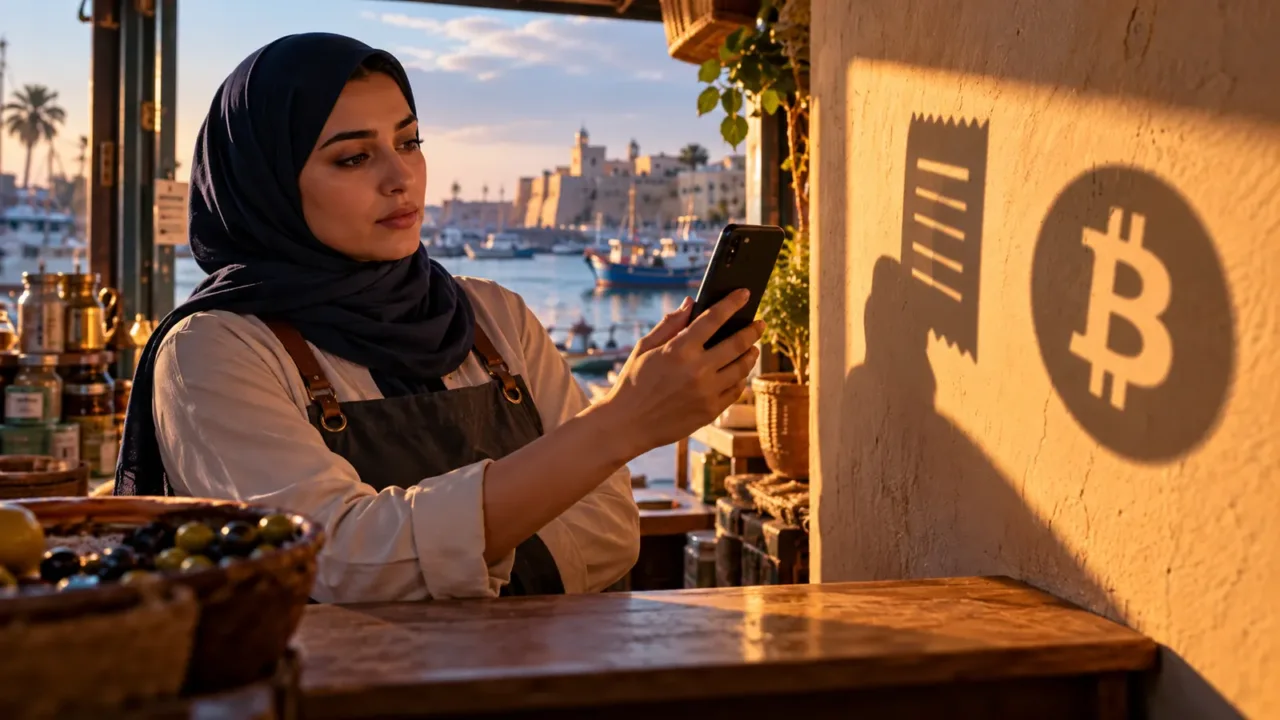
Consider a merchant who receives a notification on a phone. The message may confirm a payment in dinars through a local app. It could also display a fabricated screenshot or report a token transfer on a foreign network. Before handing over goods, the merchant should check the relevant account personally and understand the nature of the payment rather than infer its validity from the interface.
The official presentation of LYPay describes an instant payment service between Libyan banks. It notably mentions an account with an IBAN, a participating bank and registration in the NAD system. In that presentation, the service is not a Bitcoin exchange. Digital terminology never removes the need to examine the exact product.
Reading warnings without inventing new law
On May 15, 2018, Libya Observer reported a warning from the Central Bank of Libya describing Bitcoin and virtual currencies as illegal and lacking local legal protection. Libya Herald also reported that position. We are citing contemporary reports here: the original statement was not found among the official pages consulted for this article.
That research limitation matters. It prevents a secondary quotation from being presented as a complete regulatory text reviewed today. Nor does the absence of an accessible document amount to authorization. In light of a documented restrictive position, any commercial project or substantial transfer requires local advice addressing the specific activity and applicable rules.
Electronic-transaction provisions do not automatically resolve the issue. The reproduction of Libyan Law No. 6 of 2022 addresses payments and electronic money within a banking framework. Article 70 does not demonstrate a general authorization for private tokens. This documentary translation is no substitute for a consolidated official edition or a lawyer’s analysis.
To prepare useful questions, our report on platform-status criteria in Africa distinguishes between a company’s existence, its licensing and the scope actually covered. A foreign license is not permission to operate in Libya; public discussion of future regulation is not the adoption of a new rule.
Understanding the price actually paid in dinars
An international Bitcoin price does not provide an executable quote in Libya. The exchange rate, amount delivered, fees and seller availability must still be established. Taken together, these factors can produce a local price very different from the figure displayed on a major financial website.
Consider a simulation only, with no quoting value. A budget of 1,200 dinars gives access to a quote showing 6 dinars per fictitious unit of account. Before fees, that represents 200 units. If 12 additional units are deducted as fees and margin, the customer receives only 188 units. The effective cost is approximately 6.38 dinars per unit received, rather than the advertised 6 dinars.
The calculation proves neither that the service is legal nor that an accessible market exists. It is simply a way to read a commercial document. The quote’s validity period, conversion method and whether fees are included or added must be specified. An advertisement may show an appealing price for an amount that does not match the reader’s needs.
Our method for calculating the full cost of a crypto purchase also includes the exit. If resale requires another margin, an expensive withdrawal or a delay incompatible with an essential expense, the purchase cost represents only part of the problem. An apparent gain on screen can disappear when converting back to a payment method that is actually usable.
Assessing risks beyond price volatility
Volatility attracts attention, but it does not account for every possible loss. A provider may suspend an account, a seller may dispute a payment or a scammer may replace a destination address. These risks do not depend solely on Bitcoin’s price. They concern the quality of the contract, cybersecurity and the evidence available.
The Bitcoin documentation for new users notably stresses the need to secure a wallet and the difficulty of reversing transactions. Commercial support cannot simply restore a lost private key. Conversely, a platform that holds assets on behalf of its customer imposes its own recovery and control procedures.
Customer identification does not certify a platform. Sending an identity document to a website does not prove that the website has the local right to operate. Our guide to KYC checks and data protection recommends verifying the data controller, official channels and available remedies before sharing sensitive information.
Beginners should also distinguish technical availability from financial availability. An app may connect for several weeks and then block a withdrawal for review. An unstable internet connection may prevent someone from meeting a deadline. None of these events turns housing or healthcare spending into an acceptable investment: money needed in the short term should not depend on an uncertain exit.
Assessing local payments without assigning them a crypto role
Banks and operators are developing useful payment services independently of public blockchains. Receiving a salary, paying a bill and transferring dinars between accounts do not require converting those funds into a speculative asset. The appropriate choice depends first on the actual need, not on the technology label.
A banking service that uses the acronym P2P may simply refer to a person-to-person transfer. A crypto marketplace uses the same acronym to match buyers and sellers. The first meaning does not prove any integration with the second. In a dispute, responsibility for the payment system and responsibility for the seller may remain entirely separate.
The principles of mobile payments and crypto purchases help identify this separation. In Libya, they are not an authorized operational tutorial. We assume neither a LYPay partnership with a platform nor the ability to convert a local wallet into USDT. A brand displayed in a third-party advertisement does not prove that its owner agreed to the arrangement.
Before making any decision, requesting written confirmation from the official provider is safer than relying on a group conversation. The question should address the specific use, account conditions and required documentation. If a seller recommends lying about the purpose of a payment or a person’s residence, that is a stop signal—not a shortcut for simplifying the process.
Building a verifiable file rather than taking a gamble
A decision sheet can fit on one page: objective, affordable amount, exact product, counterparty, proof of status, fees, exit method and available remedies. Each item should have a dated answer and an identifiable source. A large number of favorable messages does not replace a contract or confirmation from an authority.
Evidence varies in quality. Official terms consulted today carry more weight than an old screenshot; a licensing register provides more information than a company registration number; a blockchain transaction proves movement between addresses, not the certain identity of their holders or the performance of every commercial obligation. These distinctions help prevent rushed conclusions.
For a business, maintaining usable accounts, identifying the source of funds and checking foreign-exchange rules require appropriate support. This guide assigns no universal tax treatment and recommends no method for circumventing a control. When the treatment of a transaction remains uncertain, postponing it often costs less than a block whose consequences extend beyond the amount transferred.
The practical rule is simple: a local payment operates under its own rules; a crypto asset carries distinct risks; an accessible service is not automatically authorized. In Libya, starting with these three distinctions provides a stronger foundation than a promise of returns or a platform ranking unsupported by local evidence.