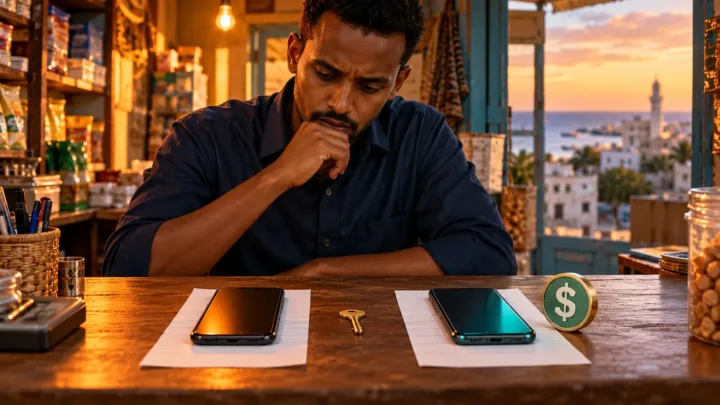
This guide examines those differences through practical needs: holding a reserve, paying a bill or sending money to a relative. It does not certify any local platform, individual authorization or yield. The calculations are fictional and intended to explain costs and adverse scenarios without turning a targeted peg into a guarantee of availability.
In brief
- A token’s reference stability guarantees neither local liquidity nor immediate personal redemption.
- A mobile dollar balance and a stablecoin involve different risks and responsibilities.
- The comparison should follow the money through to the final expense, after all fees.
Stablecoins in Somalia: separating the unit from the right
The guide to crypto wallets and custody helps frame a simple question: who controls the means of moving the balance? For a stablecoin, the answer involves the wallet or intermediary, as well as the token’s characteristics. For mobile money, the service’s terms of the payment contract must be examined. The two instruments do not become identical simply because they use the same phone.
The Mobile Money regulations published by the CBS notably govern the issuance and conversion of mobile money in approved currencies. This framework does not turn a private token into authorized mobile money. Users must identify the nature of the balance before drawing conclusions about their rights: a dollar-like name may refer to a payment claim, a market asset or merely an internal unit.
A stablecoin targets a reference value, often the dollar, through a structure that depends on the product. It may involve an issuer, reserves, redemption terms and technical restrictions. Other models use different mechanisms and carry different risks. The word “stable” is therefore not a guarantee. It describes a value objective that must be assessed against the holder’s actual evidence and rights.
For a household budget, start with the expense. If a bill is paid from a mobile account, the number of tokens held elsewhere does not yet explain how much is available for that bill. The tokens may have to be sold, with a counterparty found, and the money then transferred. Each step adds a condition. The relevant measure is the amount that can actually be used, where and when the need arises.
Comparing the direct route with the token detour
The Mobile Money and cryptocurrency guide makes it possible to map two comparable routes. The first transfers money through a documented service. In the second, the sender buys a stablecoin, transfers it and then sells it. Neither route automatically wins. For a given need, the full costs, timing, obligations and recipient’s ability to use what they receive must be compared.
The CBS overview of the national payment system describes transfer and interoperability infrastructure. This development provides a useful benchmark without proving that every service is available to every user. A blockchain solution must show what it actually improves compared with an already accessible route. Adding a token without a measurable benefit may only add another counterparty and a currency conversion.
In a fictional simulation, the direct route costs 3 dollars for a comparable need. A token-based detour requires 2 dollars to buy, 1 dollar to transfer and 2 dollars to exit, for a total of 5 dollars. The first route is therefore 2 dollars cheaper, before any additional risk is considered. These amounts do not describe any Somali fee schedule; they show why a single low commission does not capture the full comparison.
The conclusion could change under other conditions that are properly documented. Current quotes should therefore be requested for the same recipient and the same outcome. A price calculated for a large amount does not automatically apply to a small payment. The guide to the full cost of crypto transactions helps maintain a common basis and flag steps whose pricing remains unknown.
Testing a depeg, an expensive exit and an outage
Market value can move away from the reference. To measure the effect, imagine 300 tokens each targeting one dollar. If their price falls, hypothetically, to 0.97 dollar, their theoretical value becomes 291 dollars—a 9-dollar decline before fees. This does not predict any market move; the scenario simply shows that a target peg does not guarantee an outcome under all conditions.
Accessible channel liquidity can deteriorate without any dramatic change in the global price. A seller may offer a less favorable buyback rate, a service may suspend withdrawals or a compliance check may immobilize the account. The portfolio’s theoretical value then says nothing about when the budget will become available again. For a near-term payment, this timing risk may matter more than a small difference in the usual fees charged by two solutions.
The third scenario concerns access. If the phone is lost, recovery fails or a network remains unavailable, the holder must know the recovery procedure. Personal backups and intermediary-based recovery systems do not address the same incidents. An emergency reserve held entirely in a system whose recovery process has never been understood may be unavailable precisely when it is needed.
Exit fees must remain part of the test. A small amount can face a disproportionately high fixed cost. Depending on the network and wallet, a separate native asset may also be required to move the token. Prepare for that constraint without automatically buying more products. The purpose of the scenario is to identify dependencies before an emergency, not to multiply operations when the user is looking for a quick solution.
Reading issuer terms without assuming a universal cash desk
Tether’s terms, used here as an issuer example and not as a recommendation, govern access to its services. They should not be confused with the commitments of a secondary seller or platform. The holder must identify the party from which conversion can actually be requested. A dollar target does not by itself prove an immediately payable claim against every participant in the route.
The issuer’s direct fee schedule states a minimum acquisition or redemption amount of 100 000 dollars under certain conditions. This is not the minimum for every secondary-market transaction. It illustrates the difference between a direct institutional mechanism and the experience of an individual holding a small amount. That individual will often depend on the channel they can actually use, with its own prices, limits and account rules.
Any reserve attestation should be read together with its date and scope. It may provide useful information without covering every event: an address error, fraud, lost keys or an account blocked by a third party. Do not turn a transparency communication into personal insurance. Before relying on it in a decision, determine what the evidence measures and what it leaves outside its scope.
The network brings its own characteristics. Verify the actual token, its contract where relevant and the destination’s instructions. A symbol copied into a wallet does not prove that an asset is genuine. Bridged versions may add another dependency. For a simple custody or payment need, that complexity should be justified by a concrete benefit, not by a promise of universal convenience.
Factoring in Somalia’s framework and the responsibilities along the route
The CBS warning from June 2024 includes stablecoins among the virtual assets it discusses. That date should be retained, and later references reviewed, before any transaction. This guide does not certify any individual provider. Visiting an international website or seeing a payment currency mentioned in an advertisement does not replace checking the status applicable to the service and the user.
The framework for assessing crypto platforms and their status recommends separating identity, access and operational quality. A good price does not compensate for an untraceable contracting company. A payment license does not necessarily demonstrate authorization to custody tokens. For professional use, obligations concerning customers, funds and supporting documents require a specific review, separate from a private individual’s learning process.
Residency, the service’s territory and the payment unit must remain precise. Regional documentation does not automatically apply to every situation. If SOS amounts are involved, verify that they refer to the Somali shilling and not another unit called a shilling. Keep the amount and currency for each step so that conversions can be understood and the transaction flow explained without reconstructing the file from memory.
The guide to KYC, data protection and recourse helps identify the relevant documents to prepare. Use official channels, and do not confuse proof of identity with wallet secrets. Public transaction references can help track an incident; a recovery phrase can provide access to the funds. No purported support agent should receive that power merely to investigate a commercial complaint.
Allocate the budget by need, not enthusiasm
Start with the sums that must remain available for essential expenses. Do not automatically expose them to a crypto detour simply because the token tracks the dollar. A reserve that may need to be mobilized quickly requires access that is understood and suited to the need. Concentrating all savings in one account, one phone or a single recovery mechanism can create an additional point of failure, even without a price decline.
Set a limit and define the reasons for exiting: costs becoming too high, a service changing, access remaining unconfirmed or liquidity being needed. This decision should be made before an emergency. Do not chase a fixed return presented as risk-free simply because the asset involved is called a stablecoin. An interest-bearing product may add lending, counterparty or strategy risk and no longer resemble simply holding the original token.
For funds intended for a relative, discuss their constraints before sending the money. Do they have the right tool, understand custody and know a lawful, documented exit route? The sender’s technical expertise does not guarantee the recipient’s. A useful transfer should reduce the recipient’s difficulties rather than leave them with a series of procedures, unknown fees and contacts they must find after receiving the funds.
Stablecoins in Somalia should ultimately be compared on the basis of rights, net cost and actual availability. A displayed dollar does not tell the whole story of a balance. The decisive question is concrete: how much can be used for the planned expense, how quickly and with what recourse? If the route cannot answer clearly, a stable reference is not enough to justify exposing the budget.