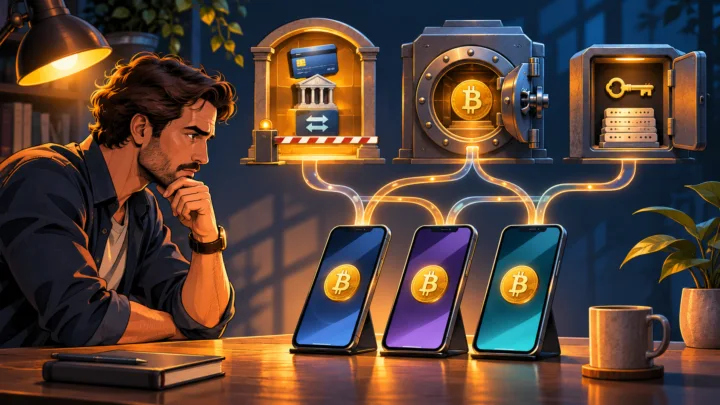
Comparing Bitcoin wallets for 2027 is not about choosing the one with the most features. A wallet should let users receive, verify and sign transactions through a setup they understand. The software and the location of the keys are not always the same thing.
Sparrow, Electrum and BlueWallet provide three documented examples, each designed for different desktop or mobile use cases. Their documentation was reviewed on November 5, 2026. Features and compatibility should be checked again before installation, and a project’s popularity should never be treated as a blanket security guarantee.
In brief
Our guide to self-custody wallets explains the responsibility that comes with controlling private keys. Choosing a wallet should extend that reasoning, not simply replace a platform account with an application.
- A watch-only wallet can display funds without having the power to spend them.
- A backup must match the format and wallet type actually in use.
- Separate signing reduces certain risks, but it does not verify the destination and transaction conditions on the user’s behalf.
Separating the software, keys and signing device
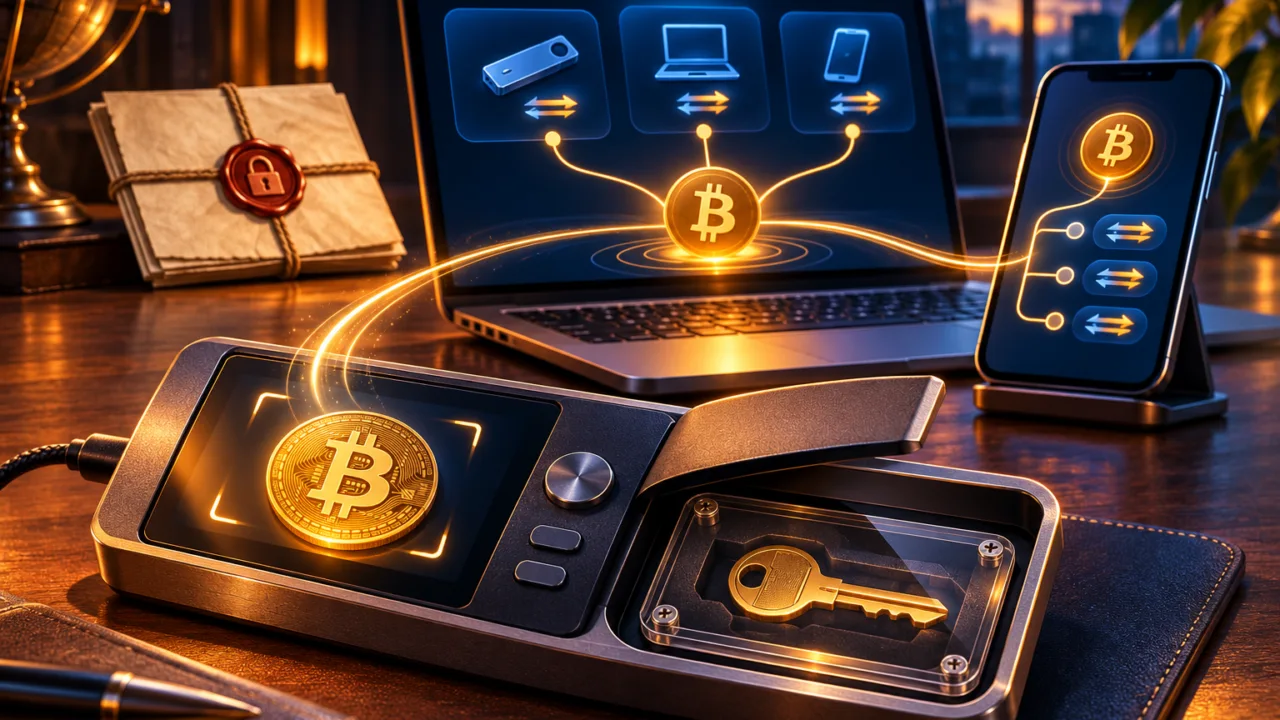
A wallet organizes the information needed for transactions. It may store private keys on the device, access only public information or communicate with a separate signing device. These configurations do not have the same consequences if a computer is lost or compromised.
Watch-only mode makes it possible to monitor a wallet without importing the private keys needed to spend. This separation can be useful for tracking a reserve. Public information is not harmless, however: an extended public key can reveal addresses and financial relationships that need protection.
A hardware wallet can sign transactions using keys held on a separate device. The interface software then prepares and broadcasts the transaction according to the configuration. That does not mean everything it displays should be approved: checking the information on the signing device remains an important step.
The threat model should guide the decision. Is the main goal to limit mistakes on mobile, separate a reserve from a connected device or manage multiple signers? A setup that is too complex to restore correctly can introduce a weakness instead of improving protection.
The guide to the limitations of hardware wallets expands on this distinction. Hardware does not replace backups or human verification. The comparison should therefore cover the entire setup rather than ask whether a particular wallet name is safe in every situation.
Comparing Sparrow, Electrum and BlueWallet by specific features
The Sparrow feature overview describes a desktop Bitcoin wallet with support for partially signed transactions, UTXO control and multiple key configurations. This range of features may appeal to users who want to examine how transactions are built, provided they understand the settings.
The Electrum documentation presents a lightweight Bitcoin wallet and guides covering watch-only use, offline storage and multisig. Its usefulness should be assessed alongside the download, backup and recovery procedures actually being used, rather than on the basis of its age alone.
The BlueWallet feature page highlights mobile use, watch-only mode and support for partially signed transactions with certain hardware configurations. The exact features must be checked for the relevant version and device. A mobile wallet does not automatically mean that the keys for an entire reserve should be imported into it.
| Example | Angle to examine | Control question |
|---|---|---|
| Sparrow | Detailed desktop transaction construction | Does the user understand the inputs, outputs and signatures? |
| Electrum | Lightweight client and documented configurations | Do the backup and connection match the wallet? |
| BlueWallet | Monitoring and mobile use | Is the monitored account separate from signing authority? |
This table does not declare a winner. The three projects do not necessarily meet the same need with the same configuration. An available feature should not be activated merely to create the most sophisticated setup. Actual use and the ability to recover access remain the priorities.
Check the backup format before receiving more funds
A recovery phrase is not an ordinary password. Depending on the configuration, it may reconstruct keys and therefore allow funds to be spent. It should never be given to support staff, copied into a verification form or sent to someone offering to repair the wallet.
Not all formats are interchangeable. The number of words alone does not prove compatibility between two software applications. The standard, address type and settings required for recovery must be known. Documentation for the wallet actually in use should take precedence over a generic procedure found in a video.
A multisig wallet may require additional information about the policy and the other public keys. Our guide to multisig wallets explains this multiple-signer model. Having a key backup alone does not guarantee that the entire setup can be restored easily.
Backup separation also needs to be considered. Keeping all secrets and instructions in one location can concentrate risk. Conversely, scattering the elements without a clear inventory can prevent legitimate recovery. The setup should remain explainable without exposing secrets in everyday notes.
A recovery test should be planned carefully and in accordance with the documentation. A large reserve should not be imported onto a connected device merely to check whether the words work. The goal is to validate the procedure without creating a new exposure of the keys.
Review fees and transaction control
Bitcoin transaction fees cannot be inferred simply from the amount sent. The transaction structure and network conditions also matter. Two payments of the same amount can therefore incur different costs, particularly depending on the inputs used and outputs created.
UTXO control allows users to choose particular inputs through the software’s features. This can help them understand costs and links between funds, but it requires knowing what is being selected. An advanced option does not guarantee better privacy or automatic savings.
The guide to trading and network fees helps distinguish a platform commission from the cost of broadcasting a transaction. The fact that wallet software can be downloaded for free does not mean every transfer will be free.
Fee-adjustment features should be reviewed together with their conditions. Speeding up or attempting to replace an unconfirmed transaction does not guarantee that every payment can be canceled. Its actual network status and initial configuration affect the options available.
The final amount and destination must be checked before signing. Compromised software or misleading instructions may present a different address. On a separate signing device, reading the displayed information provides an additional check, provided users do not automatically approve every request.
Understand network connections and privacy limits
A wallet needs information about transactions and must broadcast those it signs. Depending on its configuration, it may rely on third-party servers or infrastructure controlled by the user. This connection can reveal different types of information and must be understood before concluding that a particular use would be anonymous.
Using a personal server can reduce certain dependencies without eliminating every identification risk. Transactions remain public on the network according to their characteristics. A network configuration should therefore not be presented as an absolute guarantee of financial privacy.
Watch-only mode protects against certain spending risks when no private key is present, but it can still expose the history being monitored. The file therefore deserves protection even when it cannot sign transactions. Spending authority and privacy are two separate issues.
Download links should come from the official project. When software publishes distribution signatures, verification should follow its documented procedure. An alert displayed by a fake website should not lead to installing an update from an address received in a private message.
Lightning-related features also require a specific review. Their presence in a menu is not enough to determine who manages the channels, funds and recovery process. This guide does not conflate on-chain Bitcoin features with every payment model built around it.
Choose a setup that can be maintained and restored
A selection checklist can record the device, key model, software, backup, connection and sending procedure. It should specify what happens if a device disappears. A setup that works today but whose recovery remains unknown is a fragile dependency.
For a reserve, a separate signing device may meet certain needs; for mobile monitoring, a watch-only wallet may be enough. These examples are not individual recommendations. Users should assess the features and skills required by their own organization.
In 2027, the best Bitcoin wallets will therefore be those whose operation remains understood before the next deposit or signature. Sparrow, Electrum and BlueWallet offer different angles to study. A sound decision is not about collecting features, but knowing who can spend, what must be backed up and how to regain access without improvising.