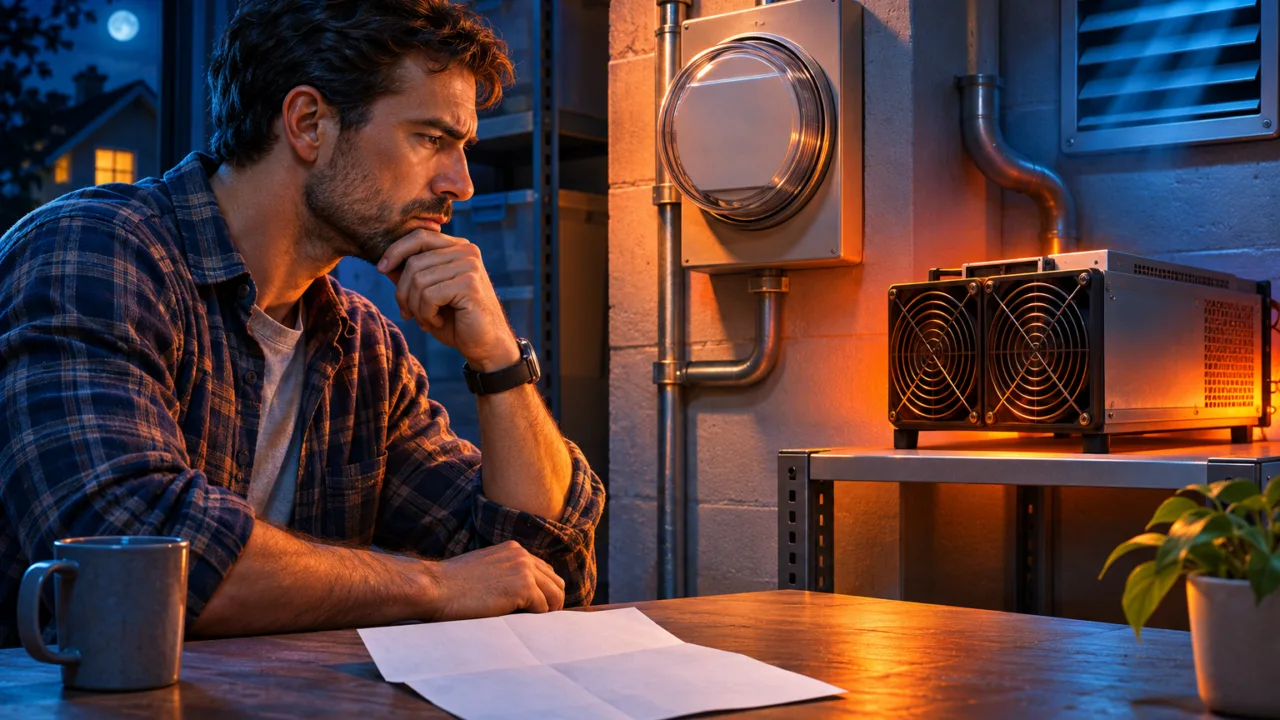
Bitcoin mining in 2027 may generate revenue for an individual without producing a profit. The difference depends on the electricity bill, hardware, housing conditions and the income actually received. A screenshot showing a few euros per day does not reveal whether the setup is paying back its cost or gradually consuming capital.
This guide presents a decision-making method for home mining, separate from an industrial overview. The calculations below use fictional assumptions and do not predict the price of BTC or the network’s future difficulty. The technical mechanisms are examined based on documents available on November 13, 2026; commercial and local conditions must be verified before any purchase.
In brief
- A margin after electricity is not yet a profit: hardware, maintenance, installation and other costs must also be included in the calculation.
- A maximum electricity rate can be calculated for a given set of assumptions, but that threshold changes when revenue, uptime or other costs change.
- Noise, heat, available power and local rules can make a home project unsuitable before yields are even compared.
Bitcoin mining in 2027: start with the home, not the calculator
The guide to how mining works explains the general mechanisms. For a home setup, start instead with a list of physical constraints: space, ventilation, available electrical capacity, neighbors and access for maintenance. A machine that appears profitable on paper may be incompatible with the location where you intend to operate it.
Have the installation inspected by a qualified professional before connecting high-power equipment. This guide does not provide electrical installation instructions or methods for bypassing a safety device. Requirements depend on the equipment and local circumstances. An unsuitable residential power supply does not become acceptable simply because the projected revenue appears high.
Also check the terms of your electricity contract and the rules applicable to use of the premises. A tariff assumption must correspond to real, lawful access. Do not assume that an industrial rate published by a large miner will be available to an apartment. Connection or adaptation costs alone may be enough to change the decision.
Noise and heat require a practical assessment. A machine running continuously may disrupt sleep, disturb neighbors or interfere with normal use of the home. Do not treat these constraints as free simply because they do not appear in a calculator. If you need to rent space or install an additional system, that cost belongs in the project.
Turning watts into a genuinely comparable electricity bill
The first conversion is straightforward: power in kilowatts multiplied by operating time. Under a teaching example of 3.5 kW running for twenty-four hours, consumption reaches 84 kWh per day. Over thirty continuous days, that represents 2,520 kWh. These figures describe this fictional profile, not a measurement from any particular device.
At €0.05 per kWh, the energy would cost €4.20 per day. With a rate of €0.15, the bill would rise to €12.60. At €0.25, it would reach €21. The same power consumption could therefore produce three radically different financial outcomes, without any change in the price of Bitcoin or technical performance.
Include auxiliary consumption where applicable. Cooling equipment, circulation systems or separate infrastructure may also use electricity. The relevant measurement covers the costs actually being funded. Comparing only the miner’s stated power draw with a bill that includes other items creates a discrepancy that will be difficult to explain later.
Also account for the tariff structure. A subscription, time-based variation or tax can change the marginal cost of operating the equipment. If you do not yet have a confirmed contract, present several scenarios and flag the uncertainty. A rounded estimate should not become a false quote merely because it appears in a well-presented table.
Once it is safe to do so, actual post-installation measurements should replace the technical assumptions. Keep the readings and the measurement period. Consumption observed over a few minutes does not necessarily represent a full month. Startups, shutdowns and operating conditions must be taken into account without assuming perfect uptime.
Calculate an electricity break-even point, then test its resilience
For this exercise only, assume €10 in revenue per day, consumption of 84 kWh and €1 in daily costs excluding energy. That leaves €9 available to pay for electricity. The corresponding threshold is €9 divided by 84, or approximately €0.107 per kWh. Above that rate, the scenario becomes loss-making before excluded costs are considered.
This is not a magic electricity rate for 2027. It depends entirely on the assumptions used. If revenue falls to €7 with the same costs, the threshold drops to approximately €0.071 per kWh. The project can therefore lose its margin without the machine breaking down or the electricity provider changing its price.
Mining revenue does not remain fixed. The Bitcoin technical documentation on the blockchain describes, among other things, the difficulty adjustment. Competition for blocks changes over time, so a constant amount of hardware power does not guarantee a constant amount of BTC. Converting that amount into euros adds another market variable.
Assess falling revenue and rising expenses separately. A robust comparison should not show only the central case. In your spreadsheet, show the outcome if energy becomes more expensive, operations are interrupted or revenue declines. The project should be able to withstand an unfavorable period without drawing on reserves needed for essential expenses.
Do not use a personal loan as an automatic solution to an insufficient margin. Financing creates its own commitments and costs. Variable income does not eliminate a contractual repayment. The financial analysis must explain how those obligations would be paid if mining failed to deliver the expected result.
Distinguish revenue, margin and capital recovery
An ASIC remains a capital expense that must be recovered. In a fictional example, €3,000 for hardware and €500 for installation represent €3,500 committed. With a €5 daily margin after all included recurring costs, the simple payback period would reach 700 days. This calculation assumes a constant margin and excludes the items explicitly left out.
It therefore does not predict actual repayment. A breakdown, a change in difficulty, a price decline or a repair could extend the period. More favorable conditions could shorten it. The honest approach is to show the assumptions and test how they change, not to announce a definite recovery date.
Resale value deserves a cautious scenario. Specialized equipment does not necessarily offer the flexibility of a general-purpose computer. Check transportation costs, whether the warranty can be transferred and the conditions of any potential secondhand market. A price shown in a listing does not prove that a buyer will pay that amount when you want to exit.
Cash flow remains separate from economic performance. Holding the bitcoin you mine exposes you to its future price, while the electricity bill must be paid according to its due dates. A strategy that never sells may require additional cash resources. You therefore need to decide how expenses will be paid without assuming that digital assets will always be sufficient when needed.
The differences between self-custody and delegated custody also apply to mining revenue. Check where payments are sent and who controls the funds. The theoretical output displayed by a service should not be confused with an amount actually received and available under the stated terms.
Uptime and pools: average revenue is not a daily promise
Continuous operation is a demanding assumption. A power outage, a voluntary shutdown or maintenance reduces productive time. If a machine runs for twelve hours instead of twenty-four, both consumption and production must be adjusted according to the scenario. Fixed costs do not necessarily decline in the same proportion.
Choosing a pool also changes how payments are handled. The guide to the different meanings of the word pool helps distinguish mining pools from liquidity and staking pools. Read the payment method, fees, payment thresholds and withdrawal terms in the documents for the service selected.
A small solo miner cannot treat a theoretical average income as a regular guaranteed payment. The technical guide to blocks and confirmations recalls the distinction between proposing a block and complying with the rules. An exceptional success story is not a personalized estimate of your expected revenue.
Keep an operating log covering active hours, consumption, incidents, fees and payments received. This record makes it possible to compare assumptions with actual results. Without it, a BTC balance that is increasing may create the impression of success even when expenses in fiat exceed the value of production.
Also establish a shutdown procedure. Define in advance the loss level or change in conditions that will trigger a review. Equipment that has already been paid for should not continue operating solely to avoid admitting that the initial decision was wrong. The question is the additional cost and expected result from today onward.
A decision framework for individual miners in 2027
Compare three options: do not launch the project, gain limited exposure to BTC directly or operate mining hardware. They do not offer the same rights or carry the same risks. Mining adds a technical and economic activity; it does not turn buying Bitcoin into a free or volatility-free operation.
Before making any commitment, obtain a hardware quote, an installation cost, an applicable electricity rate and several revenue scenarios. Have the relevant safety issues and local obligations reviewed. A tax rule or authorization valid in one country does not automatically apply to your home or activity.
Keep all unconfirmed points in the file. Pressure from a seller, an unclear energy rate or missing warranty information should prompt verification, not a favorable assumption. The advertised return must be compared with the net amount after all costs and with the risk of never recovering the capital committed.
Bitcoin mining may appeal to an individual with suitable conditions, but its profitability in 2027 cannot be inferred from a slogan. The decision should fit on one understandable sheet: what you will spend, what you might receive, what could reduce that result and what would allow you to stop. Without those four answers, buying a machine still comes before the analysis instead of following from it.