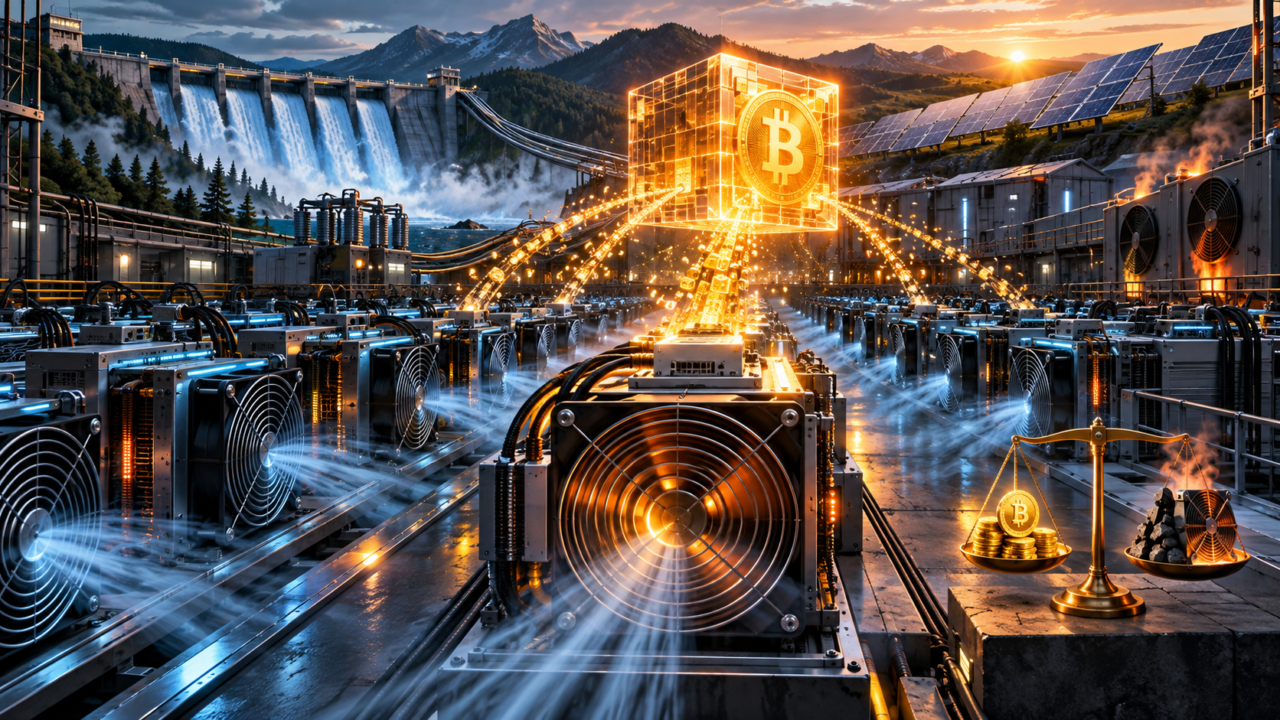
The image of an individual running a computer in their bedroom, however, largely belongs to the past when it comes to Bitcoin.
Today, BTC mining is based primarily on specialized machines known as ASICs, installed by the hundreds or thousands in data centers that negotiate electricity contracts directly. The price per kilowatt-hour, machine efficiency, network difficulty and Bitcoin’s price can determine whether a mining farm is profitable or loses money every hour.
Not all cryptocurrencies work this way. Ethereum ended mining in September 2022 by switching to Proof of Stake. Monero can still be mined with processors. Litecoin and Dogecoin use a different algorithm. Zcash has its own mining economy.
The term “cryptocurrency mining” therefore covers several different realities.
Bitcoin is the place to start when seeking to understand the mechanism.
Mining’s first role is to secure Bitcoin
BrefCrypto’s complete guide to Bitcoin covers the protocol’s various components: transactions, the blockchain, nodes, mining and monetary issuance. Miners play a specific role in this architecture. They gather candidate transactions into a block and attempt to produce a proof of work difficult enough for the network to accept that block.
This does not mean that miners alone decide which transactions are valid.
Bitcoin nodes verify the protocol’s rules. A miner that attempts to create too many bitcoins, spend nonexistent funds or publish a block that does not comply with the rules will see that block rejected by the nodes.
Miners primarily provide computational work.
This expenditure makes rewriting history extremely costly.
Each block refers to the previous block. Changing an old transaction would alter the cryptographic content of the relevant block, then require the attacker to redo that block’s proof of work and that of every subsequent block, while also catching up with the honest network as it continues producing new blocks.
This is precisely the objective of Proof of Work, as described in Bitcoin’s technical documentation.
Mining is therefore not merely a mechanism for distributing new BTC.
It is part of Bitcoin’s security system.
A miner is not solving a mysterious equation
It is often said that miners “solve extremely complex mathematical problems.”
The formula is useful for explaining the concept.
Technically, however, it is quite imprecise.
A Bitcoin ASIC does not think through an equation like a student standing at a blackboard. It essentially performs the same cryptographic operation a gigantic number of times.
The miner builds a block header containing, among other things, a reference to the previous block, a fingerprint of the transactions, the time, the difficulty target and a nonce. It then calculates the hash of that header.
Bitcoin uses SHA-256 in its Proof of Work.
A hash can be imagined as a digital fingerprint produced from data. Change only a small part of the input and the result becomes completely different.
The miner searches for a hash low enough to meet the target set by the network.
It tries.
Fails.
Changes the nonce or other available data.
Tries again.
Billions, then trillions of times.
Bitcoin’s documentation describes this process precisely: the hardware cycles through possible values, calculates hashes and returns a solution when a result falls below the required target.
The “difficulty” of the problem therefore comes primarily from probability.
There is no known shortcut for directly guessing the correct hash.
Huge numbers of combinations must be tried.
This is the repetitive work that ASICs perform at industrial speed.
Hashrate measures this raw computing power
Hashrate measures the number of hash calculations that a miner or the network as a whole can perform each second.
The units have become enormous.
One kilohash per second equals one thousand hashes.
One megahash equals one million.
One gigahash equals one billion.
One terahash, or TH/s, equals one trillion.
Then come the petahash, exahash and zettahash.
A modern Bitcoin ASIC generally operates at hundreds of TH/s.
The network as a whole is now measured in hundreds of exahashes per second. In 2026, Bitcoin’s hashrate moved around 900 EH/s several times, after previously passing levels above 1 ZH/s. BrefCrypto analyzed these changes when AI began competing with mining for access to the best power sites.
A higher hashrate does not automatically mean that Bitcoin processes more payments per second.
The two concepts are different.
Hashrate measures the computing power devoted to Proof of Work.
It mainly affects security and competition among miners.
If you represent 1% of the global hashrate, you have, in simplified terms and over a very long period, roughly a 1% chance of producing blocks.
Short-term reality remains random.
A small miner may find a block quickly.
They may also wait for years.
This is precisely why mining pools became dominant: to reduce this variance.
Bitcoin automatically adjusts its difficulty
Bitcoin targets an average pace of roughly one block every ten minutes.
But what happens if twice as many machines suddenly begin mining?
Without a corrective mechanism, blocks would be produced much faster and the issuance of new BTC would accelerate.
Bitcoin therefore adjusts its difficulty.
Every 2,016 blocks, or approximately every two weeks, the protocol checks how long the previous period took.
If blocks were found too quickly, difficulty increases.
If they were produced too slowly, it decreases.
The goal is to gradually bring the pace back to roughly ten minutes per block. Bitcoin’s documentation describes this recalculation over 2,016 blocks and the relationship between the cryptographic target and the average amount of work required.
This mechanism completely changes mining economics.
Imagine a farm producing 1 BTC per month.
Many competitors then add machines while its own computing power remains unchanged.
Its share of the global hashrate declines.
So does its expected revenue.
It may therefore produce less Bitcoin even though its machines are operating at exactly the same speed.
2026 illustrated the opposite situation. Bitcoin recorded difficulty reductions of 11.16% in February and then 10.09% in June when hashrate had fallen sharply.
The protocol adapts.
The miner’s accounts must survive between adjustments.
The reward comes from new BTC and fees
When a miner produces a valid block, they can receive two main categories of revenue.
The first is the block subsidy.
Since the April 2024 halving, it has stood at 3.125 BTC per block.
The second comes from the transaction fees included in the block.
Each user can attach fees to their transaction. Miners therefore have an incentive, all else being equal, to select transactions offering the most attractive remuneration per unit of block space.
The sum of the subsidy and fees makes up the block reward.
This distinction will become increasingly important.
In 2009, the subsidy was 50 BTC.
It fell to 25 BTC in 2012.
Then 12.5 in 2016.
6.25 in 2020.
And 3.125 in 2024.
The next halving, expected around 2028, should reduce it to 1.5625 BTC.
Fees will then carry relatively greater importance.
In the very long term, when the issuance of new units becomes extremely small, Bitcoin’s security model will have to rely increasingly on these fees.
Mining therefore connects two elements that are often studied separately: Bitcoin’s monetary policy and network security.
Reducing issuance automatically changes the revenues of the companies providing Proof of Work.
The halving can transform profitability
A halving does not cut the electricity bill in half.
It primarily reduces the number of new BTC paid per block.
Take an imaginary farm producing the equivalent of 10 BTC per month before a halving, with stable difficulty and a stable share of the hashrate.
All else being equal, its theoretical issuance could approach 5 BTC after the halving.
Yet the electricity consumed remains almost identical.
So do wages.
Rent as well.
The financing for the machines has not disappeared.
To remain profitable, several factors can provide compensation: Bitcoin’s price may rise, transaction fees may increase, less efficient competitors may shut down their machines, or the miner may improve its own efficiency.
This pressure explains why each halving acts as an economic selection process.
Older machines that are expensive to power become the first candidates for shutdown.
Miners with very cheap electricity contracts gain ground relatively.
Highly indebted companies are more exposed.
And new ASICs become more attractive.
The halving is therefore not merely an event investors watch in an attempt to anticipate BTC’s price.
For a miner, it directly affects the income statement.
It is even one of the few economic events in the sector whose direction is known with complete certainty well in advance.
The exact date varies with the pace of block production.
The reduction itself is programmed.
ASICs industrialized Bitcoin mining
At the beginning of Bitcoin, a computer processor was enough.
Miners then discovered that graphics cards could calculate much faster.
FPGAs emerged next.
Finally, ASICs, short for Application-Specific Integrated Circuit, took control of the competition.
An ASIC is designed for a particular task. In Bitcoin’s case, that specialization concerns SHA-256.
BrefCrypto details the evolution of ASICs and their role in cryptocurrency mining.
This specialization produces efficiency that a traditional computer cannot match on the same algorithm.
A GPU can perform many different types of calculations.
An ASIC sacrifices that flexibility to become extraordinarily good at one particular calculation.
As a result, mining Bitcoin with a modern graphics card is generally no longer economically rational compared with equipment built solely for SHA-256.
The hardware industry itself is highly concentrated.
The Cambridge Centre for Alternative Finance estimated in its report published in 2025 that the leading manufacturer held approximately 82% of the SHA-256 ASIC market, while the three largest controlled more than 99%.
This concentration raises an interesting question.
The Bitcoin network is open.
In theory, anyone can mine.
But manufacturing machines capable of competing at the highest level now requires much more concentrated industrial supply chains.
Protocol decentralization and economic concentration can therefore coexist.
TH/s and J/TH determine much of the hardware equation
Two figures appear constantly in ASIC specifications.
The first is hashrate.
A 200 TH/s machine theoretically produces twice as many hashes as a 100 TH/s machine.
All else being equal, it therefore has approximately twice as many chances of contributing to rewards.
The second figure is energy efficiency, often expressed in joules per terahash, or J/TH.
Here, lower is generally better.
A 20 J/TH machine uses less energy to produce the same amount of computation as a 35 J/TH machine.
Take two 200 TH/s ASICs.
The first operates at 20 J/TH.
The second at 30 J/TH.
The first will require approximately 4,000 watts to produce its hashrate, compared with around 6,000 watts for the second, before certain operating nuances.
Two machines can therefore display exactly the same computing power and generate radically different economics.
The Cambridge report estimated the weighted efficiency of the fleet studied at 28.2 J/TH in June 2024, an improvement of 24% over one year. It also observed top-performing machines at around 12 J/TH and anticipated further progress.
Mining is therefore not merely a race for hashrate.
It is a race for hashrate per watt.
Electricity turns advances in silicon into an economic advantage.
Electricity often decides the winner
An ASIC can cost several thousand dollars.
Once installed, the decisive bill arrives every month: electricity.
The Cambridge Centre for Alternative Finance report provides a particularly useful order of magnitude here. In its sample, electricity accounted for more than 80% of miners’ cash operating expenses. The reported median cost reached approximately $45 per MWh for electricity alone and $55.5 per MWh in total associated costs.
Let’s convert that.
$45 per MWh equals $0.045 per kWh.
A machine consuming 3.5 kW continuously uses approximately 84 kWh per day.
At $0.045 per kWh, electricity alone costs approximately $3.78 per day.
At $0.15 per kWh, the same machine consumes $12.60.
The machine has not changed.
Nor has its hashrate.
Its economics have.
This is why miners seek hydropower, excess gas, surplus solar power, industrial contracts and regions where electricity generation sometimes exceeds local demand.
A difference of a few cents per kWh can be worth several million dollars a year for a large farm.
Mining therefore turns a highly local factor—the price of electricity—into a global competitive advantage.
One BTC generally has the same price.
The cost of producing it can differ radically from one site to another.
Calculating profitability requires several variables
The question “how much does a mining machine earn?” never has a fixed answer.
At a minimum, you need to know its hashrate, power consumption, network difficulty or total hashrate, the cryptocurrency’s price, pool fees, electricity costs and operating time.
Then add the purchase price of the device.
Then cooling.
Transformers.
Maintenance.
Repairs.
Taxes.
The building.
Internet access.
And sometimes the interest paid on debt used to finance the equipment.
Gross revenue is therefore not profit.
A machine may generate $10 in crypto per day while consuming $8 in electricity. That leaves $2 before all other costs.
If the ASIC cost $4,000, the theoretical return on investment becomes very long.
And before it is paid off, difficulty may rise or a new generation of machines may make the older model less competitive.
The calculation is dynamic.
That is what makes screenshots claiming that a machine “earns $15 per day” dangerous.
The next question should always be: based on what assumptions for price, difficulty and electricity?
Profitability calculated today is not a promise for next year.
The market and the network are constantly changing.
Hashprice summarizes part of the economics
Bitcoin professionals often follow an indicator called hashprice.
Hashprice represents, in simplified terms, the revenue that a given amount of hashrate can be expected to generate over a specific period.
It combines several factors of direct interest to miners: BTC’s price, the block reward, transaction fees and difficulty.
When Bitcoin rises sharply, hashprice may increase.
When difficulty rises faster than the price, it may decline.
After a halving, it normally comes under heavy pressure if nothing else immediately offsets the halving of the subsidy.
This indicator helps explain a common paradox.
Bitcoin can rise.
And miners can still earn less per unit of computing power.
This is exactly what can happen when a price increase rapidly attracts new machines.
Total rewards increase in dollar terms.
But they are shared among more hashrate.
BrefCrypto recently noted a similar phenomenon on Zcash: while ZEC was rising, the rapid arrival of new miners slightly reduced the gross revenue of a given machine. Network power rose from approximately 25 to more than 30 GSol/s in a few days.
Mining therefore follows a classic competitive logic.
A highly profitable activity attracts competitors.
Competitors gradually reduce the economic rent.
The protocol does not even need to change its rules to create this pressure.
Solo mining or a mining pool?
A miner can theoretically work alone.
This is solo mining.
If they find a valid block, they receive the entire reward corresponding to that block.
The problem is statistical.
With tiny computing power compared with the global Bitcoin network, the odds of personally finding a block become extremely low.
You could mine for years without ever receiving a reward.
Then, one day, possibly find an entire block.
It is a lottery weighted by hashrate.
Mining pools reduce this variance.
Thousands of participants combine their computing power. When one pool member helps find a block, the reward is distributed according to the pool’s rules and each participant’s contributed work.
Bitcoin’s documentation clearly distinguishes these two models: solo mining produces rare and very large payments, while pool mining provides smaller, more frequent income.
To measure contributions, the pool asks machines to produce shares.
These shares are not necessarily difficult enough to be valid Bitcoin blocks.
They serve to prove that a miner is actually performing the amount of work claimed.
From time to time, a share also meets the network’s much more difficult target.
The pool has then found a real block.
This statistical pooling allows a small operation to receive regular payments without waiting for a miracle.
PPS, FPPS and PPLNS change the payments
Not all pools pay their miners in the same way.
The PPS, or Pay Per Share, model pays a predetermined amount for valid shares submitted. The pool then absorbs part of the variance caused by finding more or fewer blocks than expected.
FPPS, or Full Pay Per Share, generally seeks to add an estimate of transaction fees to theoretical block rewards.
PPLNS, or Pay Per Last N Shares, distributes more revenue based on the blocks actually found over a defined window of contributions.
For miners, these differences matter.
A more stable payment can come with higher pool fees.
A system more directly linked to collective luck can produce greater fluctuations.
You should also examine the minimum withdrawal threshold.
Payment frequency.
The pool’s reputation.
Its location.
The connection protocol used.
And its share of the global hashrate.
Large pools make industrial operations easier, but their weight regularly raises decentralization concerns.
However, pool operators should not be confused with machine owners.
A pool can coordinate the work of thousands of legally independent miners.
If participants are no longer satisfied, they can technically redirect their hashrate to another pool.
This does not make concentration harmless.
It makes it different from a company physically owning all the machines it coordinates.
Home mining remains possible, but not necessarily profitable
Can you still mine at home in 2026?
Technically, yes.
Economically, the answer depends heavily on the cryptocurrency and where you live.
For Bitcoin, an individual must compete with industrial farms using high-performance ASICs and electricity negotiated at professional rates.
A household paying $0.20 or $0.30 per kWh starts with a major disadvantage.
You also have to deal with noise.
A Bitcoin ASIC is not a quiet computer.
Its fans operate at very high speeds and can produce noise levels that are difficult to tolerate in an apartment.
Then there is heat.
A machine consuming 3 or 4 kW turns almost all that energy into heat.
That is equivalent to several electric heaters running continuously.
In a cold climate, this heat may potentially be recovered.
In a warm region, it becomes an additional cost because it must be removed.
Residential electrical supply can also be a problem. Several ASICs exceed the power that an ordinary household installation can comfortably support without a properly sized circuit.
Finally, dust reduces cooling efficiency and increases maintenance.
Domestic Bitcoin mining therefore still exists.
It looks more like a technical project or the opportunistic use of particularly cheap electricity than a universal method for generating passive income.
GPUs and CPUs have not disappeared completely
Bitcoin now belongs almost entirely to ASICs.
Cryptocurrency mining, however, is not limited to Bitcoin.
Some blockchains use algorithms designed to remain accessible to more general-purpose hardware.
Monero is the best-known example.
The project uses RandomX, a Proof of Work designed to make the advantage of ASICs much more difficult. Monero’s official documentation states that the network can be mined with CPUs and GPUs, while emphasizing that processors are generally more efficient for RandomX.
This philosophy seeks to prevent a small group with extremely expensive specialized hardware from automatically controlling most of the network.
Other projects continue to use GPUs depending on their algorithm and economics.
General-purpose hardware has an important advantage.
A graphics card can be reassigned.
It can be used for other calculations, resold to gamers, used for rendering or, depending on the model, for AI.
An ASIC is much less flexible.
A Bitcoin ASIC that becomes unprofitable remains essentially a SHA-256 machine.
This specialization makes ASICs extremely efficient.
It also increases the risk to their residual value.
CPU, GPU and ASIC therefore represent three different trade-offs between versatility, efficiency and accessibility.
Ethereum has not been mined since 2022
An impressive number of old tutorials still promise to explain “how to mine Ethereum.”
They are obsolete.
Ethereum abandoned Proof of Work on September 15, 2022, during The Merge.
Since that transition, the network has operated with validators using Proof of Stake. Ethereum.org states this explicitly: ETH mining is no longer possible, and new blocks are produced and attested by validators.
The energy shift was dramatic.
Ethereum estimates that The Merge reduced its energy consumption by approximately 99.95%.
What happened to the miners?
Some GPUs were resold.
Others moved to blockchains that still use minable Proof of Work.
Some networks experienced a rapid and massive increase in computing power after Ethereum mining disappeared, before profitability rebalanced.
This episode shows something important.
Mining is not an obligatory property of a blockchain.
It is a choice of consensus mechanism.
Bitcoin considers Proof of Work a fundamental part of its security and monetary policy.
Ethereum made a different choice.
Simply comparing their electricity consumption without recalling this architectural difference therefore produces an incomplete analysis.
Litecoin, Dogecoin, Zcash and Monero follow different rules
Not all Proof of Work cryptocurrencies calculate SHA-256.
Litecoin and Dogecoin use Scrypt.
Specialized Scrypt ASICs now exist, which once again makes graphics cards much less competitive at industrial levels.
Litecoin and Dogecoin also have a particular feature: merged mining allows some miners to contribute to multiple compatible chains without simply having to divide their computing power as they would between two completely separate activities.
Zcash uses a different family of algorithms and also has an ASIC industry.
In September 2026, BrefCrypto observed the rapid arrival of new machines on Zcash while the price of ZEC exceeded $1,000. The phenomenon perfectly illustrated the relationship between price, profitability and competition: revenue attracts hashrate, and that additional power then reduces the share of rewards returned to each machine.
Monero maintains a different approach with RandomX and its focus on CPUs.
A miner therefore does not choose only “a crypto.”
They also choose an algorithm.
Bitcoin’s SHA-256 hardware cannot be freely redirected to Monero.
A Scrypt ASIC does not become a Zcash ASIC.
This constraint limits migration options.
For miners, understanding the algorithm is therefore just as important as following the token’s price.
Cloud mining appears simple, which attracts scams
Cloud mining promises to eliminate all the unpleasant parts.
No machines.
No noise.
And therefore no heat or electrical installation.
The user simply buys a contract representing a quantity of hashrate hosted elsewhere.
The concept can exist legally.
A company genuinely owns machines, operates them in a data center and rents out part of their computing power or revenue.
The problem lies in the lack of transparency.
How can you verify that the ASICs actually exist?
What is their electricity cost?
Which exact machine produces the purchased hashrate?
What maintenance costs will be deducted?
What happens if profitability turns negative?
Some contracts may automatically halt production when it falls below a threshold.
Other supposedly mining-based models have mainly served as fronts for Ponzi schemes.
New customers pay.
Part of that money finances withdrawals by earlier customers.
An app displays “mining rewards” every day.
No ASIC is needed behind the dashboard.
Technical vocabulary simply makes the story more credible.
A promise of fixed and high returns therefore deserves extreme caution.
Genuine mining produces variable revenue.
Price, difficulty and fees change.
A company claiming it can guarantee the same performance regardless of these parameters should be able to explain precisely where that guarantee comes from.
Hosting is different from cloud mining
Another industry is known as machine hosting.
Here, the user may genuinely own the ASIC.
They buy a machine.
An operator then installs it in its data center and provides electricity, networking, cooling and maintenance in exchange for payment.
This model provides access to an industrial electricity rate without requiring the user to build a farm themselves.
However, it shifts part of the risk to the host.
Is the ASIC actually installed?
At which site?
Does the electricity meter match the advertised rate?
Who pays for a repair?
Can the machine be physically recovered?
What happens if the company goes bankrupt?
The contract becomes almost as important as the hardware.
For small operations, hosting may make more economic sense than a home installation.
For larger volumes, companies negotiate energy, buildings and equipment directly.
In both cases, users need to understand one simple distinction.
Cloud mining: you generally buy contractual exposure to hashrate.
Hosting: you may own the equipment and pay someone to operate it.
The two models are sometimes marketed with very similar wording.
Actual ownership of the machines is what distinguishes them.
Energy is also at the center of the environmental debate
Proof of Work consumes a great deal of electricity by design.
The serious question is therefore not whether Bitcoin consumes energy.
It does.
The debate concerns the amount, the source, associated emissions and any services potentially provided to the electricity system.
The major Cambridge Centre for Alternative Finance study published in April 2025 estimated the Bitcoin network’s annualized consumption at approximately 138 TWh as of June 30, 2024, or approximately 0.54% of global electricity consumption. Its model rose to around 183 TWh at the end of December 2024 after a sharp increase in hashrate.
The study estimated annual emissions at around 39.8 million tonnes of CO₂e, according to its methodology based on data reported by surveyed operators.
These figures are important.
They must also be read correctly.
Electricity consumption does not automatically translate into the same amount of emissions everywhere.
A megawatt-hour produced from coal does not have the same footprint as a hydropower-generated megawatt-hour.
That is why the energy mix matters so much.
And this is precisely where the industry has changed significantly.
Renewables are growing, while fossil fuels remain present
According to Cambridge, 52.4% of the energy reported by miners in its sample came from sources classified as sustainable: approximately 42.6% renewable energy and 9.8% nuclear power.
Natural gas still accounted for 38.2%.
Coal accounted for approximately 8.9%.
These figures provide a more nuanced picture than the two extreme narratives.
Bitcoin is not powered exclusively by coal.
Nor is it powered exclusively by wasted renewable energy.
The industry operates with a mix.
Geography matters enormously.
A hydropower-based farm does not have the same footprint as one connected to a heavily carbon-intensive grid.
Price explains part of this search for energy.
Solar, wind and hydropower can produce periods of very cheap electricity when local supply exceeds transmission capacity or demand.
A miner can locate near this production.
It can also agree to shut down during periods when the grid needs the electricity more.
This flexibility is one of the arguments put forward by the sector.
It does not erase environmental impacts.
It shows that total consumption is not the only useful indicator.
The location, time and source of the megawatt-hour also matter.
Mining can become a flexible electricity load
A traditional factory generally does not like abruptly interrupting production.
A blast furnace, chemical process or industrial production line cannot necessarily be stopped for thirty minutes simply because electricity has suddenly become scarce.
A Bitcoin ASIC can.
A farm can be switched off, left idle and then restarted.
The Bitcoin network continues in the meantime with the other miners.
This property turns mining into a flexible load.
Cambridge reports that the companies studied reduced their consumption by 888 GWh in 2023 through various curtailment practices, providing a real example of load modulation.
This can be useful in an electricity grid with significant intermittent generation.
When solar or wind power is abundant but demand is insufficient, miners can absorb part of the surplus.
When demand rises sharply, the machines can be shut down.
This does not mean that every farm automatically improves the grid.
A miner connected in a region already under strain may instead contribute to congestion.
Everything depends on the contract, location and infrastructure.
This is precisely why discussing mining only in terms of TWh hides part of the issue.
A megawatt consumed around the clock does not have the same system behavior as a megawatt that can disappear on demand.
Mining can sometimes monetize energy that is difficult to sell
Bitcoin has a fairly unusual economic characteristic: the final product does not need to be physically transported.
An isolated power plant can generate electricity far from a major urban center.
If sufficient transmission lines do not exist, part of that capacity can lose much of its value.
A mining data center can be built near the source and convert that energy into hashrate.
The bitcoins earned can then be transferred over the internet.
The same logic applies to associated gas.
At some oil sites, gas is burned because there is no economically viable infrastructure to transport it. Mining companies have tested installing generators that use this gas directly on site.
The environmental question then becomes more complex.
Burning gas in an engine to produce electricity for mining still emits carbon.
But depending on the configuration, this solution may avoid certain methane emissions or replace less efficient flaring.
Cambridge specifically emphasizes that the climate impact of these models depends heavily on the methodology used and requires more data.
Slogans should therefore be treated cautiously.
“Bitcoin monetizes wasted energy” may be true for some projects.
It is not a universal description of the network.
Bhutan illustrates another energy model
Bhutan has provided one of the most interesting examples of sovereign mining.
The small Himalayan kingdom has substantial hydropower resources.
Some of this energy has been used to produce bitcoins.
The country subsequently accumulated a significant BTC reserve relative to the size of its economy.
In 2026, BrefCrypto followed several sales of bitcoins linked to this hydropower strategy.
The case is interesting because it reverses the usual logic.
The government was not simply buying BTC with foreign-exchange reserves.
It was using a national energy resource to produce an exportable digital asset.
Hydropower was indirectly becoming a source of Bitcoin.
This model obviously cannot be copied everywhere.
It requires sufficiently abundant energy.
A favorable political framework.
Infrastructure.
And a cost below the expected value of production.
But it shows why mining sometimes attracts countries with excess electricity resources.
The initial asset is not necessarily financial capital.
It may be a dam.
An oil field.
A geothermal plant.
Or a surplus that is difficult to sell locally.
Mining gives this energy an extremely mobile global buyer.
Africa has energy, but also constraints
On paper, several African regions have attractive mining advantages: hydropower, geothermal power, solar energy and areas where potential electricity generation exceeds solvent demand or transmission capacity.
Reality is more complicated.
Cheap electricity on paper is not enough.
You need transmission lines.
Transformers.
Reliable internet.
Import procedures. Technicians. And spare parts.
Clear regulation.
And, in some cases, a currency that can be used to pay for imported equipment.
BrefCrypto’s guide to crypto in the DRC specifically notes that financial and regulatory infrastructure differs significantly across African countries.
Mining raises an additional question.
In a region where households and businesses already lack electricity, allocating megawatts to Bitcoin may be politically difficult to defend.
In an area with underused hydropower generation because of a lack of customers or transmission, the equation may be different.
The debate therefore cannot be reduced to “Africa has a lot of renewable electricity.”
You need to examine the local electricity grid.
Access rates.
Unused capacity.
The price actually charged.
And the jobs or investment associated with the project.
The same data center may look like waste in a rationed city and like a useful buyer near an isolated power plant.
Bitcoin miners are now moving closer to AI
An important change emerged from 2024 onward and accelerated in 2026.
Mining companies own something that artificial intelligence companies are desperately seeking: sites already connected to hundreds of megawatts.
Bitcoin ASICs do not become Nvidia GPUs.
The two machines are very different.
Land, substations, transformers, fiber and permits, however, can serve both industries.
That is where the competition begins.
BrefCrypto has shown how AI is already pushing miners toward the cheapest energy sources. Core Scientific, TeraWulf, IREN and other groups have redirected part of their sites toward high-performance computing.
Riot Platforms illustrates the scale of the movement even more clearly. In 2026, the company signed a data-center contract that could represent $9.1 billion in revenue over twenty years.
For an operator, the question becomes almost stark.
Why allocate one megawatt to Bitcoin if the same connection earns much more by hosting AI?
Mining is not disappearing.
It is being forced to prove that it is the best buyer for each type of electricity.
Mining stocks are not simply leveraged Bitcoin
Publicly listed mining companies are sometimes presented as a way to gain Bitcoin exposure with greater volatility.
That comparison has some validity.
Their revenue often depends heavily on BTC’s price.
But buying a mining stock is not the same as buying Bitcoin.
You must add energy costs.
Debt.
Spending on new ASICs.
Shareholder dilution.
Management quality.
Site availability.
Electricity contracts.
And now exposure to AI data centers.
In September 2026, BrefCrypto observed that Bitcoin had gained approximately 22% since August 17, while the median performance of the listed miners it tracked had reached only around 1.8%. Only Canaan outperformed BTC in the cited sample.
This is a useful reminder.
A miner can miss a Bitcoin rally because its costs increase.
It can also outperform when margins widen.
A stock represents a company.
Bitcoin represents the network’s asset.
The two are linked.
They are never interchangeable.
Can a miner attack Bitcoin?
A miner with substantial hashrate has significant influence over block production.
But that power has limits.
It cannot simply change Bitcoin’s maximum supply and impose that rule on all nodes.
Nodes enforce their own consensus rules.
An invalid block remains invalid even if it required a great deal of electricity.
The best-known attack is the 51% attack.
An actor controlling a majority of the computing power for an extended period could attempt to reorganize recent transactions, censor certain operations or carry out some double-spending attacks.
Through this mechanism alone, it could not arbitrarily create BTC beyond the accepted rules or directly steal coins for which it does not possess the private keys.
The cost of such an attack increases with the size of the honest hashrate and the hardware required.
This is precisely one of Proof of Work’s economic functions: making attacks costly.
Pool concentration is nevertheless monitored because a small number of coordinators can represent a large share of the apparent hashrate.
The nuance matters again.
Pools do not necessarily own all the connected machines.
But excessive operational concentration is never desirable for a protocol seeking censorship resistance.
Nodes and miners are not the same thing
This confusion is extremely common.
A miner seeks to produce blocks and consumes significant computing power.
A full node verifies blocks and transactions according to Bitcoin’s rules.
It is possible to run a node without mining.
And miners must also rely on network data to build their blocks.
Why does this distinction matter?
Because miners do not define Bitcoin alone.
Imagine a miner creating a block that pays itself a 100 BTC subsidy when the rules allow only 3.125.
It can perform as many hashes as it wants.
Compliant nodes will reject the block.
Proof of Work proves that a quantity of computation was expended.
It does not turn an invalid rule into a valid one.
The network therefore operates through several actors with different responsibilities: users, developers, nodes, miners, exchanges, wallets and companies.
Reducing Bitcoin to “miners control the network” is as imprecise as saying they have no power at all.
They play a major role in block ordering and production.
They operate within a set of rules that nodes verify.
This separation is one reason mining should be studied as a component of Bitcoin, not as Bitcoin itself.
Hardware also produces electronic waste
Mining’s impact is not limited to electricity.
ASICs age economically.
A machine may still function perfectly but no longer be profitable against a more efficient generation.
This is a particular form of obsolescence.
Cambridge nevertheless estimated that 86.9% of decommissioned equipment reported by surveyed companies was resold, repurposed or recycled.
Its estimate of electronic waste directly associated with Bitcoin mining reached approximately 2.3 kilotonnes in 2024.
The secondary market plays an important role here.
An ASIC that has become too inefficient in Texas with electricity at $60/MWh can be resold to an operator with much cheaper energy.
The machine is therefore not necessarily discarded.
It moves.
This even creates a cascading geography.
The newest fleets go to operators able to finance new models quickly.
Previous generations move to sites where electricity offsets their lower efficiency.
Finally, devices that are truly too old are dismantled or recycled.
An ASIC’s economic life cycle therefore depends as much on the price of electricity as on its age.
An Antminer is not obsolete simply because a new model exists.
It becomes obsolete when it no longer generates enough revenue to cover the cost of operating it in a given environment.
Cooling a mining farm is a profession in itself
An ASIC converts almost all of the electricity it consumes into heat.
A 100 MW farm must therefore manage a considerable amount of thermal energy.
The traditional solution uses large volumes of air.
The machines’ fans draw in cooler air and expel hot air.
In dusty or hot areas, this architecture becomes more difficult.
Filters clog.
Components heat up.
Fans consume more power and fail.
Another technology has developed significantly: immersion cooling.
The machines or their components are submerged in a dielectric fluid that does not conduct electricity. The liquid absorbs heat much more effectively than air, after which the heat is transferred to a cooling system.
Immersion can reduce noise, stabilize temperatures and, in some cases, allow machines to operate at higher performance levels.
It also adds costs and specialized infrastructure.
Local climate once again becomes an economic parameter.
A farm in Scandinavia does not have the same needs as a farm in the Middle East.
Some projects also seek to recover heat for buildings, greenhouses or industrial processes.
Mining then produces two things: hashrate and heat.
The second has value only if someone is close enough to use it.
Mining taxation depends heavily on the country
Receiving cryptocurrency from mining is not taxed the same way everywhere.
In some jurisdictions, the value of the crypto received may be treated as income when it is acquired.
A second tax consequence may then arise when the coins are sold later at a gain or loss.
In other systems, treatment depends on whether the activity is professional or occasional.
A farm operated by a company with several megawatts will obviously not be analyzed like an individual running a CPU in their spare time.
Costs may also count: electricity, hardware, depreciation, buildings, maintenance or staff, depending on the applicable regime.
Regulation is evolving.
In the United States, debates are still taking place over when certain mining and staking rewards should become taxable. In 2026, BrefCrypto followed the Tax Clarity for Mining and Staking Act and discussions about deferring taxation until disposal.
Universal calculators claiming to provide “net profitability” should therefore be avoided.
A machine that is profitable before taxes may produce a different result after taxation.
And two miners using exactly the same ASIC may receive completely different legal treatment depending on their country.
Regulation can determine where hashrate goes
Hashrate is surprisingly mobile.
ASICs are physical.
But they can be moved.
The history of Chinese mining demonstrated this: when a regulatory environment becomes hostile, a significant portion of the machines can move to other jurisdictions.
Governments consider several dimensions.
Electricity consumption.
Impact on local prices.
Hardware imports.
Taxation.
Jobs.
Grid stability.
Use of subsidized energy.
One government may welcome miners because they purchase excess generation.
Another may restrict them because the power grid is already suffering from a deficit.
A third may authorize the activity while applying a specific tariff.
These differences create a shifting economic geography.
Mining does not seek only the cheapest electricity.
It seeks electricity that is reliably accessible.
A contract at $0.03/kWh is not very valuable if the government can shut down the site without notice after six months.
Legal certainty therefore becomes a profitability variable.
For large projects, it can weigh almost as much as the price per megawatt-hour.
Mine or buy the cryptocurrency directly?
This question deserves a cold calculation.
Suppose you have $10,000.
Option 1: directly buy $10,000 of BTC.
Option 2: buy ASICs, install them and try to produce BTC for several years.
Mining can become more profitable if you have a genuine advantage: extremely cheap electricity, machines bought at a good price, efficient cooling, suitable taxation and professional operations.
Without that advantage, buying directly may be much simpler.
You obtain the BTC immediately.
No breakdowns.
No noise.
And therefore no rise in difficulty to manage operationally. No machine whose value depreciates.
Mining is therefore an industrial activity, not merely a different way to buy Bitcoin.
The miner is betting on their ability to produce the asset at a cost below its future market value.
At the same time, they take on several additional risks.
If Bitcoin falls, their revenue falls.
If difficulty rises, their relative production falls.
If electricity prices rise, their margins fall.
If a new ASIC model arrives, their hardware loses value.
An investor who buys BTC directly does not have these operating costs.
In exchange, the miner has an opportunity that the buyer does not: to turn an advantageous energy or infrastructure resource into new bitcoins.
That is where its economic rationale lies.
How to get started without buying an industrial farm
Someone who wants to learn about mining does not need to immediately order ten ASICs.
The first step is choosing the network.
Bitcoin?
Monero?
Zcash?
Another Proof of Work network?
Next comes compatible hardware.
A CPU does not economically mine the same algorithm as a SHA-256 ASIC.
You then need to know your actual electricity cost.
Not a vague estimate.
The rate per kWh.
Taxes.
Time-of-use rates.
Potentially demand charges.
Then measure the machine’s power consumption.
Add pool fees.
Compare expected revenue with current difficulty.
And simulate several scenarios.
Bitcoin -30%.
Difficulty +20%.
Electricity +15%.
What remains?
This analysis is much more useful than a calculation based only on the day’s favorable conditions.
A beginner can also experiment with Monero on a CPU to gain a practical understanding of wallets, pools, shares, hashrate and payments without investing several thousand dollars.
The income may be very small.
The learning is real.
Mining becomes much clearer when you see a machine produce shares and a pool calculate a reward.
The main scams always rely on the same mechanism
“Buy this $500 machine and earn $50 per day for life.”
The calculation should immediately raise questions.
If a machine genuinely paid for itself in ten days with little risk, why would the seller part with it instead of operating thousands of units themselves?
The same logic applies to cloud mining.
Guaranteed returns.
Machines never shown.
Vague company address.
Highly generous referral program.
Withdrawals blocked until a “tax” is paid.
These are warning signs.
A genuine mining company should be able to explain its sites, hardware, electricity rate, payment system and the risks that reduce its profitability.
Another scam targets beginners directly with fake mining software.
The application promises to increase hashrate.
In reality, it steals passwords or wallets.
There is also cryptojacking, in which software secretly uses a victim’s CPU or GPU to mine.
The electricity bill and performance degradation remain with the victim.
The rewards go elsewhere.
Mining is technical enough to generate a great deal of jargon.
Fraudsters know this.
Pools also raise a centralization question
Proof of Work functions best when computing power is distributed.
Economically, however, miners have an incentive to join pools to smooth their income.
These two forces can conflict.
If a pool represents a very large share of the hashrate, it may have greater influence over block construction.
Precision is still necessary.
The pool does not necessarily own the machines.
Miners can often point their hardware elsewhere.
Recent technical developments are specifically seeking to give individual participants greater control over block construction.
The Stratum protocol, which has long been used, has deeply structured communication between pools and machines. Bitcoin’s documentation explains how pools provide miners with the information needed to generate their headers and measure their shares.
The development of new pool versions and architectures aims in particular to reduce certain points of centralization.
The subject matters because mining is not only an energy industry.
It is also a component of the network’s operational governance.
Competition among pools matters.
So does competition among ASIC manufacturers.
As does the geographic diversity of mining sites.
No single indicator summarizes decentralization on its own.
Fees could become essential after several halvings
Today, the 3.125 BTC subsidy still represents a significant share of miners’ revenue.
In 2028, it should fall to 1.5625 BTC.
Then to approximately 0.78125 BTC four years later.
And so on.
With each halving, Bitcoin reduces issuance.
The model is designed never to exceed 21 million BTC.
This scarcity is central to Bitcoin’s monetary proposition.
For security, it creates a long-term question.
Transaction fees will gradually need to play a larger role in miners’ compensation.
If Bitcoin usage generates strong demand for block space, users may compete with high fees.
If fees remain persistently very low while the subsidy becomes tiny, some researchers and industry participants question the security budget available.
The debate does not yet have a definitive answer.
It concerns several decades.
But it shows why Bitcoin fees are not simply an inconvenience paid by users.
They are gradually becoming a more structural part of Proof of Work’s financing.
Monetary policy therefore also sets a trajectory for the transformation of miners’ business model.
AI may paradoxically make mining more specialized
If the best electricity sites connected to major grids become more profitable for AI, Bitcoin miners may be pushed toward resources that are less attractive to traditional data centers.
Intermittent electricity.
Small industrial surpluses.
Gas that is difficult to transport.
Very remote sites.
Underused hydropower.
Frequently curtailed renewable generation.
This could return mining to one of its original characteristics: the ability to seek out electricity rather than requiring electricity to come to the computing.
An AI data center needs highly capable fiber, extremely expensive hardware, high availability and operational stability.
A Bitcoin ASIC can shut down for several hours.
It loses no files.
It simply resumes its work afterward.
This difference creates separate energy markets.
AI can therefore take some infrastructure away from Bitcoin without eliminating the appeal of Proof of Work elsewhere.
Public companies are already making that trade-off.
The Bitcoin network, meanwhile, adjusts its difficulty if some machines disappear.
In other words, AI does not necessarily have to kill mining.
It may change its geography and more severely select operators with a genuine energy advantage.
Mining will remain a race for margins
In 2026, the Bitcoin industry is far removed from the era when a personal computer could seriously participate in block production.
Modern farms look more like energy infrastructure than rooms filled with PCs.
Operators negotiate megawatts.
They import thousands of ASICs.
They build substations.
They optimize cooling.
They finance themselves in the markets.
And increasingly, they compare the profitability of one megawatt of Bitcoin with that of one megawatt of artificial intelligence.
The paradox is interesting.
The Bitcoin protocol has remained relatively simple in its fundamental logic: produce a proof of work, publish a valid block, receive a reward.
The economics surrounding that operation have become extraordinarily sophisticated.
This is why the shares of major miners can underperform Bitcoin even when BTC rises sharply.
Buying Bitcoin and mining Bitcoin are two very different activities.
The former primarily exposes you to the asset’s price.
The latter adds energy, hardware, difficulty, industrial management and competition.
A miner does not profit simply because Bitcoin rises.
It profits when the value of the Bitcoin it produces sustainably exceeds the total cost required to produce it.
That sentence summarizes almost the entire economics of the sector.
Cryptocurrency mining is not free money
It is easy to watch an ASIC produce BTC every day and imagine a money machine.
Reality looks more like a factory.
Hardware is expensive.
Electricity is consumed before you know exactly what the output will be worth.
Competition increases.
Machines age.
Rewards decline during halvings.
The price of the final product moves 24 hours a day.
Mining can be extremely profitable when an operator has a structural advantage.
A power plant with a surplus that is difficult to sell.
An exceptional electricity contract.
A highly efficient ASIC fleet purchased at the right time.
Infrastructure that has already been amortized.
Under these conditions, mining turns an energy resource into a global digital asset.
Without a particular advantage, buying the cryptocurrency directly may be much simpler.
Mining is therefore not a secret technique for obtaining Bitcoin more cheaply than everyone else.
It is a permanent competition to produce each unit more efficiently than the others.
That is also what secures Bitcoin.
Every hardware improvement, every megawatt added and every new miner increases the resources an attacker would have to overcome.
The same competition that destroys producers’ margins therefore contributes to defending the network.
Proof of Work has this strange economic elegance: miners compete with one another for a reward, and that competition itself becomes part of Bitcoin’s security.