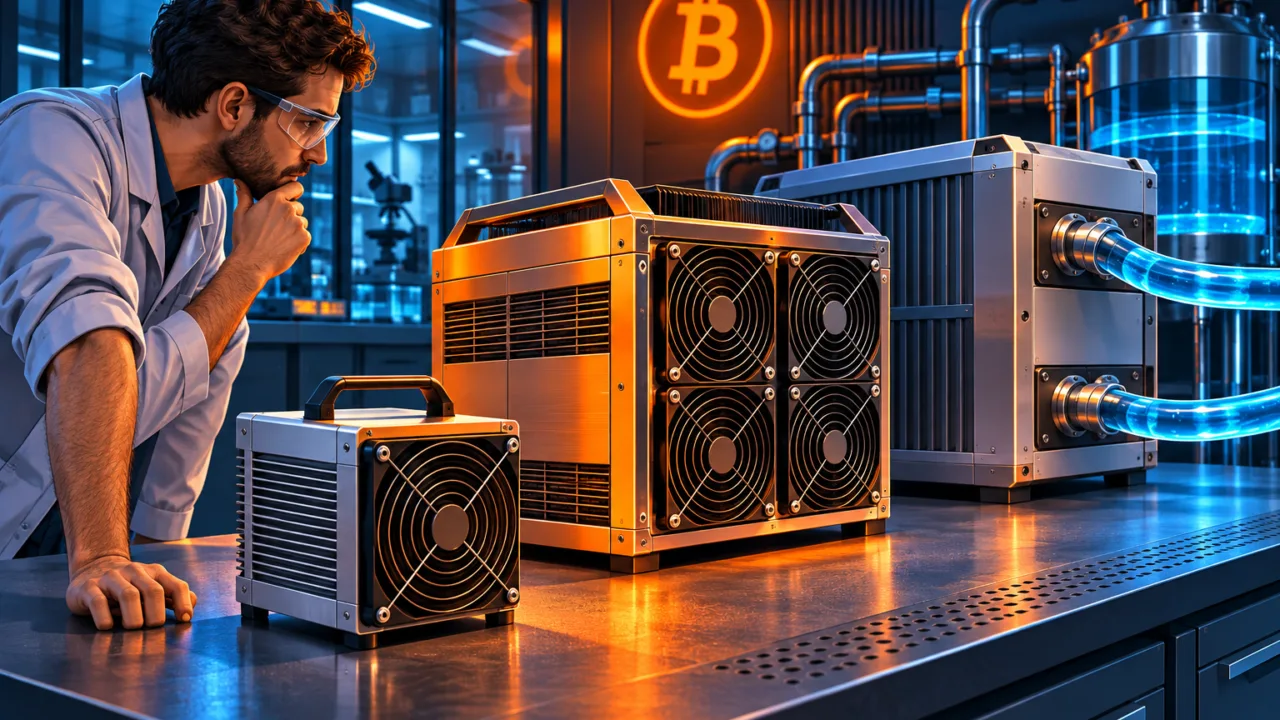
The best Bitcoin ASICs in 2027 cannot be selected based solely on the terahash figure displayed in a product listing. A more powerful machine may require more electricity, different infrastructure and an investment that is difficult to recoup. Energy efficiency is an essential metric, but it is not enough to identify a universally profitable device.
This guide compares configurations documented as of November 13, 2026, and sets out a selection method for 2027. It does not predict future hardware releases or their availability. Manufacturer figures describe advertised specifications, not independent measurements conducted by BrefCrypto. The calculations are intended to illustrate trade-offs and do not constitute personalized purchasing advice.
In brief
- Hashrate measures computing capacity; J/TH measures energy used per unit of work, while watts indicate total power draw.
- An air-cooled device and a hydro-cooled model cannot be compared without factoring in their infrastructure and auxiliary power consumption.
- Availability, warranty, actual condition and delivered price must be checked separately: a specification sheet proves neither inventory nor future profitability.
Bitcoin ASICs in 2027: understand the units before ranking them
The guide to mining and its profitability places hardware in its broader economics. To compare devices, start with three units: TH/s, J/TH and watts. Confusing them can lead you to prioritize a striking figure without understanding its implications for the site and electricity bill.
TH/s represents a rate of computation. J/TH indicates the energy required to perform a given amount of work. In a consistent specification profile, multiplying the hashrate in TH/s by efficiency in J/TH produces power in watts. This relationship helps check the order of magnitude, but it does not replace an actual meter reading.
Two devices can therefore show similar efficiency while requiring very different amounts of power. A machine with twice the capacity may consume roughly twice as much electricity to deliver roughly twice as much computing power. It is not automatically the better choice: you must still be able to finance, power, cool and operate that capacity.
Finally, check the algorithm. An ASIC specialized for another type of computation does not become a Bitcoin miner simply because a seller places it in a crypto category. Technical compatibility must be confirmed in the documentation. A commercial name and a product photograph are not sufficient proof of the model being delivered.
Three documented configurations to understand the trade-offs
The official BITMAIN S21 Pro specification sheet lists, among other details, a profile of 234 TH/s, 3 510 watts and 15 J/TH, along with stated conditions and tolerances. These figures are used here as a documentary reference. They do not show that every second-hand unit still operates according to this profile, nor that the product will be available in 2027.
The official WhatsMiner catalog lists an M70S at 248 TH/s and 13,5 J/TH at the time of consultation. The 3 348-watt figure below results from multiplying those two values. It is an order-of-magnitude calculation that must be checked against the complete specification sheet and the conditions applying to the purchased batch.
The official Bitdeer catalog also lists a SEALMINER A3 Pro Hydro at 660 TH/s and 12,5 J/TH. Its hydro-cooling system makes the installation comparison different. The 8 250-watt figure calculated from these data does not, by itself, represent the total consumption of an equipped site.
| Documented configuration | Advertised hashrate | Advertised efficiency | Reference power |
|---|---|---|---|
| S21 Pro | 234 TH/s | 15 J/TH | 3 510 W, manufacturer specification |
| M70S | 248 TH/s | 13,5 J/TH | 3 348 W, hashrate × efficiency calculation |
| A3 Pro Hydro | 660 TH/s | 12,5 J/TH | 8 250 W, hashrate × efficiency calculation |
This table is not a ranking. It shows precisely why the lowest J/TH figure does not mean the lowest total power draw. Profiles, cooling, tolerances and additional equipment must be assessed together before any decision. Availability observed in a catalog still needs to be confirmed through a verifiable quote and order.
Compare at the same computing capacity and electricity rate
To isolate efficiency, start with the same theoretical computing target. At 200 TH/s, an efficiency of 15 J/TH corresponds to 3 000 watts, compared with 2 500 watts at 12,5 J/TH. The difference is 500 watts, or 12 kWh over twenty-four hours of continuous operation. This standardized exercise does not assume that any particular device can operate at exactly that setting.
At a hypothetical rate of 0,10 euro per kWh, this difference would represent 1,20 euro per day, or 438 euros over 365 days without interruption. At 0,05 euro, the saving would fall to 219 euros. The acceptable additional purchase price therefore depends heavily on your electricity costs, even before accounting for other operating costs and uncertainties.
Assume, solely for illustration, an additional 1 000 euros to obtain this theoretical saving. With an annual difference of 438 euros, the simple payback period would exceed two years. This is not a predicted recovery period: availability, operating variation, repairs and actual conditions may change the result. A calculated value is not the same as a guaranteed economic quote.
Revenue must then be modeled separately. A daily yield shown by a calculator depends on network and price assumptions. The guide to blocks and the mining mechanism explains that hardware participates in a competition, not in a contractually fixed distribution of bitcoins.
A proper comparison keeps the date of every assumption. Combining an appliance’s current price, historical difficulty and a favorable estimate of future BTC produces an artificially precise result. Identify what comes from a source, what results from a calculation and what represents a scenario assumption.
Air cooling, hydro cooling and infrastructure: do not overlook the rest of the system
Cooling is not merely an aesthetic option. It affects space requirements, necessary equipment, maintenance and the skills required. A hydro-cooled model should not be presented as directly interchangeable with an air-cooled device in a domestic room. The complete solution and the manufacturer’s requirements must be assessed with qualified professionals.
Ask for a quote that separates the machine, power supply, connection, cooling, transport and commissioning. Auxiliary consumption should be identified where applicable. An efficiency figure at the miner level does not demonstrate the total efficiency of the site. The measurement scope must remain consistent throughout the comparison.
Operation in hot conditions or at altitude may also change the expected operating conditions. Do not infer environmental compatibility from a simple product image. Consult the limits for the exact version and the official requirements. This guide does not provide electrical modifications or procedures intended to bypass hardware protection.
Maintenance must be part of the decision before purchase. Where is the repair center located? Who pays for shipping? How long could downtime immobilize the machine? A long warranty on paper may provide less value if exercising it requires expensive transportation and a significant interruption to operations.
Security and revenue-management costs do not disappear either. The limitations of hardware wallets show that protecting a signing device does not eliminate every operational risk. Production, receipt and custody require separate procedures, each with its own responsibilities.
Buying new, second-hand or on preorder: three different cases
A new device should be identified by its model, version and seller conditions. Check the invoice, the serial number where relevant and the origin of the documents. A page displaying a manufacturer’s logo does not prove that it is an authorized commercial channel. Verify the sales channel rather than relying solely on a link received in a messaging app.
Second-hand equipment requires an examination of its condition, operating profile and testing options. A device may function while delivering a different hashrate or consuming more or less power than advertised. Ask how these factors can be measured and what conditions apply if the result does not match. A low price does not compensate for being unable to verify the item being sold.
A preorder introduces scheduling risk. An announced or reserved product should not be treated as already installed and generating revenue. The Bitdeer catalog consulted distinguishes between items that are available, sold out or offered on preorder. These categories do not justify automatically extrapolating delivery dates for your own order.
Include the delay in your economic scenario. A device received later generates no revenue while you wait and may face different network conditions when it starts operating. Avoid calculating payback from the payment date if revenue begins only later. Import fees and local conditions must also be confirmed.
The differences in control between a self-custody wallet and an intermediary become relevant when the seller also offers hosting or payment services. The hardware purchase and delegated operation should be covered by separate documents. Do not assume that proof of a machine guarantees the return of funds entrusted to another service.
The selection sheet to complete for 2027
Gather the data on one page: manufacturer profile, power, cooling, tolerances, delivered price, installation, warranty, availability and revenue scenario. Add the evidence and its dates. Unknown fields should remain explicitly unknown; filling them with an optimistic assumption turns a comparison into a sales pitch.
Then present at least one downside case. What happens if revenue falls, electricity prices rise or the hardware stops operating for several weeks? It is not enough for the central scenario to show a margin. The budget must be able to absorb deviations without relying on permanent refinancing or an assumed rise in BTC.
Keep an exit option and a loss limit. Specialized hardware can lose value before it is fully amortized. Your decision should therefore be based on the full cost and the level of risk accepted, not solely on the satisfaction of owning the model displaying the largest figure in an advertisement.
The best Bitcoin ASIC in 2027 will be the one that fits a verified installation and a defensible economic model, not necessarily the newest or most powerful device. The configurations examined here provide a way to read the data. The final choice still requires a current quote, actual energy conditions and a scenario you can explain without making promises about the future market.