Bitcoin rests beneath an Arctic mountain
To understand what was buried, we need to go back to February 2, 2020. On that day, GitHub created a snapshot of all active public repositories that met its archiving criteria. The bitcoin/bitcoin repository, which contains Bitcoin Core, was naturally included. GitHub still cites it among the emblematic projects in its Arctic Vault.
This software is the direct descendant of the Bitcoin client published by Satoshi Nakamoto. It can be used to run a full node, verify blocks and transactions, and participate in the network without having to trust a central server.
Piql then converted the snapshot onto a medium far less modern than the software it contains: photosensitive film designed for very long-term preservation.
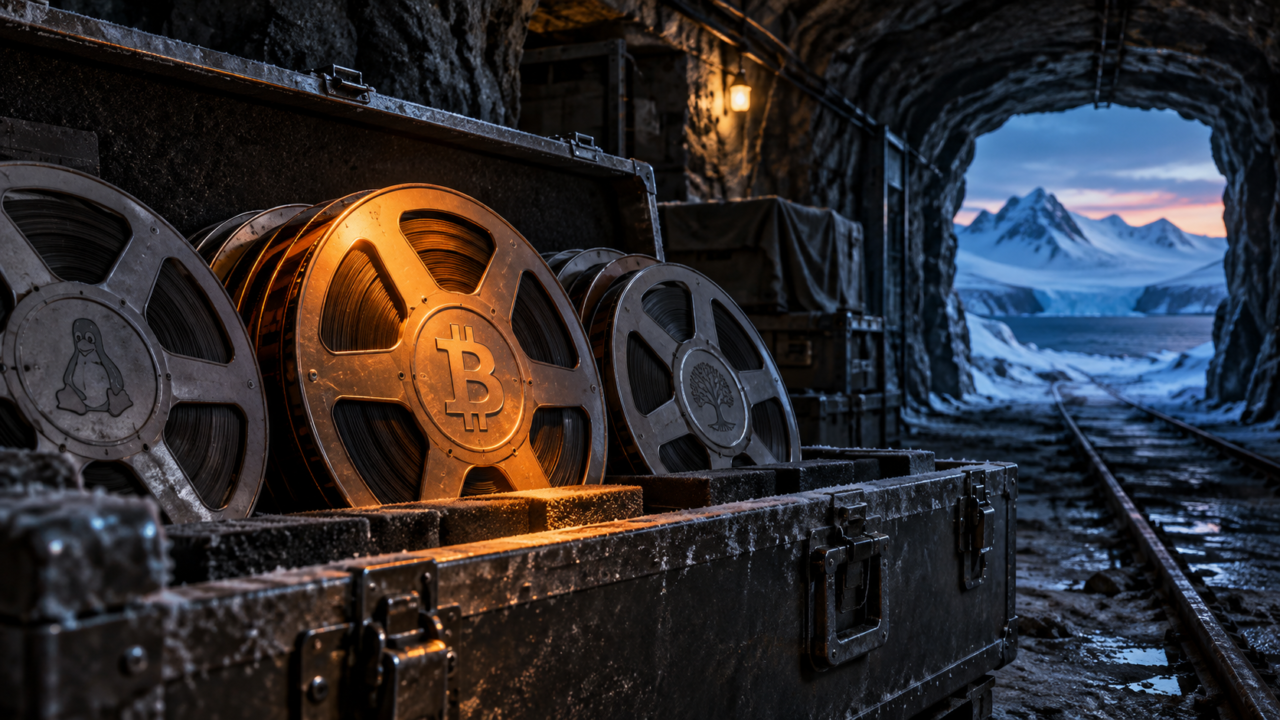
The 21 TB of data required 186 reels when they were deposited in July 2020. They were transported to Longyearbyen, Svalbard, and placed in the Arctic World Archive, a facility located in a former coal mine. GitHub describes the site as being deeply buried in an Arctic mountain and protected by permafrost.
Bitcoin is therefore literally sleeping in the Arctic.
Or, more precisely, a snapshot of its code from 2020 is.
The 21 TB are not 21 TB of Bitcoin
This distinction matters because the viral wording can easily cause confusion.
Bitcoin Core obviously does not occupy 21 terabytes of source code. Those 21 TB correspond to all the millions of active public repositories selected by GitHub for its snapshot. Linux, Python, Ruby on Rails, Docker, OpenSSL, TypeScript, PHP and many other open-source projects are part of the same archive.
Nor did GitHub simply copy the entire history of every project as one would duplicate a server.
For the Arctic Code Vault, GitHub explains that it archived the HEAD state of the default branch at the time of the snapshot. In other words, this was the latest version of the project available on that date, with certain rules applying to large binary files. Projects with at least 250 stars received more comprehensive treatment for those files.
Bitcoin was obviously well above that threshold.
The stored code is therefore not the entirety of Bitcoin’s history since 2009, commit by commit. It is instead a usable snapshot of Bitcoin Core as of February 2, 2020.
And it is no longer up to date.
Since then, the project has received thousands of modifications, fixes, optimizations and new features. The bitcoin/bitcoin repository now exceeds 50,000 commits on GitHub.
The Arctic preserves a software fossil.
A particularly valuable fossil.
Film designed to survive until 3020
Why print computer code onto film in the 21st century?
Because the technologies used to preserve our data age much faster than we imagine.
A hard drive can fail.
An SSD can lose its data.
Formats become obsolete.
A platform disappears.
A data center constantly requires electricity, maintenance teams and new machines.
GitHub was looking for something else: a medium capable of waiting for centuries without depending on a server that remains operational.
The piqlFilm used in the project is based on silver halides on a polyester base. GitHub says the medium has a lifespan of 500 years measured according to ISO standards, while accelerated aging tests suggest that it could last approximately 1,000 years under suitable conditions.
The data was compressed and then represented, among other methods, as optically readable codes. Each reel also contains a human-readable guide explaining how to reconstruct the information.
That is a fascinating detail.
Archiving the bits is not enough.
Someone must also explain to a future human being what those bits mean.
GitHub therefore designed a “Tech Tree,” a kind of computer-civilization manual explaining the concepts needed to understand the archive, extract the files and recover the dependencies. Translations were prepared in several languages.
The bet is not simply that the film will survive.
Someone in 2520 or 3020 must still be able to understand it.
Bitcoin’s code is not Bitcoin itself
This is probably the most interesting distinction in the story.
If every Bitcoin computer on the planet disappeared tomorrow, taking the reels out of Svalbard would not automatically make the network reappear as it exists today.
Why?
Because source code and the blockchain are two different things.
Bitcoin Core is the software. It contains the rules and tools needed to validate transactions, recognize valid blocks and communicate with other nodes.
The blockchain is the history of the blocks those nodes have validated since January 2009.
Bitcoins themselves are not recorded in Bitcoin Core as coins in a private database. The network operates in part around UTXOs, unspent transaction outputs that indicate which amounts can still be used. A block explorer makes it possible to observe this public data.
The Arctic Code Vault does not contain users’ private keys either.
Even less so their seed phrases.
Burial of the code therefore does not amount to putting 21 million BTC in a vault.
And restoring the 2020 software would not automatically recover all transactions carried out after the snapshot.
Yet this nuance makes the project even more interesting.
GitHub is not trying to save the Bitcoin currency.
It is preserving the knowledge needed to understand how one of the most important digital monetary systems of the early 21st century worked.
No one really owns this code
The fact that Bitcoin ended up in this archive alongside Linux and Python also highlights a sometimes-forgotten characteristic of the network: its code is public.
Anyone can view the repository.
Download it.
Study it.
Propose a modification.
Create a copy.
Compile their own software.
Bitcoin Core describes its project as open source and notes that everyone can contribute. Maintainers have the right to integrate selected changes, but their role essentially consists of merging changes that have received sufficient review and consensus among contributors.
Current files still bear a fairly remarkable trace of this history.
In several parts of the code, notably bitcoind.cpp, the copyright notice for Satoshi Nakamoto from 2009-2010 is still present, followed by that of Bitcoin Core developers since 2009. The software is distributed under the MIT license.
Satoshi disappeared.
The project continued.
That may be the most remarkable part.
Technology companies are generally organized around their founders. The founder decides, recruits, raises capital and retains a certain degree of authority over the product.
Bitcoin lost its creator very early and did not stop working.
Hundreds of developers have worked on the software over the years without a successor to Satoshi becoming the new owner of the protocol.
Even technical changes remain deliberately slow. CHECKTEMPLATEVERIFY illustrates this culture well: proposing a few lines capable of changing Bitcoin’s functionality can require years of discussion, audits and testing.
Public code.
Cautious evolution.
No headquarters to call if something is not to your liking.
The Arctic also protects Linux, Python and OpenSSL
Bitcoin did not receive special treatment from GitHub.
And that is precisely what makes its inclusion interesting.
The project is part of a much broader collection that GitHub describes as the open-source software heritage of our time. Projects highlighted include Linux, Python, OpenSSL, Rails, Node.js, Docker, TypeScript, PHP, Hadoop, Homebrew and Bitcoin.
A significant part of the modern digital world depends directly or indirectly on open-source software.
Servers.
Smartphones.
Banks.
Cloud computing.
Artificial intelligence.
Blockchains.
Government infrastructure.
Consumer applications.
A software’s economic importance absolutely does not guarantee its historical preservation.
Software is strangely fragile.
A manuscript can survive for centuries in a library.
A program recorded in a proprietary format can become practically unreadable within a few decades if the machines capable of opening it disappear.
GitHub is therefore trying to avoid a strange scenario: that a 24th-century historian might know that humanity used Bitcoin or Linux without having the software needed to truly understand how they worked.
The Arctic Code Vault then becomes less of a backup than a technological time capsule.
A future researcher could examine 2020 Bitcoin almost as we study a 19th-century steam engine today.
Except that here, the complete plans are preserved with the machine.
186 reels in 2020, then 188 in the vault
Another detail deserves clarification.
The initial figure was indeed 186 reels.
The Arctic World Archive says that these 186 rolls of piqlFilm were deposited on July 8, 2020. GitHub publicly announced the completion of the operation a few days later.
But GitHub now sometimes refers to 188 reels in the Arctic Code Vault.
This is not a contradiction.
In 2022, when the company finalized its physical installation in the Svalbard vault’s metal container, two additional reels containing elements of the Tech Tree and other information needed to interpret the archive had joined the collection. GitHub wrote at the time that 188 reels were resting in the reinforced chamber.
The content was therefore designed as something more robust than a simple collection of files.
The idea could almost seem post-apocalyptic.
And GitHub does not really hide that.
The program was designed to withstand changes in societies, companies and technologies. Svalbard was chosen in part for its isolation, geological and political stability, and conditions that allow preservation without a permanent energy supply.
The Arctic World Archive is also located near the famous Svalbard Global Seed Vault, another facility built around a similar logic: preserving something today that could be valuable to generations far in the future.
Seeds for agriculture.
Code for the digital world.
And Bitcoin in the middle.
Even Satoshi would probably have recognized the principle
The irony is rather beautiful.
Bitcoin was designed not to depend on a central location.
And a copy of its code ended up sealed inside one of the planet’s most extreme physical vaults.
That creates no contradiction, however.
Living Bitcoin does not need Svalbard.
If the Arctic Code Vault disappeared tomorrow, the network would continue producing blocks. Thousands of copies of the software exist elsewhere. The repositories are cloned across independent machines. GitHub is also working with Software Heritage, the Internet Archive and several libraries to preserve other copies of open-source software. The approach even has a name in digital archiving: LOCKSS, “Lots Of Copies Keep Stuff Safe”.
This philosophy strangely resembles Bitcoin’s.
Do not trust a single copy.
Do not depend on a single server.
Multiply redundancies.
Accept that one element can disappear without taking the system with it.
Bitcoin’s code buried in the Arctic is therefore not its ultimate backup.
It is one backup among many.
And that is precisely the point.
The Bitcoin network works because its software, data and rules can be reproduced by independent people. The Svalbard vault simply extends that logic much further into the future.
In 2026, the market discusses the price of BTC, ETFs, corporate treasuries and the next technical resistance level every day.
Beneath a Norwegian mountain, another version of Bitcoin is watching no chart.
It mines no blocks.
It owns no BTC.
It simply preserves the code of a network as it existed on February 2, 2020, alongside some of the software that built the internet.
If the film truly lasts 1,000 years, someone could theoretically still read this code around the year 3020.
The price of bitcoin at that date is impossible to imagine.
Whether the protocol is still in use or has become a piece of history is equally impossible to know.
But one thing could survive both scenarios: the instructions needed to understand how Bitcoin worked when we were still here to write them.