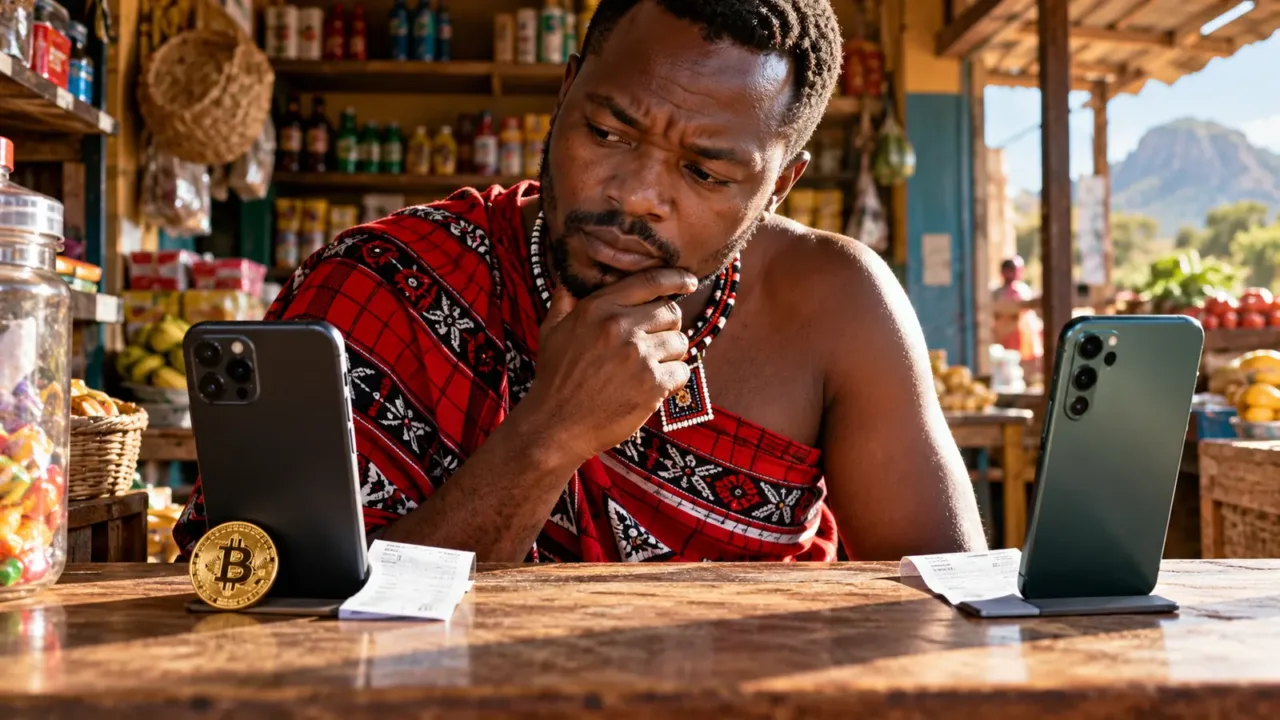
This separation helps prevent fake receipts, misunderstandings and requests for additional payments. It does not demonstrate the existence of an official integration between a local operator and a crypto seller. This guide outlines the checks to carry out before a transaction whose legal and operational framework must be verified separately. The figures are fictional and do not represent any actual rates in Eswatini.
In brief
- A Mobile Money receipt is not automatically proof that BTC has been delivered.
- Providers and their support teams are responsible for different functions in the process.
- Payment, order and transfer must be reconciled without sharing account secrets.
Bitcoin and Mobile Money in Eswatini: map the process
Start with a written outline in simple terms: your account pays a beneficiary, then a person or platform must deliver a quantity of BTC. Our guide to buying crypto with Mobile Money explains this breakdown. If the seller cannot identify the parties and references for each step, its payment instructions are not enough to support a reliable decision.
The mobile operator is not necessarily involved in choosing the asset or delivering it. The seller may simply use a mobile account to collect payment. A crypto app, for its part, may record an order without managing the local currency. These roles must be established before any dispute, because each support channel may see only the part of the process it actually manages.
The central bank publishes information on national payment systems. This can help establish the scope of payment services without automatically assigning crypto status to the parties involved. A company known or registered for one function must still demonstrate that it meets the conditions for another activity. Service names should not be used as a legal shortcut.
Before any purchase, check the applicable framework, eligibility requirements and contracts. A technically possible channel is not automatically a recommendation to use it. This guide does not endorse any seller or local offer. Where obligations remain unclear, clarify them before payment rather than later seeking reimbursement from an operator that never sold the bitcoins.
Identify three forms of evidence that cannot replace one another
The first concerns the commercial order: asset, quantity, price, timing and obligations. Next comes the payment in currency: amount debited, recipient and status. For delivery, you need the quantity of BTC and a verifiable reference when the asset leaves the platform for the network. Keeping these records separate makes it possible to determine precisely which step has been completed and which remains pending.
A screenshot does not always provide a reliable status. It may show an attempt, a scheduled transaction or an altered image. Check the official channel for the account concerned and reconcile the references. A private message announcing success does not replace the corresponding statement. The same caution applies to an alleged Bitcoin transfer for which no usable identifier is provided.
A blockchain identifier answers a different question: does a transfer appear on the expected network, with the relevant characteristics? On its own, it does not prove the commercial agreement, the seller’s legal identity or the compliance of the activity. A genuine transaction may even involve a different address or amount. Reconciling it with the order prevents a technical fact from being presented as general proof of proper performance.
For an internal platform balance, ask how the credit and its availability can be verified. The absence of a public transaction does not automatically mean that no internal movement occurred, but it requires evidence suited to the product. You need to understand custody arrangements and withdrawal options. The basics of how a crypto wallet works help distinguish these situations without confusing a displayed balance with control of the assets.
Calculate the full chain, not just the debit
Consider a wholly fictional scenario: 600 SZL paid to the seller and six SZL in payment fees. The order states 0.0006 BTC, then a deduction leaves 0.00059 BTC available. Total spending reaches 606 SZL. The effective price is therefore approximately 1 027 118,64 SZL per BTC. This calculation does not assert that any such offer exists and does not describe any current mobile rate.
The difference between the stated quantity and the amount available must have been explained in advance. A fee may be deducted in local currency or in the asset, depending on the product’s terms. Reconstruct the flow to avoid overlooking a cost. The guide to the real cost of crypto purchases makes it possible to compare transactions that produce the same result, rather than comparing quoted rates calculated on different bases.
Add the resale leg if the final need is to pay an expense in emalangeni. A purchase is only half the process. Exit fees, the price spread and the availability of a buyer may change the result. Any transaction presented as cheaper than an ordinary transfer should therefore be assessed through to the amount actually accessible to the recipient, using explicit assumptions.
Timing also has an economic value. Funds that are tied up cannot pay a bill when it falls due. Ask when the price becomes firm and what happens if payment is delayed. A seller that changes the quantity after receiving the funds should be able to point to a clear condition, not a rule invented during the discussion.
Protect the payment against substitutions
The beneficiary must match the verified instructions and the service framework. A change of number or account holder requires a new independent check. Do not treat an urgent explanation in a messaging app as sufficient. An account presented as belonging to an assistant, brother or agent may introduce a third party without making responsibilities clear.
Identity procedures must be consistent with the payment. Our guide to KYC and personal data highlights the importance of authentic documents and official channels. Borrowing an account to pass a check creates a mismatch that may resurface during a dispute. Saving a few minutes can then make it much harder to prove ownership of the funds.
Do not share a confirmation code or access secret with the seller. Remote assistance can become an account takeover when it asks you to approve actions you do not understand. Read each screen before confirming. An instruction presented as a simple verification may actually authorize a transfer or change the security settings of the account being used.
If a payment error occurs, contact the operator through its official channel and describe the facts immediately. The technical possibility of requesting a cancellation does not guarantee that it will be accepted. Do not assume that a mobile payment can always be recovered before carrying out an irreversible transaction on another network. The gap between the rules of the two systems is precisely one of the risks that must be examined.
Avoid blockages on the Bitcoin side
The destination must match the expected asset and network. A service displaying Bitcoin may also offer different representations or products. Ask about the exact nature of the withdrawal and any minimums before buying. The address must come from the recipient’s official channel. A last-minute change may require suspending the transaction rather than trying to save time.
Prepare custody arrangements in advance. If you control the keys, understand the recovery process and keep the secrets out of commercial conversations. If an intermediary holds them, identify the access and withdrawal conditions. The choice should not be improvised after the purchase under pressure from a seller. An inadequately prepared wallet can turn a successful delivery into a new risk of loss.
When choosing an intermediary, the comparison of platforms based on evidence is more useful than an isolated testimonial. A small successful delivery does not prove a company’s compliance or solvency. It confirms only an observed operation. Keep that limitation in mind when deciding on a later amount or recommending a service to someone close to you.
A limited test can help verify compatibility that has already been documented within an appropriate framework. Still, calculate its fees and do not present it as protection against every type of fraud. Scams that allow an initial transaction to succeed precisely in order to obtain a larger amount later do exist. The maximum budget should remain independent of the enthusiasm generated by that first result.
Organize reconciliation and respond to incidents
After the transaction, reconcile the three references: order, payment and delivery. Record the times, amounts and any discrepancies. A simple table can show whether the problem involves a missing payment, an unexecuted order or a transfer that was not credited. This precision is more useful than a general message saying that “crypto does not work” without identifying the affected step.
For an incident, prepare a concise file and contact each party within its remit. Mobile support can examine a debit reference; the seller or platform must address the order. An authority or mediator may not have jurisdiction over the entire chain. State the limits honestly rather than promising a refund simply because the initial payment used a known service.
Do not send a second amount on the claim that it will automatically unlock the first. Check any new fee and its basis through the official channel. Secure any accounts that remain accessible and preserve the evidence without sharing private data in public groups. An attempt to recover funds should not give a stranger the means to take the assets that remain.
Bitcoin and Mobile Money in Eswatini should therefore be understood as systems connected by a contract, not as one seamless transaction. The decision becomes clearer when every movement has evidence and an accountable party. If this chain cannot be described before payment, it is better to suspend the plan. A phone’s simplicity does not remove the complexity of rights and risks.