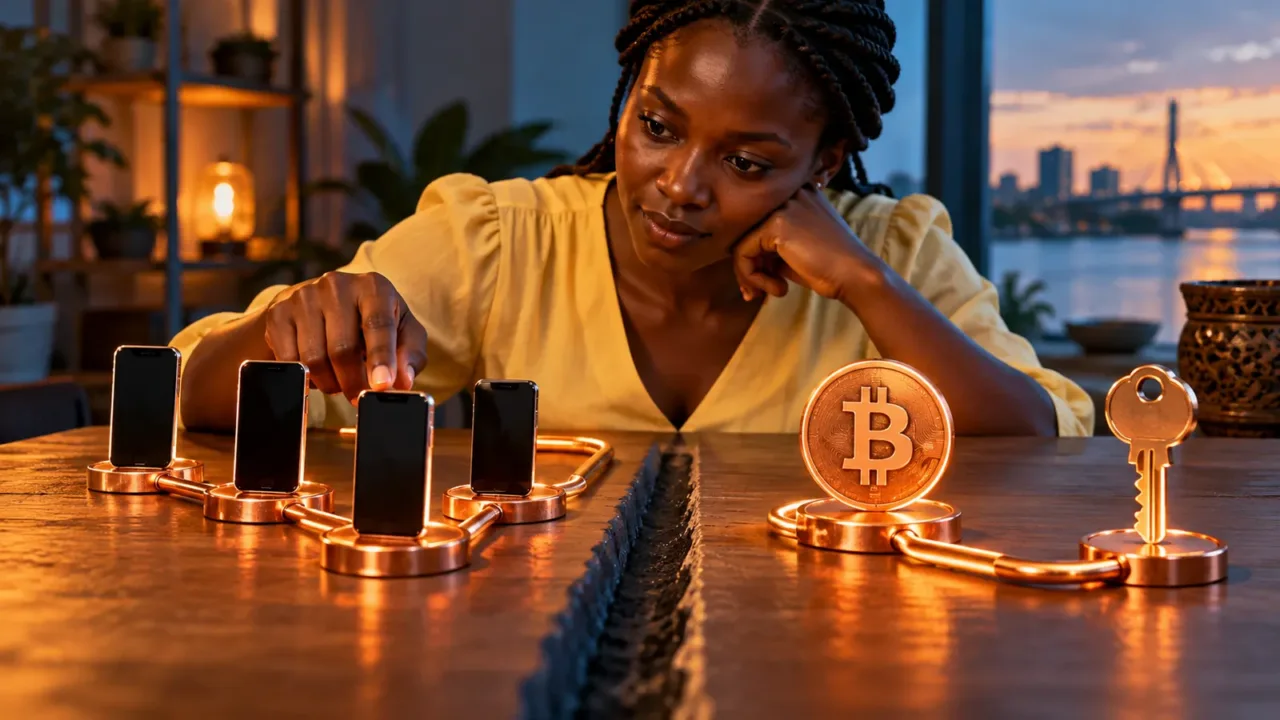
South Sudan has local services, including mGURUSH and MTN MoMo. Their existence does not demonstrate an approved crypto gateway or universal compatibility with a seller. This guide separates the systems, costs and controls, without assuming that M-Pesa or Airtel Money operates locally by analogy with a neighboring country.
In brief
- A mobile-wallet balance does not automatically represent ownership of Bitcoin.
- A payment operator and a crypto seller may remain two independent counterparties.
- Final receipt must be verified in the correct system, using matching references.
Bitcoin and Mobile Money in South Sudan: keeping the ledgers separate
Our guide to mobile payments and cryptoassets distinguishes the payment method from the product being purchased. An app may display an amount, but that figure does not show who owes it to the user. Before discussing available funds, identify the ledger, currency, provider and conditions governing the movement of value.
With a mobile-money service, the account holder uses a payment relationship and functions defined by the operator. Bitcoin works differently: transactions are validated on its network and signatures rely on keys. The fact that both interfaces use a number, code or button does not turn their guarantees into a shared mechanism.
A third system may also be involved: a crypto platform’s internal accounting. A customer may see a balance without directly controlling a transaction on the Bitcoin network. This architecture adds an intermediary and withdrawal conditions. Any comparison should therefore avoid the vague phrase “in my phone” and specify where the value actually sits at each stage.
The guide to wallets and key control raises the essential questions: who can sign, block or restore access? The answer may differ between two apps installed on the same device. It determines the precautions to take and the information that must never be shared with a seller or purported assistant.
Examining local services without assigning them a crypto role
The mGURUSH website presents a mobile-transfer and payment service in South Sudan. It notably advertises deposits and withdrawals through agents. That description does not prove that every outlet has the necessary liquidity at a given moment, nor that a third party using the service is authorized to sell cryptoassets.
The MTN MoMo South Sudan page also describes mobile-money functions. Readers should check the conditions applicable to their situation and the intended transaction. A general service description does not guarantee that every function is available for every account, destination or amount. This guide does not claim to have tested any individual wallet.
An operator’s name in a crypto advertisement does not prove a partnership. A seller may simply be stating which payment method they want to receive. Their commitments and payment terms must be checked separately. A displayed technical integration, phone number or copied logo is not enough to assign the Mobile Money provider any guarantee that Bitcoin will be delivered.
The framework for assessing crypto-platform status helps maintain this distinction. The authorization or reputation of one link in the chain does not automatically cover the others. A bank, mobile operator and platform may all appear in the process without bearing the same responsibility. The file should describe their respective roles rather than grouping them under a single reassuring brand.
Map the process before comparing fees
The route may involve a deposit, payment, conversion, digital delivery and withdrawal. Each stage should identify the debtor, beneficiary and expected proof. The conditions for cancellation or reimbursement should also be recorded. A process that cannot explain what happens after an interruption is not sufficiently defined for committing a significant amount.
The full-cost calculation for crypto purchases avoids focusing only on the most visible commission. In a completely fictional example, sending 50,000 SSP with an additional 600 SSP fee requires a total debit of 50,600 SSP. The commission represents 1.2% of the amount sent. This is not an operator tariff or a current local offer.
If a second deduction applies to the Bitcoin delivery, it adds to the economic cost of the process. Clarify whether the seller quotes a gross or net amount and whether a withdrawal is still required. An operation described as “free” in one system may therefore precede another paid step. The two offers should be compared using the same amount that can actually be used at the final destination.
Time also has a cost. A person may have to travel, wait for an agent or resolve a documentary check. Those constraints do not disappear because one digital step is completed quickly. The quote must therefore be consistent with the payment’s actual timing and with when the beneficiary needs the funds. An instant notification does not guarantee immediate final availability.
Verify receipt in the system that matters
The mobile payment should be confirmed from the relevant account, with the expected amount, beneficiary and reference. A received or forwarded message may be incomplete, outdated or misleading. Consult the service through its known channel rather than following a link supplied by the counterparty. A screenshot sent by the seller does not replace the account holder’s transaction history.
Receiving Bitcoin requires a separate check: destination, amount and relevant transaction. Bitcoin’s documentation explains that broadcast and confirmation do not represent the same status. A visible pending payment is not equivalent proof to a confirmed transaction. Network timing does not follow a fixed commercial promise and should be understood before committing.
The timeline should connect the two events without confusing them. Proof of a Mobile Money debit may help demonstrate that a payment was made, but not that BTC was delivered. Conversely, a public transaction does not necessarily prove the identity of the person who initiated it. References should match the quote and the identified parties, with a clear record of the accepted terms.
Do not try to resolve uncertainty with another improvised payment. A contact may demand an activation fee, tax or verification payment. Before proceeding, independently locate the service and review its terms to check the request. Doubt about the first transaction calls for an inspection, not an automatic increase in the amount committed.
Protect the phone number, device and documents
The guide to KYC and personal-data protection distinguishes administrative documents from login secrets. An operator or service may request identification through an approved channel, but an independent seller does not automatically have the right to collect a passport. Users should know whom they are giving information to and for what purpose.
A phone may concentrate several forms of access: communications, mobile wallet, messaging and platform authentication. Loss or compromise can therefore affect multiple systems at once. Know the replacement and reporting procedures, without keeping all secrets in a conversation accessible from the same device. Ease of use should not conceal this point of concentration.
A Bitcoin wallet recovery phrase and a Mobile Money service code are different secrets. An assistant does not need to receive them to explain a transaction reference or general procedure. Requests to share a screen, install software or provide a temporary code should be treated cautiously, especially when they arrive after an alarming message or a purported emergency.
Family communications also require independent verification. An impersonated voice or hacked account may request an immediate payment to a new number. Calling the person back through an already known channel can confirm the need before acting. Readers should not rely solely on contact details supplied in the suspicious message, as they may be part of the same manipulation attempt.
Plan for the final use and a fallback option
A phone-based service can reduce certain constraints, but it does not eliminate dependence on the network, power supply or provider functions. USSD access does not mean the service works without mobile connectivity. Distinguish what can be done without a smartphone from what requires available infrastructure. Do not assume uniform coverage or permanent availability based on a demonstration.
Cash withdrawal adds another condition: whether the selected outlet can handle the amount. A digitally available balance may therefore not correspond to cash immediately accessible at the desired location. For an urgent expense, the beneficiary should know the real options before the transfer is sent. An alternative route should not be improvised at the last minute with an unidentified intermediary.
mGURUSH’s information about its transfer and withdrawal services should be read as a presentation of functions, not proof that every possible international corridor is available. The sending country, partners and individual conditions still need to be confirmed. A general announcement cannot guarantee that a route works in both directions or for every person.
The right approach is ultimately to follow the value through to the beneficiary’s actual need. Mobile Money may settle one part of the journey without certifying the crypto link, while Bitcoin may move without guaranteeing an exit into SSP. Describing the systems separately, keeping the evidence and maintaining an independent reserve makes it possible to compare options without turning a phone into a promise of universal security.