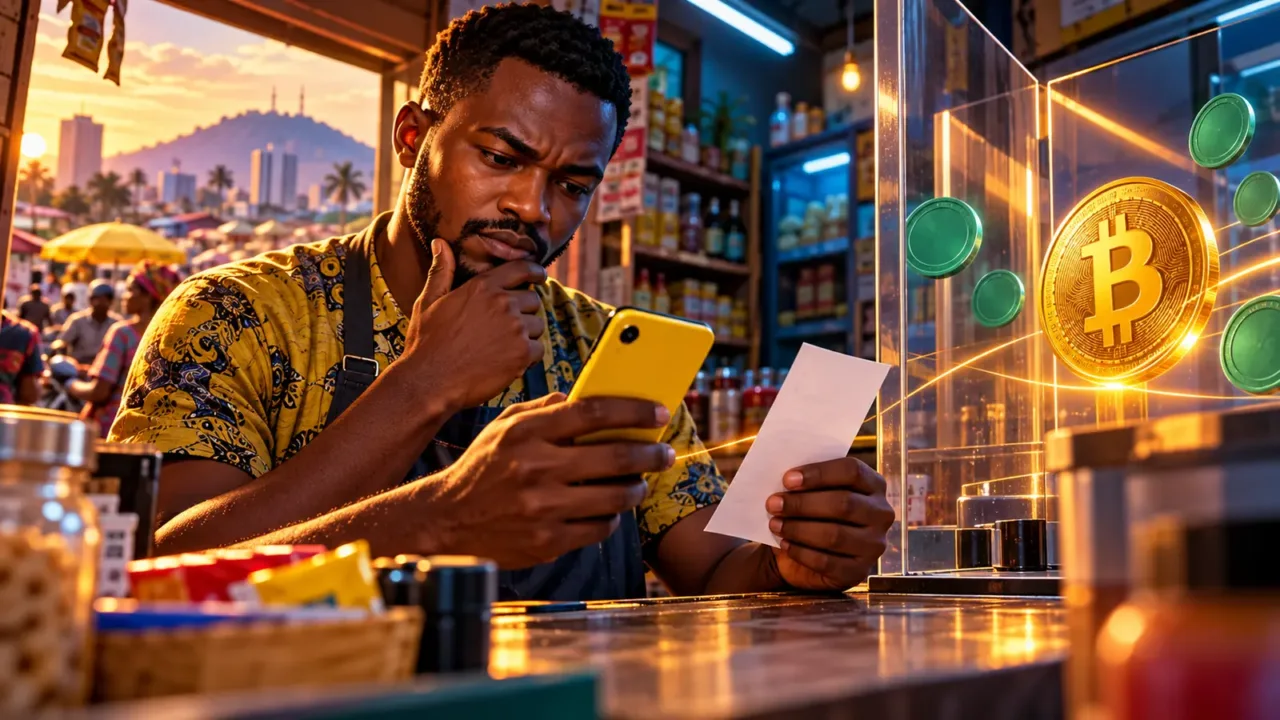
The relevant review therefore covers the entire chain: payment account, seller agreement, quotation, debit, delivery and custody. This guide explains how to assess a possible transaction without suggesting that MTN and a crypto platform offer a universal official integration. All numerical examples are fictional and do not represent any current pricing.
In brief
- MTN MoMo provides a payment service; the sale and delivery of Bitcoin must be verified separately.
- The beneficiary, fees and net amount must match a documented order before any approval.
- A payment receipt, a platform balance and a Bitcoin transaction prove different stages of the process.
Bitcoin and MTN MoMo in Cameroon: verify the proposed process
The guide to buying crypto with Mobile Money explains why payment and delivery are not the same thing. For MTN MoMo in Cameroon, start by identifying the exact service involved. A seller that accepts a mobile transfer is not necessarily an official MTN partner, nor does that mean the transaction is an approved integration for every account.
MTN’s Cameroon section covering its published Mobile Money terms and conditions addresses the payment service and notably distinguishes disputes involving the non-delivery of a paid-for good or service. The document highlights the importance of the seller’s agreement. It does not establish that every third-party Bitcoin sale is supported or guaranteed by the operator.
Three transaction routes may look identical on a phone while creating different relationships. A direct purchase may go through an identified provider; a P2P transaction involves a counterparty; and a sale arranged through a messaging service depends on an independent seller. Check who sets the price, who receives the XAF and who is responsible for delivering the bitcoins in each case.
The local context also deserves scrutiny. Our report on crypto in Cameroon distinguishes technical possibilities from institutional questions. The payment account and the crypto service must each comply with their respective terms. A technically feasible transfer does not, by itself, answer the legal question of whether the seller is operating professionally.
If a platform displays an MTN option, verify the country and product involved. Documentation used in another African market may refer to a same-brand operator working under different contracts. The currency, declared residence and service provider must match the Cameroon-based process. Do not apply a country-specific tutorial simply because the interface looks familiar.
Before proceeding, prepare a short checklist: responsible entity, stated beneficiary, asset, net amount, fees, timing and incident procedure. Missing information at any of these stages may justify postponing the transaction. A simple screen does not compensate for an opaque contract behind it.
Calculate what the XAF actually buys
Our method for assessing fees and the total cost of a crypto purchase starts with the final budget. Add the payment cost and any additional charges, then measure the amount available after delivery or withdrawal. A seller that lists a commission does not necessarily explain the price difference already built into the quotation.
The official MoMo fees in Cameroon can be used to check the payment component for the transaction being considered. They do not automatically set the price of Bitcoin sold by a counterparty. Deposits, transfers, merchant payments and withdrawals may each be subject to different terms. Ask which specific transaction applies to the proposed route rather than relying on a general percentage found in a comment.
Consider a calculation using fictional figures. An order involves 60,000 XAF for 0.001 BTC, plus a 600 XAF payment charge. The seller then announces a withdrawal fee of 0.00001 BTC. The total expense reaches 60,600 XAF and the net amount is 0.00099 BTC. The effective cost is approximately 61.21 million XAF per available BTC, without this representing the current market price.
This example shows why the quantity matters. A slightly lower quotation may leave you with fewer bitcoins after withdrawal. Compare offers at the same time, with the same budget and the same final custody method. An internal balance available for trading is not exactly the same as an amount already received in your personal wallet.
The quotation’s validity period must be known before payment. If the price changes during the process, check the planned mechanism: cancellation, a new quotation or an adjusted amount. Do not accept an unexplained reduction in delivery after the fact. Keep the confirmation linking the XAF spent to the expected amount and the stated fees.
Also plan the conversion back into XAF. If the purchase is intended to cover an upcoming expense, the selling cost and final withdrawal become decisive. Market movements may increase or reduce the result, while the local payment route adds its own fees. A transaction presented as a simple transfer can therefore create unwanted financial exposure.
Authorize the payment without surrendering control of the account
Use a properly identified account whose information matches the requirements of the process. If a provider requires the account holders’ names to match, verify this before placing the order. A different name, a number changed at the last minute or an unexpected third-party beneficiary should lead you to suspend the transaction. Seek official clarification rather than relying on the seller’s verbal assurance.
Your PIN and temporary codes must not be shared with the counterparty. Approve the transaction through the service’s designated channel, after checking the amount and beneficiary. A supposed support agent asking for these secrets may take control of the account. Saying “it’s to speed up the payment” does not change the nature of the risk.
Personal data deserves comparable protection. Our guide to KYC checks and personal data helps distinguish justified requests from opaque data collection. Verification of the payment account and verification by a crypto platform may be separate processes. Do not automatically hand over all your documents to an individual seller simply because they use a familiar logo.
Before confirming, review the total amount and check that your balance covers the stated fees. Any difference between the order and the payment request must be explained before approval. Do not try several procedures at once to get past a slow screen. A payment already initiated may not appear immediately in the seller’s interface.
After approval, check the status through the official service. Keep the reference, beneficiary and time, but do not publish sensitive information. An SMS may provide useful information, but a screen or notification forwarded by the counterparty does not replace checking your own account. Verification should be carried out through your own secure access.
Artificially splitting transactions is not a solution to a control. If a limit or refusal appears, ask for the reason and review the applicable terms. Using several accounts, disguising the purpose of the payment or using a different identity can make the transaction harder to trace. A purchase should not depend on a process that requires deceiving service providers.
Verify Bitcoin delivery and prepare for custody
The order should state where the bitcoins will be delivered. A balance on a platform reflects a relationship with that operator; a transaction to your personal address gives you a different form of control. Our guide to crypto wallets and custody helps users choose with a clear understanding of their responsibilities. No solution eliminates every risk.
For an on-chain receipt, verify the network and the full address through a reliable channel. An offer presented as Bitcoin may use a BTC-representing product on another infrastructure. The recipient must support the exact asset and network. The displayed name is not enough to establish compatibility, especially if the seller promises “cheaper” delivery.
A transaction has an identifier that can be checked independently when the transfer uses a public blockchain. It can be used to examine the amount, destination and confirmations. It does not automatically prove the seller’s identity or the transaction’s compliance. For contractual purposes, also retain the order and the corresponding payment evidence.
The payment timeline and the network timeline may progress separately. A debited account does not mean that the seller has sent the bitcoins; a completed transfer does not mean that the receiving service has credited them yet. Separating these stages helps identify the problem. A complaint should specify which stage is missing rather than simply stating that “the money has disappeared.”
If you personally control the keys, prepare a backup before receiving a significant amount. The recovery phrase must not be sent to the seller or stored in a conversation. A phone that works today may be lost tomorrow. Security includes recovery, not just completing the first transfer.
The general precautions outlined by Bitcoin.org notably emphasize caution around transactions and volatility. Apply the same logic to the amount committed. Bitcoin may fluctuate after delivery; a MoMo payment does not guarantee the asset’s future value. A properly executed transaction can therefore still result in a financial loss.
Contact the right party and avoid paying twice
If delivery is delayed, first check whether the payment was actually debited and how much was delivered. Review the order status before creating another one. A second transfer does not necessarily resolve the first incident; it may simply double the amount at risk. The seller should be able to explain which stage is pending.
If the issue concerns the payment, contact the relevant service’s official support team with the reference and precise facts. If the debit succeeded but the Bitcoin is missing, also file a complaint with the seller or platform. These steps may be complementary. A cancellation request does not guarantee recovery, particularly once the funds or assets have already moved.
Build a timeline linking the quotation, authorization, debit, order and expected delivery. Attach legible evidence and conceal secrets. Distinguish an authorized transaction followed by non-delivery from fraudulent access to the account. This classification helps the relevant parties understand the dispute and avoids contradictory requests.
Messages asking for an additional payment to “release the bitcoins” should be treated with extreme caution. A cost disclosed in advance may be legitimate; an improvised new payment after an incident requires consistent evidence and contractual support. Do not pay a supposed recovery agent who guarantees a refund in exchange for an upfront fee.
The final discipline is to consider the transaction complete only after verifying delivery and the chosen custody arrangement. MTN MoMo and Bitcoin belong to two separate systems connected by a provider or counterparty. Understanding that connection makes it possible to pay with less blind trust, preserve the right evidence and walk away when the process requires too many assumptions.