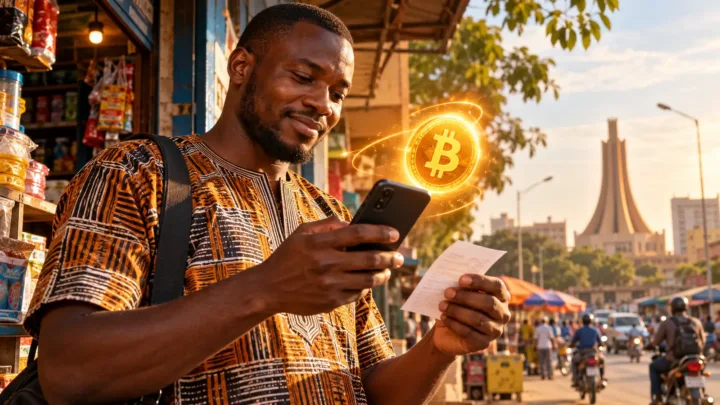
Another distinction matters just as much: holding a balance with an intermediary versus controlling the keys to a wallet. This guide explains how these mechanisms work, along with the relevant fees and precautions for Niger residents. It promises neither returns nor the availability of any particular service, and it does not replace advice tailored to your circumstances.
In brief
- You can buy a fraction of a bitcoin without purchasing a whole unit.
- A price displayed in dollars must be converted into a verifiable net cost in XOF.
- Controlling your keys removes some dependencies but makes you responsible for backups.
Bitcoin in Niger: reading amounts in BTC, satoshis and XOF
The guide to the differences between XOF and XAF provides a first reference point: in Niger, the quote should be in the West African CFA franc. A page showing an amount in naira relates to a different market. Check the country of residence listed on the account, the payment currency and the currency shown in the summary, rather than relying on the title of a page found through a search engine.
One bitcoin is divisible into 100 million satoshis. An amount of 0.0005 BTC therefore equals 50,000 satoshis. This divisibility makes it possible to work with a limited budget, but a provider’s minimums and fees can make a very small purchase uneconomical. The mathematical possibility of buying a fraction does not guarantee that doing so will be cost-effective or available everywhere.
Consider these deliberately fictitious assumptions: one bitcoin is priced at 80,000 dollars and one dollar is worth 600 XOF. The calculation produces 48 million XOF per BTC. A fraction of 0.0005 BTC would then represent 24,000 XOF before fees. These figures are used solely to illustrate the calculation; none should be treated as a rate for a real transaction.
If the seller asks for 25,000 XOF for that fraction, the effective cost rises to 50 million XOF per BTC, or approximately 4.17% above the previous educational reference point. The difference may combine a margin and fees. It does not automatically indicate fraud, but it should be included in the comparison. The method for converting dollars into CFA francs helps identify the source of each gap.
Always record the time at which the quotes were compared. A global price recorded the previous day cannot be used to assess a quote issued today. For a fair comparison, use the same quantity, the same destination and the same point in time, then separate the commercial cost from market movements. Sound reasoning matters more than a display showing eight decimal places.
Understanding what the network does—and does not do
Bitcoin enables units to be transferred through cryptographic instructions. The network does not know the agreement you made with your seller or the order number for your mobile payment. Once the units have been sent to an incorrect address controlled by a third party, the Mobile Money service cannot alter the blockchain to recover them.
The technical documentation on Bitcoin transactions explains how inputs and outputs work. For users, the practical rule is simple: the receiving address, amount and fees must match the intended transaction. The name assigned to a contact in your phone does not prove that the displayed address belongs to the correct recipient.
A transaction ID can be used to look up a transfer on a compatible block explorer. Check the destination and amount, not merely whether some transaction exists. A fraudster may send a link to an unrelated transaction. The public history shows a technical transfer; on its own, it does not establish the seller’s legitimacy or the lawful origin of the funds.
Confirmation times are not guaranteed down to the second. Network conditions and the fees selected affect how long a transaction takes. A platform may also conduct its own checks before authorizing a withdrawal or after receiving the funds. In your tracking, distinguish between the statuses “order accepted,” “withdrawal requested,” “transaction broadcast” and “deposit credited.”
Some services offer alternative channels, including Lightning or representations of BTC on another blockchain. Do not assume that these are compatible with a standard Bitcoin address. Read the full name of the deposit method and the destination’s instructions. A wrapped asset also involves an additional mechanism or issuer, which changes the risk even if its name contains Bitcoin.
Choosing a custody arrangement you can actually maintain
With a custodial platform, users depend on the provider’s controls, withdrawals and solvency. The guide to crypto wallets explains the difference between this type of account and a wallet whose secrets you control. No option eliminates every risk; each distributes them differently between the user and third parties.
A personal wallet requires a durable backup protected from theft, loss and prying eyes. Do not photograph your recovery phrase and store it in the same messaging account you use to communicate with sellers. If that account is compromised, all the units could be exposed. The application password and the recovery phrase do not necessarily serve the same purpose.
Before placing a significant amount in the wallet, learn the restoration procedure in a controlled environment using an empty test wallet. Never use a website suggested by a stranger to “verify” your phrase. Legitimate assistance can explain the steps without knowing your secret words. If you have serious doubts about their confidentiality, seek qualified help to secure a new device.
Self-custody does not eliminate dependence on a phone. Prepare for a dead battery, a lost SIM card or an unavailable device. At the same time, secure your email address and the exchange’s recovery mechanisms. A sound setup protects the asset while also ensuring that its owner can access supporting records and assistance procedures.
For a family, consider continuity without handing all the keys to the first available relative. An inventory can indicate that a device exists and identify the appropriate person to contact while keeping the secrets separate. Estate-planning arrangements require advice suited to the circumstances. Without an arrangement, savings visible on a statement can become an asset that no one can recover.
Calculate potential losses before looking for gains
Let us take a second educational example: BTC is worth 64,000 dollars and the dollar is worth 620 XOF. Bitcoin then reaches 39.68 million XOF, while the same 0.0005 BTC represents 19,840 XOF before withdrawal fees. Compared with an initial purchase cost of 25,000 XOF, the theoretical loss is 20.64%. The dollar’s movement did not offset Bitcoin’s decline.
This calculation shows why a planned short-term expense should not depend on a rebound. Money set aside for school fees, rent or business inventory serves a time-bound purpose. If the asset falls by that deadline, the user must sell more units or give up the expense. A long-term conviction does not remove this immediate constraint.
Crypto fees incurred in Africa can make repeated small transactions more expensive. A fixed withdrawal fee has a greater impact on a small amount. Grouping withdrawals may reduce that burden, but it temporarily increases exposure to the custodian. Assess both effects together, without turning a fee-saving measure into a recommendation to leave funds indefinitely on a platform.
Debt and leverage add a separate difficulty. A position financed with borrowed money may have to be closed before your market scenario plays out. Derivatives involve mechanisms that a simple BTC purchase does not. A beginner has no technical reason to activate them merely to receive a small fraction in their wallet.
Set a position-size rule and a stop rule before making any purchase. For example, determine an amount whose loss would not compromise any obligation, and refuse to add funds under pressure. This personal framework does not guarantee an outcome; it mainly prevents you from repeatedly moving the limit after a drop, an advertisement or a promise of recovery.
Plan the return to CFA francs and keep your records
A market price is not a promise of a local buyback. Before buying, check the options available for recovering XOF, as well as minimums, fees and identity requirements. A comparison of crypto platforms should include this exit route, not just the ease of registration or the appearance of the app.
In a peer-to-peer sale, wait for confirmation in your own payment account before releasing the units, following the service’s procedure. A text message from the buyer or a shared screenshot is not a substitute for this check. If the sender’s name does not match the transaction record, ask for clarification through the official platform rather than accepting an improvised arrangement.
Keep records of purchases and sales, quantities, dates, commissions and technical identifiers. This information helps you understand actual performance, respond to requests for supporting documents and prepare for tax-related questions. The guide to KYC checks explains how to provide the necessary documents without unnecessarily exposing your secrets or personal records.
We did not make a customer purchase for this guide or verify the eligibility of a Nigerien account on every platform. Commercial terms may change. A recent screenshot from another user is an indication to investigate, not a guarantee applicable to your identity, bank or intended payment method.
Before any transaction, you should be able to answer three questions: how many satoshis will you receive, who will control the means of moving them, and how many XOF could you recover in an unfavorable scenario? If the answers remain unclear, postponing the purchase offers more protection than betting on the next price move.